Thailand-Cambodia border conflict and colonial boundary legacy
Source:The Hindu ↗
Why It Matters
This conflict highlights the complexities of colonial-era border legacies, the mechanics of international conflict resolution, and the active role of regional bodies like ASEAN and international courts (ICJ) in maintaining geopolitical stability. These are core components of the UPSC International Relations syllabus.
Summary
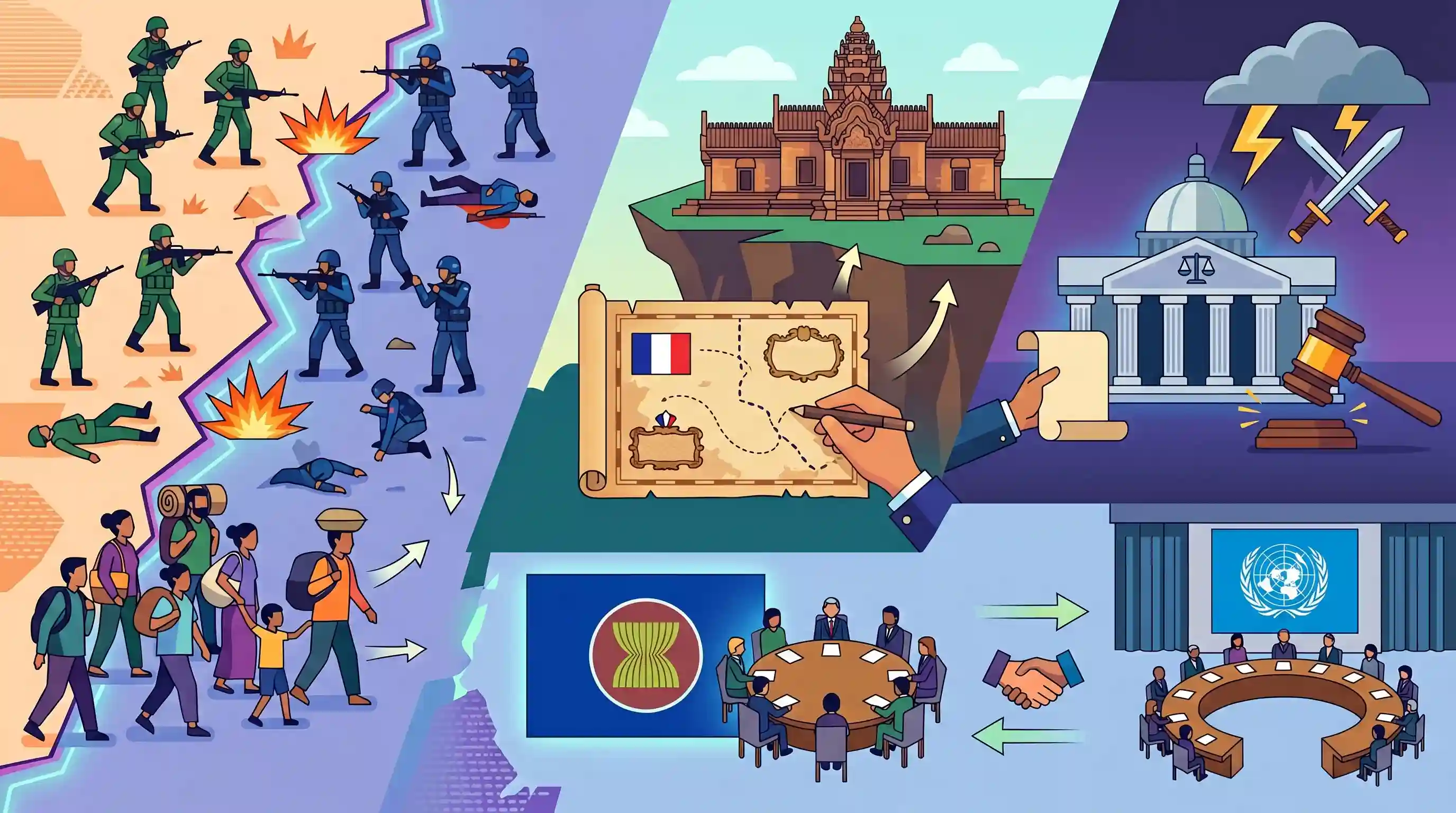
Recent border clashes between Thailand and Cambodia have escalated significantly, resulting in several fatalities and forcing over 100,000 civilians to flee the region. The conflict is rooted in a historical territorial dispute over the 11th-century Preah Vihear temple and adjacent areas, a legacy of ambiguous 1907 colonial-era maps drawn during French rule. Despite past rulings by the International Court of Justice (ICJ), tensions have resurfaced. International and regional organizations, particularly the UN Security Council and ASEAN, are currently engaged in diplomatic efforts to mediate the crisis and prevent further escalation.
Key Points
- Over 100,000 civilians have been displaced and casualties reported following border clashes between Thailand and Cambodia.
- The conflict centers on a long-standing territorial dispute over the 11th-century Preah Vihear temple and its surrounding area.
- The border dispute has historical roots in colonial-era cartography, specifically a 1907 map drawn during French rule.
- Regional grouping ASEAN and international bodies like the UN Security Council are pushing for diplomatic de-escalation.
- The International Court of Justice (ICJ) has previously intervened in this territorial dispute in 1962 and 2013, ruling largely in favor of Cambodia.
Important Terms
International Court of Justice (ICJ)

The principal judicial organ of the United Nations, established to settle legal disputes between states and provide advisory opinions on international legal questions referred by authorized UN organs.
UPSC context
GS Paper II: Important International institutions. Tests knowledge of international law and judicial mechanisms for resolving bilateral territorial disputes.
ASEAN
A regional organization of ten Southeast Asian nations fostering economic, political, and security cooperation through consensus-based diplomacy and the principle of non-interference.
UPSC context
GS Paper II: Regional groupings involving or affecting India’s interests. Tests understanding of regional security architectures and India's 'Act East' policy.
UN Security Council (UNSC)
The United Nations organ primary responsible for maintaining international peace and security, consisting of five permanent and ten non-permanent members.
UPSC context
GS Paper II: Important International institutions. Tests knowledge of global governance, peacekeeping mandates, and the structure of the UN.
Prelims Trap
Preah Vihear is a typical east-facing Buddhist temple built by the Thai kingdom.
It is actually an ancient Hindu temple dedicated to Lord Shiva, built by the Khmer Empire, featuring a unique north-south axis adapted to its cliff-top topography.
Static Concepts Connected
What are the key architectural signatures of the Khmer Empire?
- Temple Mountains: Temples like Angkor Wat were designed to represent Mount Meru, the center of the universe in Hindu-Buddhist cosmology.
- Hindu-Buddhist Syncretism: Reflecting deep Indian cultural influence, early grand structures were dedicated to Hindu deities (Shiva, Vishnu) before later transitioning to Buddhism.
- Topographical Adaptation: While typically east-facing, some structures like Preah Vihear uniquely adapted to cliff-top topography with linear north-south alignments.
What is the core mandate of the International Court of Justice (ICJ)?
- State Disputes: It settles legal disputes submitted by sovereign states (e.g., territorial and maritime boundaries) in accordance with international law.
- UN Organ: Unlike the ICC which prosecutes individuals, the ICJ is the principal judicial organ of the UN, relying on the UNSC for enforcement.
- Advisory Opinions: It provides advisory opinions on legal questions referred by authorized United Nations organs and specialized agencies.
Cross-Topic Patterns
Colonial maps & border conflicts
The 1907 French map issue mirrors India's own border challenges (McMahon/Durand lines), showing how ambiguous colonial cartography fuels enduring modern territorial disputes.
ASEAN's non-interference vs mediation
This crisis highlights the inherent tension between ASEAN's foundational principle of non-interference and its urgent need to mediate intra-regional conflicts to maintain stability.

Preah Vihear's Hindu origins and unique North-South axis could feature as a trap statement in a Prelims question on Khmer architecture.
Linked PYQs · 4
Linked PYQs · 4
- 2025MainsGS2
"The reform process in the United Nations remains unresolved, because of the delicate imbalance of East and West and entanglement of the USA vs. Russo-Chinese alliance.” Examine and critically evaluate the East-West policy confrontations in this regard.
- 2022PrelimsGS1
Which one of the following statements best reflects the issue with Senkaku Islands, sometimes mentioned in the news?
- 2015PrelimsGS1
The area known as 'Golan Heights' sometimes appears in the news in the context of the events related to
- 2023PrelimsGS1
Consider the following pairs: Area of conflict mentioned in news Country where it is located 1. Donbas : Syria 2. Kachin : Ethiopia 3. Tigray : North Yemen How many of the above pairs are correctly matched?
