Thailand Parliament Prepares to Vote for New Prime Minister
Source:The Hindu ↗
Why It Matters
The dismissal of an elected Prime Minister by a court serves as an important case study for comparative constitutional dynamics, particularly concerning the separation of powers and judicial intervention in executive ethics. Additionally, the King's commutation of Thaksin's sentence offers a comparative angle for studying pardoning powers. Thailand's political stability is also crucial for ASEAN's regional cohesion and India's Act East Policy.
Summary
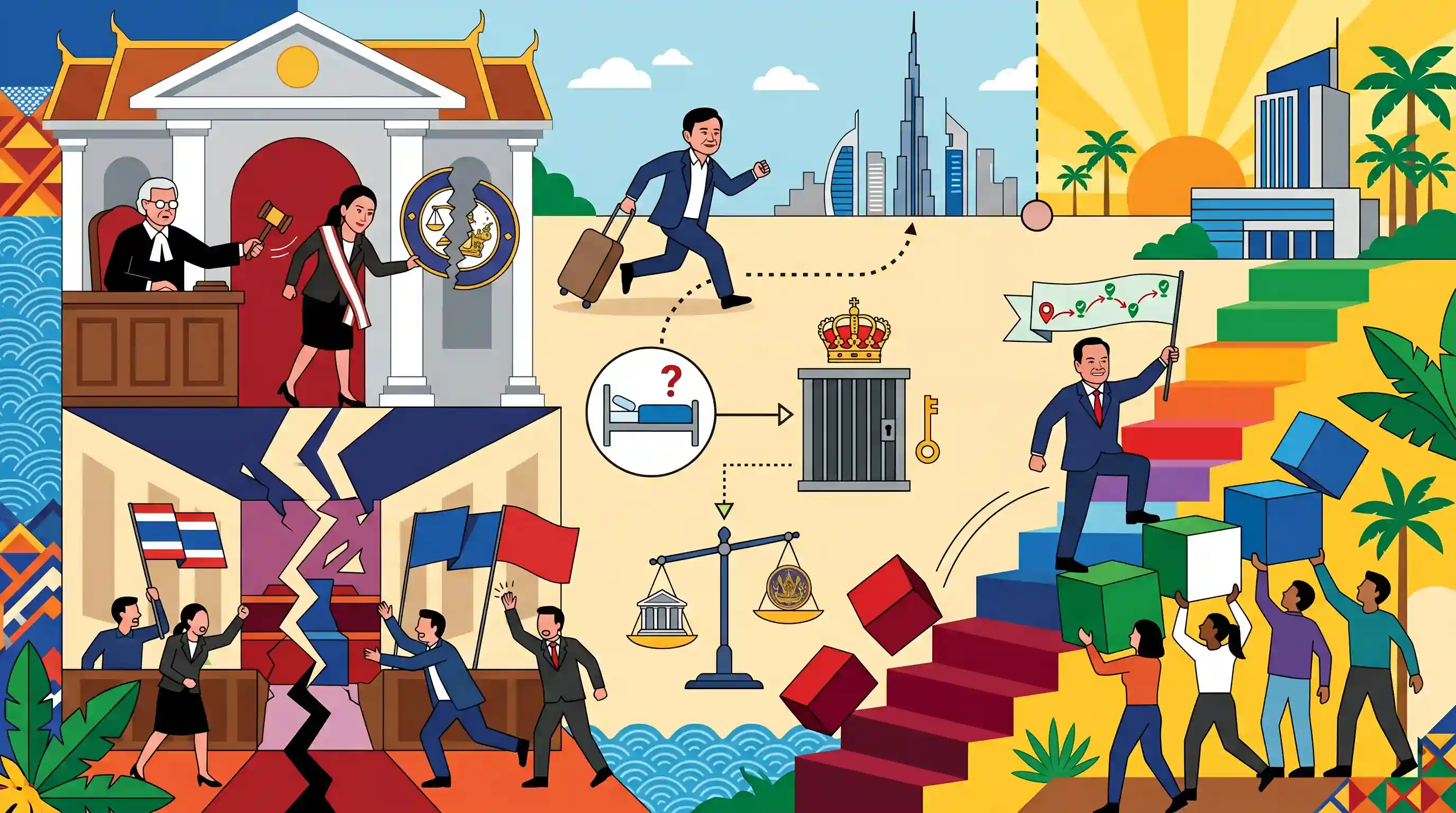
Thailand's parliament is set to vote for a new Prime Minister amid political chaos triggered by the court-ordered dismissal of PM Paetongtarn Shinawatra over an ethics violation. Her father, billionaire politician Thaksin Shinawatra, has fled to Dubai ahead of a Supreme Court ruling on whether his hospital stay counts towards his monarch-commuted prison sentence. Bhumjaithai party leader Anutin Charnvirakul has emerged as the frontrunner for the premiership, successfully outmaneuvering Thaksin's Pheu Thai party by securing necessary votes with the help of the opposition People's Party.
Key Points
- Thailand faces a political crisis after a court sacked Prime Minister Paetongtarn Shinawatra for an ethics violation.
- Billionaire power-broker Thaksin Shinawatra fled to Dubai ahead of a court ruling on his commuted prison sentence.
- Bhumjaithai party leader Anutin Charnvirakul is poised to become the new PM, having secured cross-party backing that includes the opposition People's Party.
- Thaksin's previous prison sentence was commuted to one year by the Thai King, and the Supreme Court is evaluating if his hospital stay counts as time served.
Important Terms
Thai Parliament

The bicameral legislature of Thailand, specifically the House of Representatives (Lower House), which is responsible for electing the Prime Minister and passing national legislation under the country's constitutional monarchy.
UPSC context
GS-II: Comparative Constitution. Tests understanding of parliamentary processes and government formation in neighboring democracies during political crises.
Pheu Thai Party
A major populist political party in Thailand associated with the Shinawatra family; it focuses on pro-poor policies but has frequently faced leadership dismissals and legal challenges from conservative institutions.
UPSC context
GS-II: India and its Neighborhood. Analyzes how major political parties in Southeast Asia influence regional stability and India's bilateral interests.
Bhumjaithai Party
A conservative-leaning political party in Thailand led by Anutin Charnvirakul; it transitioned from a "kingmaker" role to leading the government in 2025 through strategic coalition building.
UPSC context
GS-II: Comparative Constitution. Examines the role of coalition politics and how smaller parties can shift the balance of power in multi-party systems.
People's Party (Thailand)
Thailand's primary reformist opposition party and successor to the dissolved Move Forward Party; it advocates for structural democratic changes, including constitutional amendments and military reform.
UPSC context
GS-II: Governance and Political Reforms. Tests knowledge of progressive movements and the impact of judicial interventions on political party survival.
Supreme Court (Thailand)
Thailand's highest court of justice, whose Criminal Division for Holders of Political Positions exercises jurisdiction over high-ranking officials, including rulings on corruption and sentence enforcement for former leaders.
UPSC context
GS-II: Separation of Powers and Judiciary. Evaluates the role of the judiciary in political accountability and its interaction with executive pardoning powers.
Prelims Trap
The Supreme Court of India can directly dismiss a sitting Prime Minister for ethics violations.
In India, disqualification falls under the RPA 1951 or Anti-Defection Law, decided by the President/Governor (on ECI advice) or Speaker, not direct judicial dismissal.
Static Concepts Connected
What is the scope of the President's pardoning power under Article 72?
- Executive nature: It is an executive power exercised on the aid and advice of the Council of Ministers, not a discretionary sovereign prerogative.
- Judicial Review: Clemency decisions are subject to limited judicial review if the decision is arbitrary, mala fide, or wholly irrelevant.
- Jurisdiction: It covers offenses against Union laws, punishments by court-martial, and all sentences of death.
What is the India-Myanmar-Thailand (IMT) Trilateral Highway?
- Strategic route: A 1,360-km mega-project connecting Moreh in Manipur (India) to Mae Sot (Thailand) via Myanmar, serving as a physical manifestation of the Act East Policy.
- Economic integration: It aims to seamlessly integrate the economies of South Asia and Southeast Asia, boosting trade through ASEAN, BIMSTEC, and Mekong-Ganga Cooperation frameworks.
Cross-Topic Patterns
Act East + Neighborhood instability
Thailand and Myanmar's ongoing political crises act as structural bottlenecks for India's regional integration goals, specifically delaying the IMT Highway and impacting BIMSTEC synergy.
Comparative Constitutional Law
Judicial overreach in Thailand contrasts sharply with India's separation of powers, where courts review executive actions but cannot directly dismiss a PM for vague ethical breaches.

Thailand and Myanmar's political crises jointly stalling the IMT Highway makes Act East vulnerability a prime 2026 GS-2 Mains target.
Linked PYQs · 3
Linked PYQs · 3
- 2025MainsGS2
Compare and contrast the President's power to pardon in India and in the USA. Are there any limits to it in both the countries? What are 'preemptive pardons'?
- 2020MainsGS2
Judicial Legislation is antithetical to the doctrine of separation of powers as envisaged in the Indian Constitution. In this context justify the filing of large number of public interest petitions praying for issuing guidelines to executive authorities.
- 2016MainsGS2
Evaluate the economic and strategic dimensions of India's Look East Policy in the context of the post Cold War international scenario.
