Thailand Strategic Role in India Act East and Indo Pacific Policies
Source:Indian Express ↗
Why It Matters
India's Act East Policy and its Indo-Pacific vision are core components of the UPSC GS2 International Relations syllabus. Understanding Thailand's role as a strategic bridge to Southeast Asia helps analyze regional groupings like BIMSTEC and ASEAN, and broader maritime security challenges.
Summary
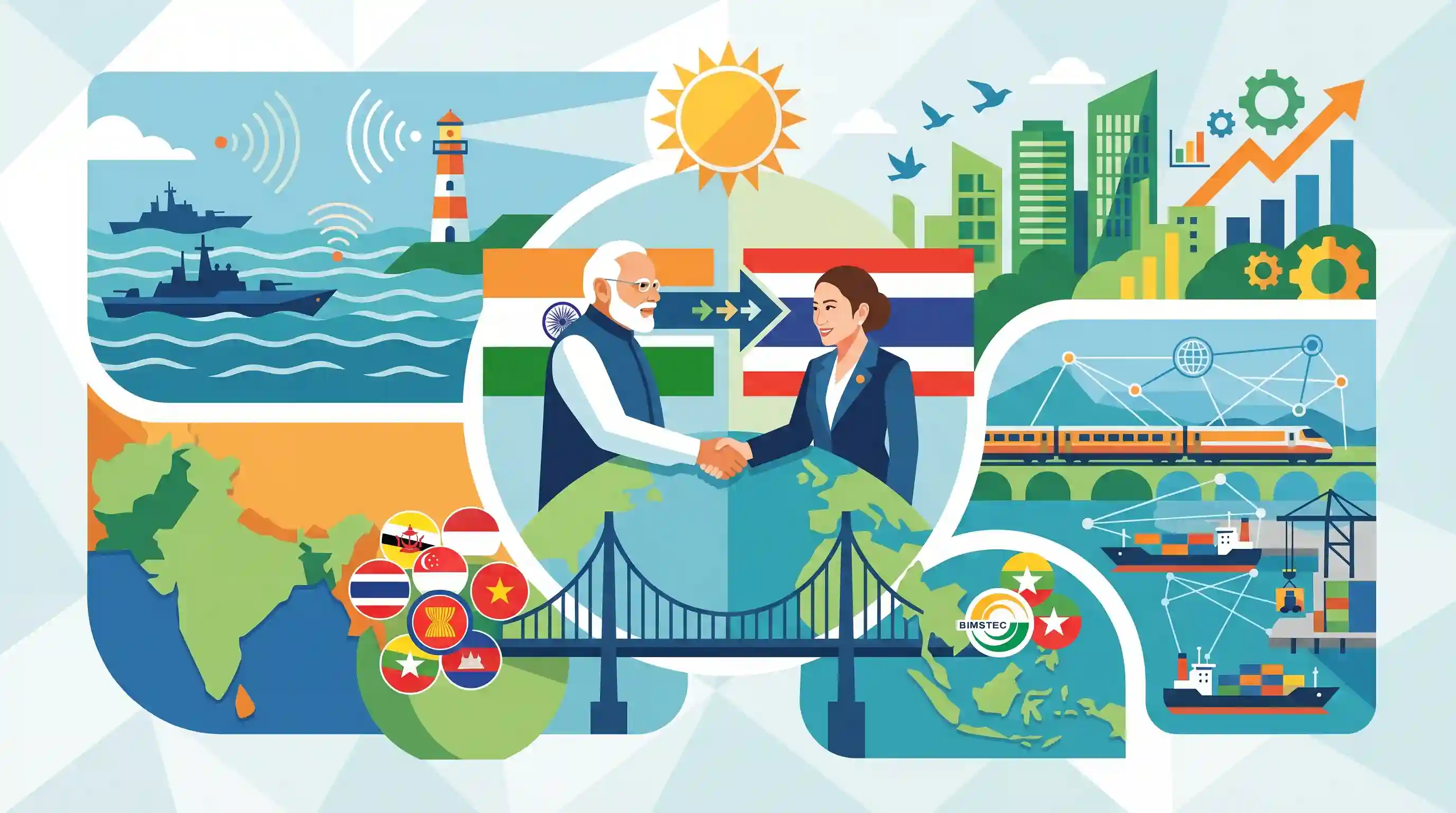
Prime Minister Narendra Modi held a strategic meeting with his Thai counterpart, Paetongtarn Shinawatra, underscoring Thailand's central role in India's Act East Policy and its broader Indo-Pacific strategy. The diplomatic dialogue emphasized strengthening bilateral relations, advancing maritime security, and enhancing regional connectivity. Both leaders highlighted the importance of multilateral platforms like ASEAN and BIMSTEC as bridges between South Asia and Southeast Asia, reaffirming their shared commitment to a stable and prosperous Indo-Pacific region.
Key Points
- Prime Minister Narendra Modi and Thai PM Paetongtarn Shinawatra held a bilateral meeting emphasizing Thailand's critical role in India's Act East Policy and Indo-Pacific vision.
- The leaders discussed enhancing regional cooperation through institutional frameworks like ASEAN and BIMSTEC to boost economic integration and strategic connectivity.
- A strong focus was placed on maintaining a free, open, and secure Indo-Pacific region amid shifting geopolitical dynamics.
- The engagement highlights India's continuing diplomatic outreach to Southeast Asia to strengthen bilateral trade, cultural ties, and maritime security partnerships.
Important Terms
Act East Policy (AEP)

India's proactive diplomatic strategy launched in 2014 to strengthen economic, cultural, and strategic ties with Southeast Asia, East Asia, and the wider Indo-Pacific.
UPSC context
GS Paper II (IR). Tests regional diplomacy, ASEAN centrality, and development of Northeast India.
ASEAN
A regional intergovernmental organization of Southeast Asian nations established in 1967 to promote political, economic, and security cooperation through the Bangkok Declaration.
UPSC context
GS Paper II (IR). Essential for understanding India's eastward engagement and regional security architecture.
BIMSTEC
A regional organization of seven member states (South Asia and Southeast Asia) providing a bridge between SAARC and ASEAN members via the Bay of Bengal.
UPSC context
GS Paper II (IR). Critical for neighborhood-first policy and sub-regional connectivity.
Indo-Pacific
A strategic maritime geography spanning the Indian and Pacific Oceans, treated as a single interconnected space for security, trade, and rules-based order.
UPSC context
GS Paper II (IR). Tests understanding of global geopolitics and India's strategic autonomy.
Maritime Security
Protection of maritime domains and sea lines of communication against threats like piracy and territorial incursions to ensure freedom of navigation.
UPSC context
GS Paper II & III. Relevant for IPOI and protection of trade routes.
Prelims Trap
"The India-Myanmar-Thailand (IMT) Trilateral Highway originates in Mizoram and connects to Thailand."
The IMT highway originates at Moreh in Manipur, not Mizoram. UPSC frequently swaps bordering Northeastern states in map-based questions to test geographical precision.
Static Concepts Connected
What are the core pillars of India's Act East Policy?
- Evolution: Upgraded in 2014 from the 1992 'Look East' policy, shifting focus from merely economic engagement to robust strategic, maritime, and security cooperation.
- The 4 C's: The policy is structurally built upon four fundamental pillars: Commerce, Culture, Connectivity, and Capacity Building.
- Geographic Expansion: It expanded India's strategic vision beyond the original ASEAN focus to include the broader Indo-Pacific region, Japan, South Korea, and Pacific nations.
What makes BIMSTEC a unique sub-regional institutional framework?
- Strategic Bridge: It acts as a critical physical and economic bridge between South Asia (5 nations) and Southeast Asia (only Myanmar and Thailand).
- Sector-Driven Approach: Unlike SAARC, BIMSTEC operates on a sector-driven approach where specific member states take the lead on distinct areas like security, trade, or technology.
- Formal Charter: It gained a formal legal identity with the adoption of the BIMSTEC Charter in 2022, streamlining its institutional mechanism.
Cross-Topic Patterns
Cultural Diplomacy and Ancient History
The naming of 'Exercise Ayutthaya' highlights deep Ramayana linkages between India's Ayodhya and Thailand's Ayutthaya, demonstrating how ancient history and art directly influence modern defense diplomacy.
Internal Security via NE Connectivity
Delays in the IMT Trilateral Highway and Kaladan project due to Myanmar's civil war severely impact India's internal security matrix and economic integration goals for the Northeast.

Expect a 2026 multi-statement Prelims question testing BIMSTEC/ASEAN overlapping memberships alongside IMT Trilateral Highway geography.
Linked PYQs · 3
Linked PYQs · 3
- 2022MainsGS2
Do you think that BIMSTEC is a parallel organisation like the SAARC ? What are the similarities and dissimilarities between the two ? How are Indian foreign policy objectives realized by forming this new organisation?
- 2020MainsGS2
What is the significance of Indo-US defence deals over Indo-Russian defence deals? Discuss with reference to stability in the Indo-Pacific region.
- 2021MainsGS2
The newly tri-nation partnership AUKUS is aimed at countering China's ambitions in the Indo-Pacific region. Is it going to supersede the existing partnerships in the region? Discuss the strength and impact of AUKUS in the present scenario.
