Conservative Coalition Leads Projections in Thailand General Election
Source:The Hindu ↗
Why It Matters
Events in Southeast Asia are crucial for India's Act East Policy. The rise of transnational cyberscam networks operating from countries like Cambodia and Myanmar represents a significant emerging security threat requiring international cooperation, while Thailand's domestic political stability influences regional geopolitics.
Summary
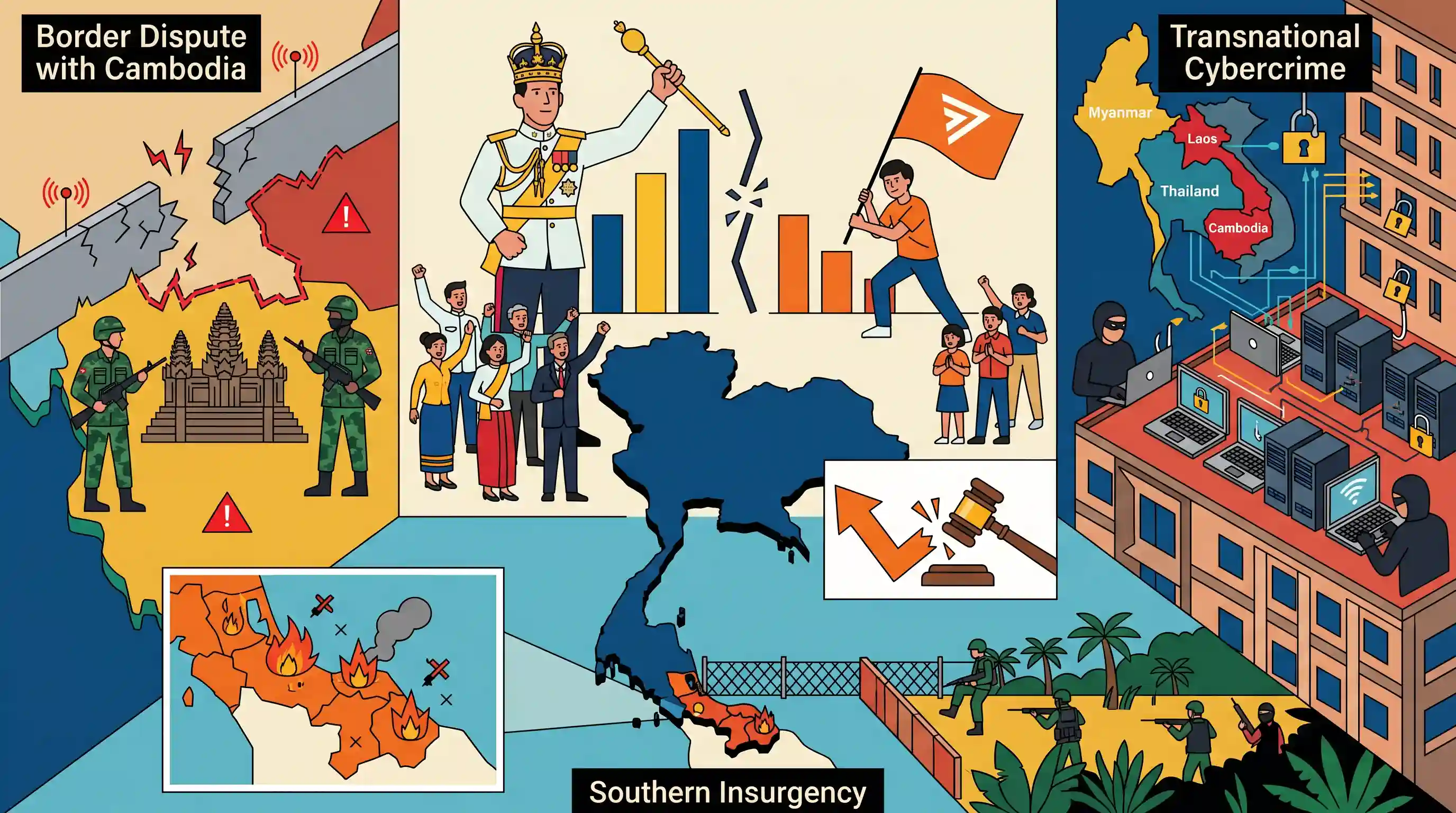
Conservative Prime Minister Anutin Charnvirakul and his royalist coalition are projected to win Thailand's general election, defeating the progressive People's Party. The election occurs in a politically charged environment following the judicial dissolution of the Move Forward Party, which won the 2023 elections but was barred from forming a government. The country faces multiple challenges, including a border dispute with Cambodia, the proliferation of transnational cyberscam networks in Southeast Asia, and a persistent insurgency in its southern provinces.
Key Points
- Projections indicate conservative Prime Minister Anutin Charnvirakul is positioned to win Thailand's general election with his royalist-backed coalition.
- The election takes place after the dissolution of the progressive Move Forward Party, which previously won the popular vote but was blocked from power by the military-appointed Senate and conservative establishment.
- Thailand's House of Representatives utilizes a mixed representation model, electing 300 members from constituencies and 200 via proportional party lists.
- Significant issues surrounding the election include a long-standing territorial dispute with Cambodia, transnational cyberscam operations in the region, and unrest in Thailand's Muslim-majority southern provinces.
Important Terms
Bhumjaithai Party

A conservative, royalist Thai political party led by Anutin Charnvirakul. It gained dominance in the 2026 elections, leading a coalition by leveraging nationalist sentiment and rural support.
UPSC context
GS-II (Political Systems); examines the rise of conservative-nationalist coalitions in Southeast Asia and their influence on regional stability.
People's Party (Phak Prachachon)
A progressive Thai political party and successor to the dissolved Move Forward Party. It advocates for democratic reform and military de-politicization, finishing second in the 2026 snap elections.
UPSC context
GS-II (Governance); illustrates the challenges reformist movements face against established judicial-military structures in developing democracies.
Move Forward Party (MFP)
The winner of Thailand's 2023 elections, dissolved by the Constitutional Court in 2024 for proposing lèse-majesté law reforms. Its dissolution triggered the formation of the People's Party.
UPSC context
GS-II (Separation of Powers); a key case study of "lawfare" and the judiciary's role in political party dissolution.
Transnational Cyberscam Networks
Industrialized criminal operations in Southeast Asia (Myanmar, Cambodia, Laos) specializing in online fraud ("pig butchering") and human trafficking, posing major regional security and humanitarian threats.
UPSC context
GS-III (Internal Security); relates to organized crime, human trafficking, and cyber threats impacting Indian citizens and regional security.
Southern Thailand Insurgency
A persistent ethno-nationalist separatist conflict in Thailand’s Malay-Muslim majority provinces (Pattani, Yala, Narathiwat). It involves low-level guerrilla violence and complex, periodically stalled peace negotiations.
UPSC context
GS-III (Security); provides a comparative perspective on ethno-religious insurgencies and conflict resolution strategies in the neighborhood.
Thailand-Cambodia Border Dispute
A historical territorial conflict between Thailand and Cambodia over the Preah Vihear Temple and energy-rich maritime zones known as the Overlapping Claims Area (OCA).
UPSC context
GS-II (International Relations); involves maritime boundary laws (UNCLOS), energy security, and bilateral dispute resolution in the Indo-Pacific.
Prelims Trap
"The Preah Vihear Temple is a UNESCO World Heritage site located within Thailand's territory."
The International Court of Justice awarded the 11th-century temple to Cambodia in 1962, not Thailand. It remains a persistent flashpoint for border skirmishes.
Static Concepts Connected
What defines the Golden Triangle and Golden Crescent in the context of global trafficking?
- Golden Triangle: Comprises Myanmar, Laos, and Thailand. Historically an opium hub, it is increasingly dominating synthetic drug trafficking and transnational cyberscam operations.
- Golden Crescent: Comprises Afghanistan, Iran, and Pakistan. It is a major global hub for illicit opium production and heroin smuggling across South and West Asia.
Which nations share land boundaries with Thailand?
- Myanmar and Laos: Myanmar borders Thailand to the north and west, while Laos borders to the north and east.
- Cambodia: Shares the eastern border, featuring the contentious Dangrek Mountains and the Preah Vihear temple.
- Malaysia: Borders the Muslim-majority southern Patani region of Thailand, an area experiencing a long-standing ethno-nationalist insurgency.
Cross-Topic Patterns
Cyber-trafficking in SE Asia
The Golden Triangle's shift from narcotics to cyberscam networks links Southeast Asian political instability directly to Indian cybersecurity vulnerabilities and transnational human trafficking.
Preah Vihear & ICJ rulings
The Thai-Cambodia dispute highlights the role of the International Court of Justice in territorial conflicts, a static IR concept relevant to India's engagements with international tribunals.

Expect a Prelims mapping pair on SE Asian disputes (e.g. Preah Vihear) or the Golden Triangle's evolution from narcotics to cybercrime.
Linked PYQs · 4
Linked PYQs · 4
- 2006PrelimsGS1
Other than India and China, which of the following groups of countries border Myanmar?
- 2021MainsGS3
Keeping in view India's internal security, analyse the impact of cross-border cyber attacks. Also discuss defensive measures against these sophisticated attacks.
- 2020MainsGS3
Discuss different types of cyber crimes and measures required to be taken to fight the menace.
- 2020MainsGS3
Analyze internal security threats and transborder crimes along Myanmar, Bangladesh and Pakistan borders including Line of Control (LoC). Also discuss the role played by various security forces in this regard.
