Thailand Cambodia border conflict escalation and coastal curfew
Source:The Hindu ↗
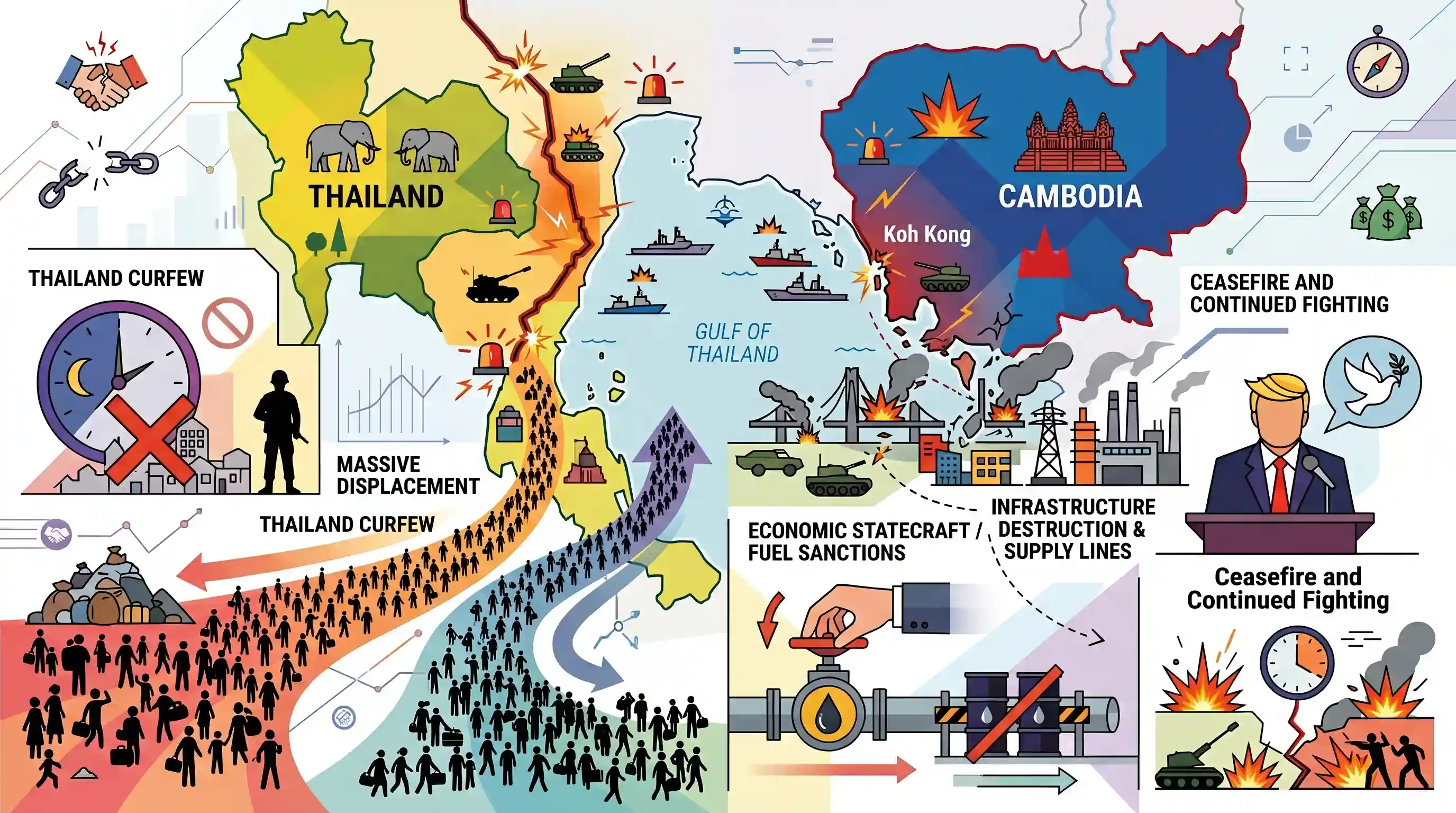
Why It Matters
The conflict provides a contemporary case study of how border disputes can rapidly escalate into severe humanitarian crises. It highlights the use of economic leverage (fuel blockades) as a tool of statecraft in regional conflicts, and underscores the complex role of external powers (like the US) attempting to mediate peace in Southeast Asia. For UPSC aspirants, mapping regional geography (Gulf of Thailand, Trat, Koh Kong) and understanding the dynamics of bilateral relations in ASEAN are critical.
Summary
An escalating border conflict between Thailand and Cambodia has spread to coastal regions along the Gulf of Thailand, prompting Thailand to impose a curfew in its Trat province. The clashes have led to massive internal displacements, with over 650,000 people fleeing their homes across both nations. Militarily, Thai forces have destroyed critical infrastructure in Cambodia's Koh Kong province to cut off supply lines. In addition to military action, Thailand is weighing economic sanctions by potentially blocking crucial fuel exports to Cambodia. Although US President Donald Trump indicated a ceasefire was imminent, fighting persists.
Key Points
- Thailand declared a curfew in its southeastern Trat province as its border conflict with Cambodia expanded to coastal areas near the Gulf of Thailand.
- The fighting has caused a severe humanitarian crisis, displacing over 652,000 people (258,000 in Thailand and 394,000 in Cambodia).
- Thailand is considering halting fuel exports to Cambodia to exert economic pressure, given Cambodia imported 2.2 billion litres of fuel from Thailand last year.
- Thai forces targeted and destroyed a bridge in Cambodia's Koh Kong province to disrupt the delivery of weapons.
- Despite US President Donald Trump mentioning an impending ceasefire, hostilities have continued unabated on the ground.
Important Terms
Economic Statecraft

The use of economic resources and instruments, such as sanctions or fuel export blocks, by a state to achieve specific foreign policy objectives.
UPSC context
GS Paper II (IR). Tests understanding of non-military coercion and its impact on regional stability and diplomacy.
Internally Displaced Persons (IDPs)
Individuals forced to flee their homes due to armed conflict or human rights violations but who remain within their own country's borders.
UPSC context
GS Paper II/III (Governance/Security). Important for discussing humanitarian crises and the state’s duty to protect citizens.
Preah Vihear Temple Dispute
A long-running territorial conflict over an 11th-century Hindu temple; despite a 1962 ICJ ruling, the surrounding 4.6 sq km remains contested.
UPSC context
GS Paper II (IR). Exemplifies historical border legacies and the limitations of international law in resolving sovereign disputes.
International Court of Justice (ICJ)
The principal judicial organ of the UN that settles legal disputes between states and gives advisory opinions on legal questions.
UPSC context
GS Paper II (International Organizations). Tests knowledge of international law and its role in mitigating state-level conflicts.
ASEAN
A regional intergovernmental organization of ten Southeast Asian states promoting economic growth and peace through consensus and non-interference.
UPSC context
GS Paper II (IR). Critical for India's 'Act East Policy' and regional stability in Southeast Asia.
Economic Sanctions
Commercial and financial penalties applied by a country against a targeted state to change its policy or behavior, such as trade blocks.
UPSC context
GS Paper II (IR). Tests analysis of the effectiveness and humanitarian impact of coercive economic measures in geopolitics.
Humanitarian Crisis
A critical threat to the health, safety, or wellbeing of a large group of people, often resulting from war or displacement.
UPSC context
GS Paper III (Disaster Management). Tests understanding of complex emergencies requiring international assistance and relief efforts.
Strategic Goods
Vital resources, such as fuel and electricity, that are essential for a nation's military capability and economic survival during a conflict.
UPSC context
GS Paper III (Security). Relevant to supply chain resilience, energy security, and logistics in modern defense strategies.
Prelims Trap
"Preah Vihear is a prominent 11th-century Buddhist temple complex at the center of the Thai-Cambodian dispute."
Preah Vihear is originally an 11th-century Hindu temple dedicated to Shiva. UPSC frequently tests the original religious affiliations of historical Southeast Asian monuments.
Static Concepts Connected
What are the key geographical highlights of the Gulf of Thailand?
- Bordering nations: It is bordered by four countries: Malaysia, Thailand, Cambodia, and Vietnam.
- Water body: It is a shallow inlet of the South China Sea, situated in the western part of the Pacific Ocean.
- Kra Isthmus: The narrowest part of the Malay Peninsula, separating the Andaman Sea (west) from the Gulf of Thailand (east).
What is the historical significance of the Preah Vihear Temple?
- Architectural roots: Built during the period of the Khmer Empire, it is an 11th-century Hindu temple dedicated to the deity Shiva.
- Location: Perched on a cliff in the Dangrek Mountains, forming a natural geographical boundary between modern-day Thailand and Cambodia.
- Legal dispute: The International Court of Justice (ICJ) ruled in 1962 that the temple belongs to Cambodia, though overlapping claims persist.
Cross-Topic Patterns
Economic statecraft in border conflicts
Thailand's threat to block fuel exports to Cambodia highlights the growing weaponization of critical supply chains and energy dependence as a primary tool of modern geopolitical coercion.
SE Asia's ancient Hindu heritage
The Preah Vihear dispute links contemporary regional border conflicts directly to ancient Indian cultural influence, a recurring theme in UPSC's Art & Culture mapping questions.

Expect a map question pairing SE Asian regions (Trat, Koh Kong) or choke points (Kra Isthmus) with their bordering seas in Prelims 2026.
Linked PYQs · 4
Linked PYQs · 4
- 2006PrelimsGS1
Other than India and China, which of the following groups of countries border Myanmar?
- 2023PrelimsGS1
Consider the following pairs: Area of conflict mentioned in news Country where it is located 1. Donbas : Syria 2. Kachin : Ethiopia 3. Tigray : North Yemen How many of the above pairs are correctly matched?
- 2022PrelimsGS1
With reference to the United Nations Convention on the Law of Sea, consider the following statements : 1. A coastal state has the right to establish the breadth of its territorial sea up to a limit not exceeding 12 nautical miles, measured from baseline determined in accordance with the convention. 2. Ships of all states, whether coastal or land-locked, enjoy the right of innocent passage through the territorial sea. 3. The Exclusive Economic Zone shall not extend beyond 200 nautical miles from the baseline from which the breadth of the territorial sea is measured. Which of the statements given above are correct?
- 2018MainsGS2
A number of outside powers have entrenched themselves in Central Asia, which is a zone of interest to India. Discuss the implications, in this context, of India's joining the Ashgabat Agreement, 2018.
