US brokers Thailand and Cambodia border ceasefire during ASEAN summit
Source:The Hindu ↗
Why It Matters
Direct US mediation in an intra-ASEAN dispute and its aggressive push for critical minerals pacts signify a deepening US footprint in Southeast Asia. This impacts the regional balance of power, ASEAN centrality, and global supply chains—factors critical to India's own Act East Policy and Indo-Pacific strategy.
Summary
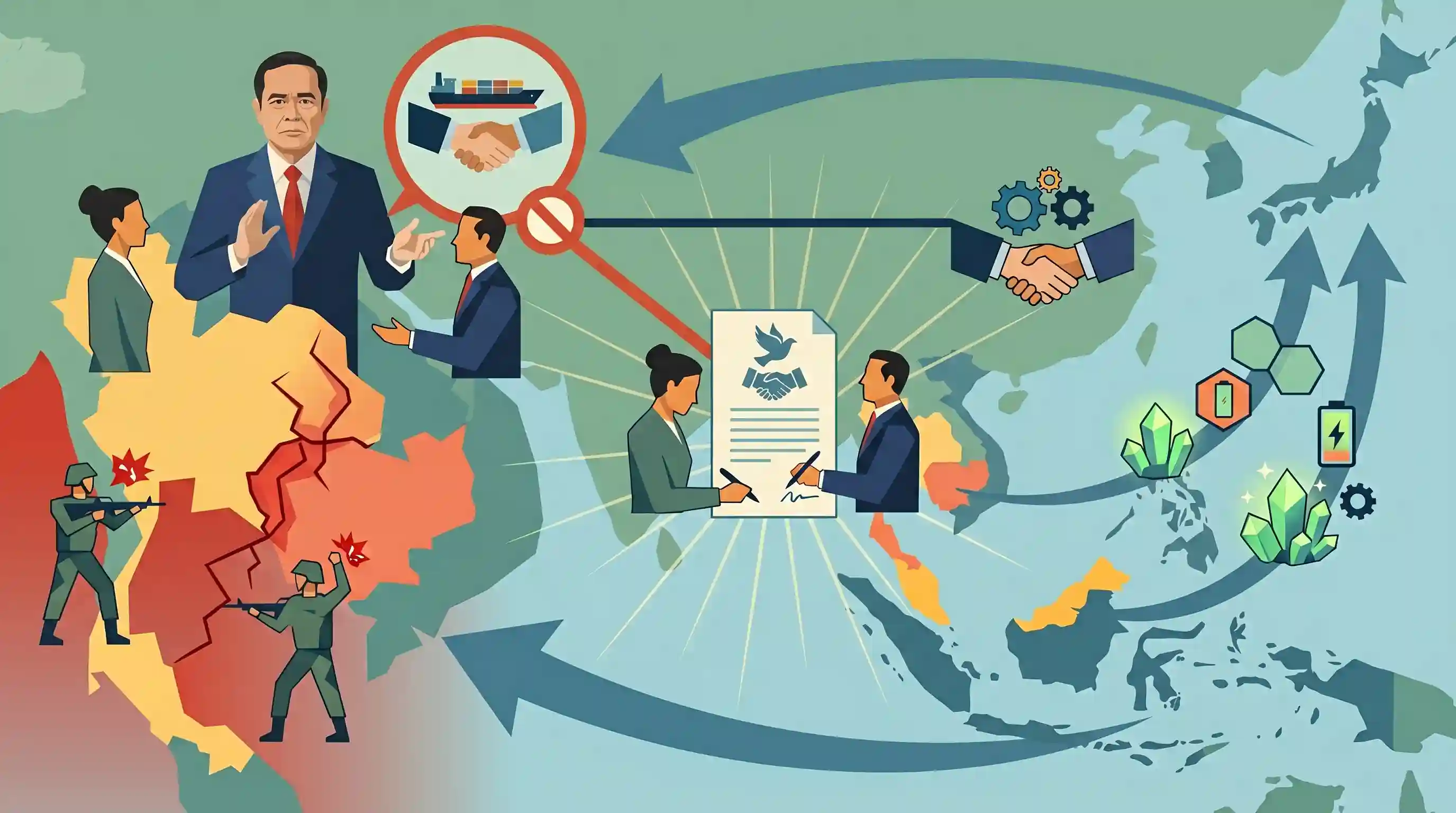
At the 47th ASEAN summit in Kuala Lumpur, Thailand and Cambodia signed a ceasefire to end a five-day border conflict, following direct mediation by US President Donald Trump. Trump leveraged US economic influence by threatening to suspend trade talks to force the agreement. Concurrently, the US signed a reciprocal trade deal with Cambodia and critical mineral agreements with Thailand and Malaysia. These moves underscore a strategic US push to assert influence in Southeast Asia and secure critical supply chains amid broader Indo-Pacific geopolitical competition.
Key Points
- Thailand and Cambodia signed an expanded ceasefire deal at the 47th ASEAN summit in Kuala Lumpur, halting a five-day border conflict.
- US President Donald Trump brokered the peace deal by threatening to pause ongoing trade talks with both nations.
- The US advanced its geoeconomic strategy by signing critical minerals agreements with Thailand and Malaysia, and a reciprocal trade deal with Cambodia.
- The US intervention and agreements highlight its proactive diplomatic and economic re-engagement in Southeast Asia, aimed at securing strategic supply chains in the Indo-Pacific.
Important Terms
ASEAN

A regional intergovernmental organization of 10 (now 11) Southeast Asian nations promoting economic growth, social progress, and regional stability.
UPSC context
GS II (International Relations); crucial for India's Act East Policy and Indo-Pacific security architecture.
ASEAN Centrality
The principle that ASEAN must be the primary platform and driving force in the security architecture of the Indo-Pacific.
UPSC context
GS II (International Institutions); tests knowledge of regional leadership dynamics and major power balancing.
Critical Minerals
Non-fuel minerals like lithium and rare earths essential for modern technology, green energy, and national defense.
UPSC context
GS I (Resource Geography) and GS III (Security); relates to supply chain resilience and 'China+1' strategies.
Reciprocal Trade Agreement
A trade policy seeking mutual market access and equivalent tariff levels between partners, often used to address trade imbalances.
UPSC context
GS III (Economic Development); highlights the shift from multilateralism (WTO) to transactional bilateralism.
Indo-Pacific Geopolitics
The strategic competition and cooperation across the maritime region bridging the Indian and Pacific Oceans.
UPSC context
GS II (Global Geopolitics); core to studying the QUAD, maritime security, and India's strategic interests.
Kuala Lumpur Peace Accord
The 2025 ceasefire agreement between Thailand and Cambodia, signed at the 47th ASEAN Summit to end a border conflict.
UPSC context
GS II (International Relations); illustrative of third-party mediation and economic leverage in diplomacy.
Prelims Trap
The US recently signed a comprehensive Free Trade Agreement with the ASEAN bloc.
While the US signs bilateral pacts with individual nations like Cambodia, it lacks a comprehensive FTA with ASEAN as a bloc, unlike India or China.
Static Concepts Connected
Why is the Preah Vihear Temple significant in Thailand-Cambodia geopolitics?
- Strategic Location: Situated atop the Dangrek Mountains, serving as a natural border and historical flashpoint between Thailand and Cambodia.
- Cultural Heritage: An 11th-century Hindu shrine originally dedicated to Shiva, which is now recognized as a UNESCO World Heritage site.
- ICJ Ruling: The International Court of Justice (ICJ) awarded ownership to Cambodia in 1962, but access and the immediate surrounding territory frequently trigger border skirmishes.
What is the Minerals Security Partnership (MSP)?
- Core Objective: A US-led alliance aiming to catalyze public and private investment in critical mineral supply chains globally, reducing dependence on China.
- Target Minerals: Focuses on securing robust supply chains for essential minerals like lithium, cobalt, and rare earths required for clean energy technologies.
- India's Status: India joined the MSP in 2023, a crucial step for securing raw materials for its domestic EV manufacturing and renewable energy transition.
Cross-Topic Patterns
Critical Minerals as Geoeconomic Leverage
The US is pivoting from traditional security pacts to resource-centric bilateral deals (like with Thailand and Malaysia) to counter China's monopoly, executing the goals of the broader Minerals Security Partnership (MSP).
Mekong-Ganga Cooperation Dynamics
India's connectivity initiatives via the Mekong-Ganga Cooperation (MGC) with Thailand and Cambodia must now navigate heightened US geoeconomic intervention and trade diplomacy in the Mekong sub-region.

Expect a mapping question linking SE Asian border disputes (Preah Vihear/Dangrek) with minilateral mineral agreements like the MSP in 2026.
Linked PYQs · 4
Linked PYQs · 4
- 2021MainsGS2
The newly tri-nation partnership AUKUS is aimed at countering China's ambitions in the Indo-Pacific region. Is it going to supersede the existing partnerships in the region? Discuss the strength and impact of AUKUS in the present scenario.
- 2016PrelimsGS1
The term 'Regional Comprehensive Economic Partnership' often appears in the news in the context of the affairs of a group of countries known as
- 2018PrelimsGS1
Consider the following countries: 1. Australia 2. Canada 3. China 4. India 5. Japan 6. USA Which of the above are among the 'free-trade partners' of ASEAN?
- 2023PrelimsGS1
Consider the following pairs: Area of conflict mentioned in news Country where it is located 1. Donbas : Syria 2. Kachin : Ethiopia 3. Tigray : North Yemen How many of the above pairs are correctly matched?
