Thailand Cambodia border dispute and US economic statecraft
Source:The Hindu ↗
Why It Matters
Provides a key case study for GS-II on how global powers deploy economic statecraft (trade leverage) to mediate regional conflicts, the persistent geopolitical challenges in Southeast Asia over historical territorial boundaries, and the complementary roles of the UN and ASEAN in regional dispute resolution.
Summary
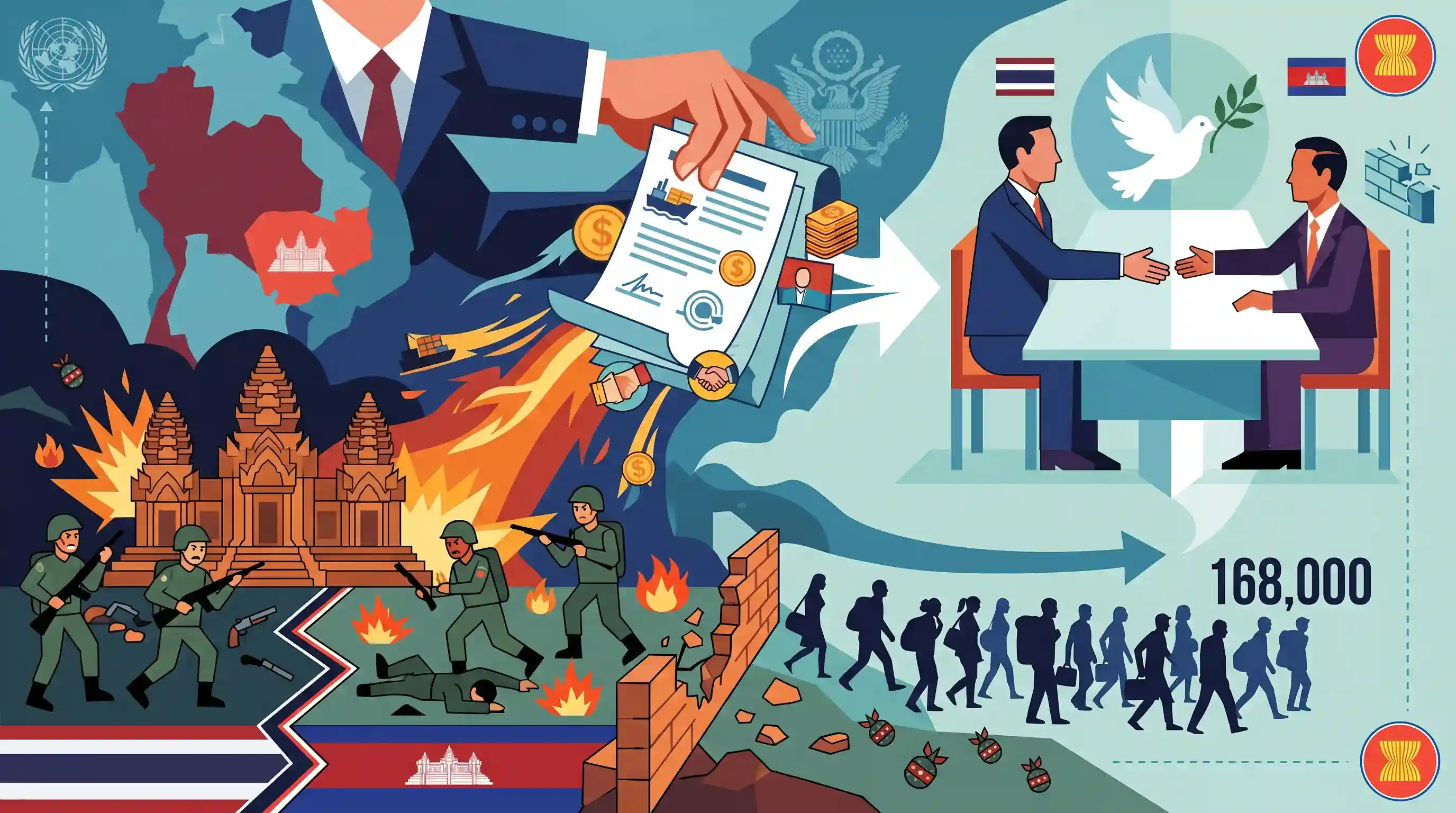
Thailand and Cambodia have agreed to ceasefire talks after U.S. President Donald Trump intervened, using the threat of withdrawing U.S. trade agreements as economic leverage to halt the ongoing border violence. The military clashes, rooted in historical territorial disputes near the Ta Muen Thom temple, have led to dozens of casualties, the controversial use of cluster munitions, and the displacement of over 168,000 people, prompting calls for mediation by the UN Security Council and ASEAN.
Key Points
- Thailand and Cambodia agreed to ceasefire talks to address their border dispute following mediation by U.S. President Donald Trump.
- Trump utilized economic leverage, threatening to halt U.S. trade agreements with both nations if they continued their military hostilities.
- The clashes centre on historical and territorial claims, particularly around the ancient Ta Muen Thom temple.
- The violence involved heavy artillery, tanks, and condemned use of cluster munitions, resulting in 33 deaths and the displacement of over 168,000 people.
- The UN Security Council has been involved, pressing regional organizations like ASEAN to help resolve the crisis.
Important Terms
ASEAN

A 10-member regional intergovernmental organization in Southeast Asia promoting economic growth and regional stability through consensus-based decision-making and the principle of non-interference.
UPSC context
GS Paper 2 (International Relations); central to India's 'Act East Policy' and regional security frameworks.
UN Security Council
The primary United Nations body responsible for maintaining international peace and security, with the authority to issue binding resolutions and authorize military intervention.
UPSC context
GS Paper 2 (International Institutions); crucial for understanding global governance and India's pursuit of institutional reform.
Human Rights Watch
An international non-governmental organization that monitors, investigates, and advocates for human rights worldwide, frequently reporting on violations during armed conflicts and border disputes.
UPSC context
GS Paper 2 (Role of NGOs/Civil Society); relevant for human rights advocacy and international humanitarian law monitoring.
Cluster Munitions
Weapons containing multiple explosive submunitions (bomblets) that scatter over a large area, often failing to detonate immediately and posing a long-term threat to civilians.
UPSC context
GS Paper 2 & 3 (International Law/Security); tests knowledge of the Convention on Cluster Munitions and humanitarian warfare standards.
Economic Diplomacy
The strategic use of a country's economic resources, including trade agreements, tariffs, and aid, as leverage to achieve foreign policy goals and diplomatic settlements.
UPSC context
GS Paper 2 (International Relations); important for analyzing modern geopolitical influence and bilateral pressure tactics.
Prelims Trap
"India, along with major powers like the US, is a state party to the Convention on Cluster Munitions."
Neither India, the US, Russia, nor China are signatories to the 2008 Convention on Cluster Munitions. Aspirants often falsely assume India complies with all UN-backed arms treaties.
Static Concepts Connected
What is the Convention on Cluster Munitions (CCM)?
- Core Prohibition: Adopted in 2008, it strictly prohibits the use, production, transfer, and stockpiling of cluster bombs.
- Key Non-Signatories: Major global military powers, including India, the United States, Russia, China, and Pakistan, have not signed the treaty.
- Clearance & Assistance: The treaty mandates clearance of contaminated areas within 10 years and requires victim assistance programs.
What is the geopolitical significance of the Dangrek Mountain range?
- Natural Boundary: The range forms a natural, highly contested border between Cambodia and Thailand.
- Khmer Heritage: It houses ancient 11th-century Khmer Hindu temples dedicated to Lord Shiva, such as Ta Muen Thom and the UNESCO-listed Preah Vihear.
- ICJ Ruling: In 1962, the International Court of Justice (ICJ) awarded the Preah Vihear temple to Cambodia, but territorial friction persists.
Cross-Topic Patterns
ASEAN Way vs. Bilateral Conflicts
The principle of non-interference and consensus (Musyawarah/Mufakat) often paralyzes ASEAN's ability to arbitrate border disputes internally, increasingly forcing reliance on external powers or the UN Security Council for mediation.
Geo-economics as Diplomatic Leverage
The US using the threat of withdrawing trade agreements to force a ceasefire highlights the growing trend of leveraging geo-economics and trade dependencies to resolve traditional hard-security military conflicts.

Expect a 2026 prelims map question on the Dangrek Mountains/Khmer temples, or statements testing India’s non-signatory status to the CCM.
Linked PYQs · 4
Linked PYQs · 4
- 2025MainsGS2
"The reform process in the United Nations remains unresolved, because of the delicate imbalance of East and West and entanglement of the USA vs. Russo-Chinese alliance.” Examine and critically evaluate the East-West policy confrontations in this regard.
- 2014MainsGS2
With respect to the South China sea, maritime territorial disputes and rising tension affirm the need for safeguarding maritime security to ensure freedom of navigation and over flight throughout the region. In this context, discuss the bilateral issues between India and China.
- 2020PrelimsGS1
Consider the following pairs: International agreement/set-up Subject 1. Alma-Ata Declaration : Healthcare of the people 2. Hague Convention : Biological and chemical weapons 3. Talanoa Dialogue : Global climate change 4. Under2 Coalition : Child rights Which of the pairs given above is/are correctly matched?
- 2020MainsGS2
Quadrilateral Security Dialogue (Quad)' is transforming itself into a trade bloc from a military alliance, in present times - Discuss.
