Telangana Transport Model and Mahalakshmi Scheme Praised Nationally
Source:The Hindu ↗
Why It Matters
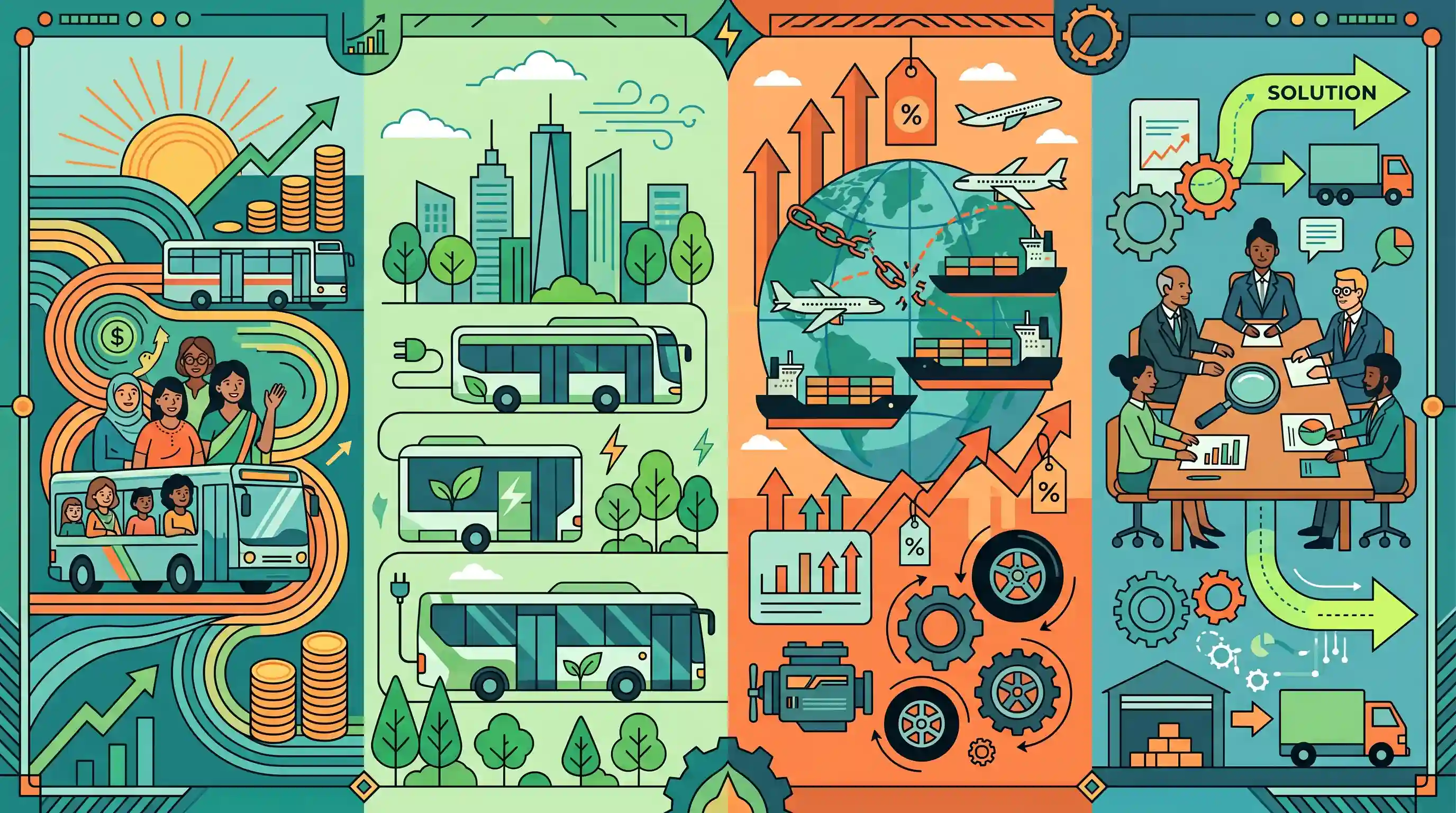
Highlights the intersection of state-funded welfare schemes, environmental sustainability through EV adoption, and the economic impact of global supply chain disruptions on domestic infrastructure operations.
Summary
The Telangana State Road Transport Corporation (TGSRTC) garnered national attention at the All-India Conference of the Association of State Road Transport Undertakings (ASRTU) in Mussoorie for its pioneering initiatives. Key highlights included the success of the Mahalakshmi scheme, which facilitated record passenger trips worth ₹10,000 crore, and TGSRTC's role as a model for eco-friendly transport via electric buses. The conference also addressed the economic challenges of global supply chain disruptions causing escalating costs of vehicle spare parts, leading to a proposal for a dedicated committee to review spare parts pricing and management.
Key Points
- TGSRTC's Mahalakshmi scheme and its deployment of electric buses received national recognition at the All-India Conference of ASRTU in Mussoorie.
- The Mahalakshmi scheme achieved record passenger trips worth ₹10,000 crore, establishing itself as a landmark model in India's public transport sector.
- TGSRTC was lauded as a national model for eco-friendly public transport owing to its extensive electric bus operations.
- Concerns were raised regarding the escalating costs of vehicle spare parts due to global supply chain disruptions linked to international conflicts.
- ASRTU is set to form a committee to review spare parts pricing and standardize procurement and management practices across state transport undertakings.
Important Terms
Mahalakshmi scheme

A flagship Telangana government welfare initiative providing free bus travel for women and transgender persons in state-run buses, aiming to enhance mobility and financial independence.
UPSC context
Relevant for GS Paper II (Welfare schemes for vulnerable sections) and GS Paper III (Inclusive growth and infrastructure).
Association of State Road Transport Undertakings (ASRTU)
The apex coordinating body for India's state-run bus transport, established in 1965 to promote resource pooling, standardized procurement, and best practices among member transport corporations.
UPSC context
GS Paper III (Infrastructure: Roadways); highlights cooperative federalism and efficiency in public service delivery.
Telangana State Road Transport Corporation (TGSRTC)
The state-owned transport provider in Telangana (formerly TSRTC), recognized for large-scale electric bus adoption and the implementation of the zero-fare Mahalakshmi scheme.
UPSC context
GS Paper III (Infrastructure and Energy); focuses on public-sector-led decarbonization and social welfare models.
Zero Ticket
A non-monetary ticket issued to beneficiaries of free travel schemes (like Mahalakshmi) to track ridership and facilitate government reimbursement to transport corporations.
UPSC context
GS Paper II (Governance and Social Justice); tests understanding of welfare delivery mechanisms and data-driven policy.
State Road Transport Undertakings (SRTUs)
Public sector organizations established by state governments to provide passenger transport services; they are the primary focus of ASRTU for operational and financial reforms.
UPSC context
GS Paper III (Infrastructure: Roads); involves debates on privatization vs. public service obligations.
Spare Parts Pricing and Management (SPPM)
An ASRTU initiative to mitigate rising maintenance costs and supply chain disruptions through standardized rate contracts and review of part-specific inflation.
UPSC context
GS Paper III (Economic Development and Supply Chain); relevant to operational efficiency in state-run infrastructure.
Prelims Trap
ASRTU is a statutory body headed by the Union Minister of Road Transport.
ASRTU is not a statutory body; it is a registered society (1860 Act). Its ex-officio President is the Secretary of MoRTH, not the Minister.
Static Concepts Connected
What are the core features of the PM-eBus Sewa scheme?
- PPP Model: Operates on a Public-Private Partnership (Gross Cost Contract) model where private entities manage operations and STUs pay a per-kilometer fee.
- Target Cities: Focuses on cities with a population of 3 lakh and above, prioritizing those lacking organized bus transport services.
- Central Assistance: Provides financial support for bus operations and upgrading depot infrastructure for a period of 10 years.
What is the Association of State Road Transport Undertakings (ASRTU)?
- Apex Body: A registered society serving as the apex coordinating entity for all State Transport Undertakings (STUs) across India.
- Leadership: It functions under the Ministry of Road Transport & Highways, with the MoRTH Secretary serving as its ex-officio President.
- Key Mandate: Facilitates standardization, bulk procurement of spare parts at competitive rates, and promotes efficient public transport systems.
Cross-Topic Patterns
Female mobility & LFPR
Targeted transit subsidies lower mobility costs, serving as a catalyst for urban female labor force participation (FLFPR) by expanding viable job search radiuses.
Welfare vs. STU Fiscal Health
Free bus schemes present a classic GS2/GS3 case study on balancing targeted socio-economic empowerment with the operational bankruptcy risks of state utilities.
Geopolitics & Local Transport
Global supply chain disruptions directly inflate vehicle spare part costs in India, demonstrating how international conflicts strain localized public utility budgets.

Expect a GS3 Mains question on the financial viability of STUs facing dual pressures: EV transition costs and subsidized welfare mandates.
Linked PYQs · 3
Linked PYQs · 3
- 2023MainsGS3
The adoption of electric vehicles is rapidly growing worldwide. How do electric vehicles contribute to reducing carbon emissions and what are the key benefits they offer compared to traditional combustion engine vehicles?
- 2022MainsGS2
Besides the welfare schemes, India needs deft management of inflation and unemployment to serve the poor and the underprivileged sections of the society. Discuss.
- 2014MainsGS2
The setting up of a Rail Tariff Authority to regulate fares will subject the cash strapped Indian Railways to demand subsidy for obligation to operate non-profitable routes and services. Taking into account the experience in the power sector, discuss if the proposed reform is expected to benefit the consumers, the Indian Railways or the private container operators.
