US Tariffs and Penalties Trigger Sell off in Indian Markets
Source:The Hindu ↗
Why It Matters
Highlights the vulnerability of India's export-driven sectors to sudden geopolitical shifts and trade protectionism, while illustrating the complex balancing act in India's foreign policy regarding US trade pressures and Russian energy/defense ties.
Summary
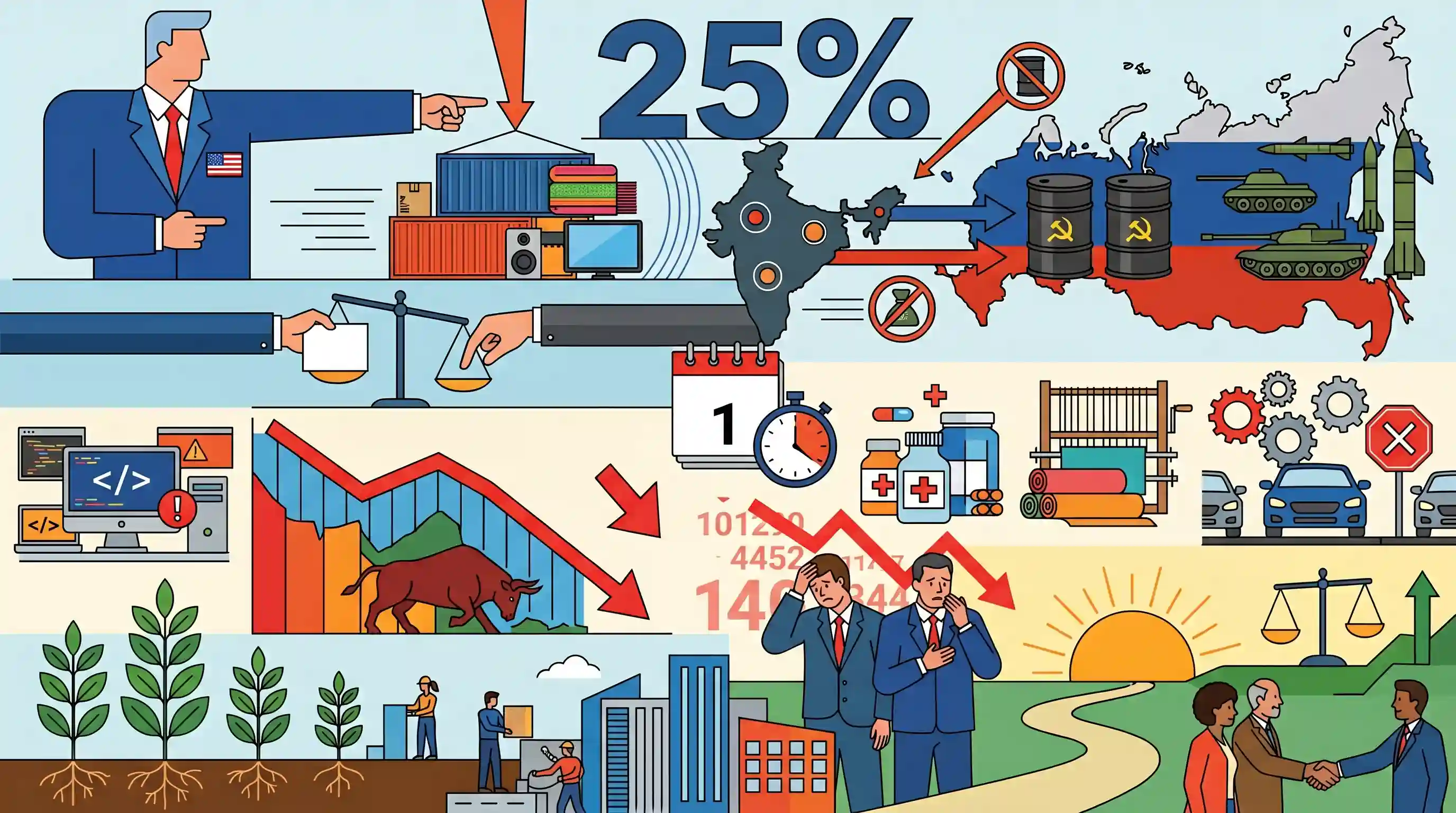
U.S. President Donald Trump has announced a blanket 25% tariff on all Indian goods starting August 1, alongside an unspecified penalty for India's continued procurement of Russian crude oil and military equipment. The unexpected geopolitical move acts as a pressure tactic for better bilateral trade deals and marks India as the first nation explicitly penalized for Russian imports. In response, Indian equity markets, including the Sensex and Nifty, experienced a sharp sell-off, heavily impacting major export sectors such as IT, pharmaceuticals, textiles, and automobiles. Despite the immediate shock to global supply chains and stock markets, analysts suggest that trade negotiations may eventually soften the tariffs and that India's strong domestic fundamentals will buffer its long-term growth trajectory.
Key Points
- U.S. President Donald Trump announced a 25% tariff on all goods imported from India starting August 1.
- India faces an additional unspecified penalty for purchasing Russian crude oil and military equipment, making it the first country penalized for Russian imports.
- The announcements triggered a sharp decline in Indian equity markets, particularly affecting export-reliant sectors like textiles, IT, auto, and pharmaceuticals.
- Market analysts view the tariffs as a U.S. pressure tactic to secure favorable trade terms but maintain that India's long-term economic fundamentals remain resilient.
Important Terms
BSE (Bombay Stock Exchange)

Asia's oldest stock exchange (est. 1875), headquartered in Mumbai. It facilitates trading in equities, debt, and derivatives, with the SENSEX serving as its primary benchmark index.
UPSC context
GS Paper III (Indian Economy); crucial for understanding capital market dynamics, financial regulation (SEBI), and the impact of global shocks on domestic wealth.
NSE (National Stock Exchange)
India’s leading stock exchange by trading volume (est. 1992). It introduced fully automated electronic trading to India and manages the Nifty 50, a benchmark index of 50 diversified blue-chip companies.
UPSC context
GS Paper III (Indian Economy); tests knowledge of financial infrastructure, secondary market liquidity, and the role of indices in tracking economic health.
Wipro
A prominent Indian multinational IT services corporation. It is a major constituent of India’s service-led export economy, specializing in cloud computing, cybersecurity, and digital transformation.
UPSC context
GS Paper III (Indian Economy/Services); represents the IT sector's critical role in India’s Balance of Payments and global trade relations.
Arvind Ltd
A leading Indian textile manufacturer and the country’s largest producer of denim. It represents the labor-intensive manufacturing sector, which is vital for exports and employment.
UPSC context
GS Paper III (Industry); relevant for discussing the impact of trade tariffs on labor-intensive manufacturing and India’s global competitiveness in textiles.
Vardhman Textiles
One of India’s largest vertically integrated textile conglomerates, majorly involved in yarn and processed fabric production. It is a key player in India's textile export supply chain.
UPSC context
GS Paper III (Industrial Growth); highlights the importance of the textile sector in India’s manufacturing GDP and its vulnerability to external trade protectionism.
Prelims Trap
CAATSA is a United Nations-backed framework used to penalize countries buying Russian military equipment.
CAATSA is a US domestic law, not a UN resolution. UPSC often traps students by conflating unilateral US sanctions with UN-mandated international sanctions.
Static Concepts Connected
What is CAATSA and how do its secondary sanctions work?
- US Domestic Law: A 2017 US federal law enacted to impose sanctions on Iran, North Korea, and Russia.
- Secondary Sanctions: Penalizes third-party countries (like India) if they engage in "significant transactions" with Russia's defense or intelligence sectors.
- Presidential Waiver: The US President holds the authority to grant waivers based on national security interests, which historically shielded India.
How do unilateral tariffs differ from WTO-compliant trade remedies?
- WTO Trade Remedies: WTO permits Anti-dumping, Countervailing, and Safeguard duties only when specific material injury to domestic industry is proven.
- Unilateral Tariffs: Blanket geopolitical tariffs typically violate WTO's Most-Favored-Nation (MFN) principle and bound tariff rate commitments.
- Retaliatory Action: Targeted nations often approach the WTO Appellate Body or impose reciprocal tariffs on US goods in response.
Cross-Topic Patterns
Strategic autonomy vs. Energy security
India's reliance on discounted Russian crude (38% of imports) illustrates the tension between controlling domestic inflation through cheap energy and navigating the risks of unilateral US secondary sanctions.
Export shocks and Forex volatility
A major hit to IT, Pharma, and Textile exports threatens India's dollar inflows. This directly links to potential Current Account Deficit (CAD) widening and subsequent Rupee depreciation.

Expect a 2026 prelims question contrasting unilateral US sanctions (CAATSA) with UN-mandated sanctions and WTO MFN rule violations.
Linked PYQs · 4
Linked PYQs · 4
- 2012MainsGS2
Discuss the likely negative impact of the protectionist measures proposed by the US on India's software industry.
- 2020MainsGS2
What is the significance of Indo-US defence deals over Indo-Russian defence deals? Discuss with reference to stability in the Indo-Pacific region.
- 2025MainsGS2
"Energy security constitutes the dominant kingpin of India's foreign policy, and is linked with India's overarching influence in Middle Eastern countries.” How would you integrate energy security with India's foreign policy trajectories in the coming years?
- 2023PrelimsGS1
Consider the following statements: Statement-I: India accounts for 3.2% of global export of goods. Statement-II: Many local companies and some foreign companies operating in India have taken advantage of India's 'Production-linked Incentive' scheme. Which one of the following is correct in respect of the above statements?
