Texprocil Rejects US Allegations on Indian Cotton Textile Sector
Source:The Hindu ↗
Why It Matters
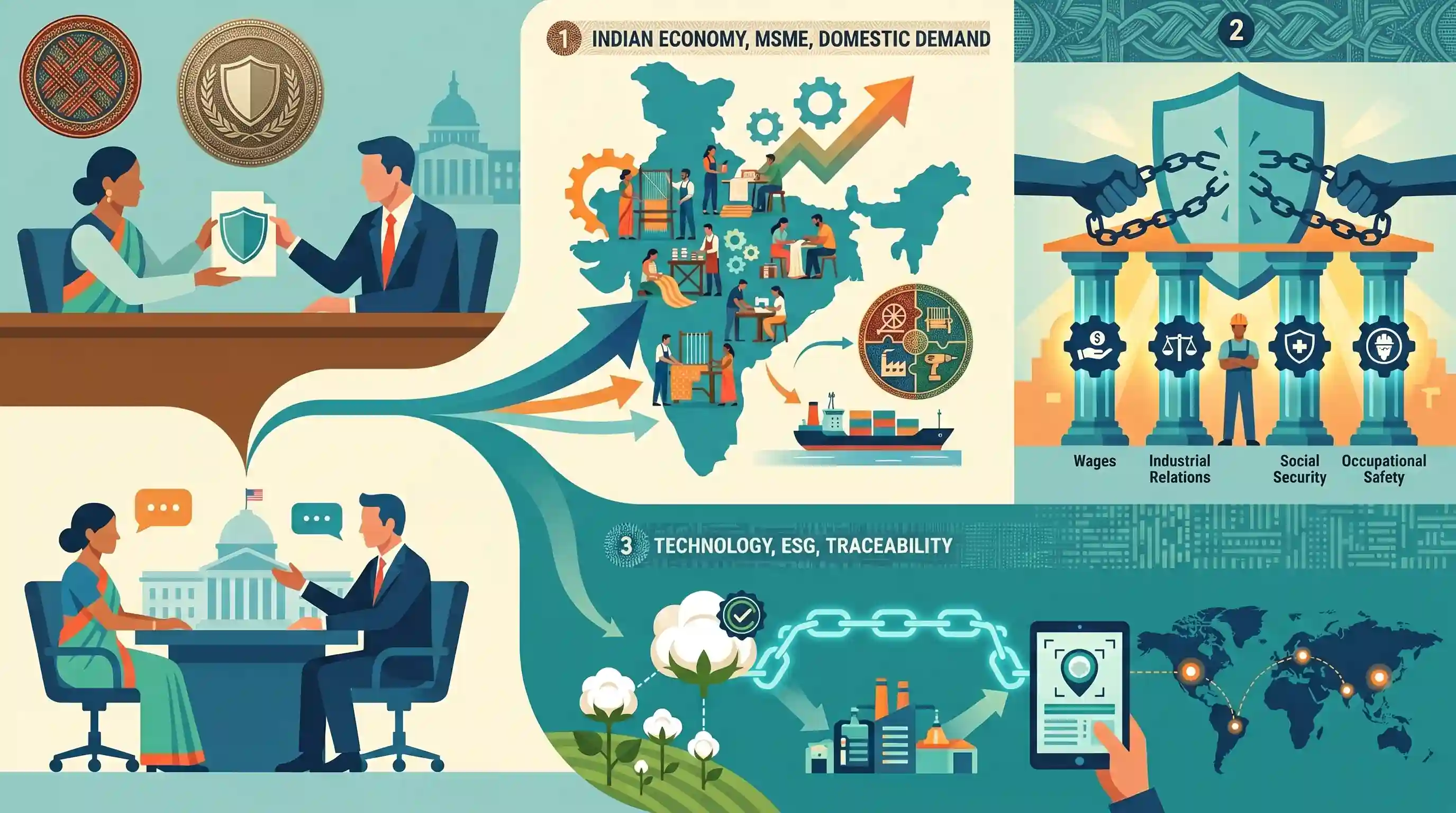
Illustrates how developed nations use non-tariff barriers (such as labor and ESG compliance allegations via Section 301) to protect domestic markets, and demonstrates how India's internal reforms (Labour Codes, digital traceability) serve as critical geopolitical and economic leverage in global trade negotiations.
Summary
The Cotton Textiles Export Promotion Council (Texprocil) has submitted a formal defense to the United States Trade Representative (USTR) challenging allegations of excess capacity and forced labor within India's cotton textile sector. The rebuttal forms part of the industry's response to ongoing U.S. Section 301 investigations into alleged market-distorting policies. Texprocil argued that the Indian textile industry is primarily driven by robust domestic demand, absorbing over 80% of production, and is characterized by a fragmented, MSME-dominated structure rather than a heavily subsidized export-surplus machine. Furthermore, the council emphasized India's comprehensive legal framework, including the recent consolidation of labor laws into four new Labour Codes, which actively prevents forced labor. To address supply chain transparency concerns, Texprocil also cited technological and ESG advancements like the blockchain-backed 'Kasturi Cotton Bharat' initiative.
Key Points
- Texprocil has submitted a formal rebuttal to the USTR, rejecting allegations of excess capacity and forced labor in India's cotton textile industry amid ongoing Section 301 investigations.
- The council clarified that India is not an export-surplus economy in textiles; over 80% of the sector's production caters to domestic demand.
- The Indian textile ecosystem is highly fragmented and dominated by MSMEs, functioning under capacity constraints rather than creating artificial excess capacity.
- Texprocil highlighted India's progressive labor reforms, consolidating 29 central laws into four Labour Codes that strictly prohibit forced labor.
- Initiatives like the blockchain-enabled 'Kasturi Cotton Bharat' demonstrate the sector's commitment to end-to-end traceability, transparency, and high ESG (Environmental, Social, and Governance) standards.
Important Terms
Section 301 (U.S. Trade Act)

A provision of the US Trade Act of 1974 authorizing the USTR to investigate and respond to foreign trade practices deemed unfair, discriminatory, or restrictive to US commerce.
UPSC context
GS II (International Relations) & GS III (Economy); tests knowledge of trade enforcement tools and bilateral trade tensions.
United States Trade Representative (USTR)
The US government agency responsible for trade policy, negotiations, and enforcement. It conducts 'Section 301' probes and produces the 'Special 301 Report' on intellectual property.
UPSC context
GS II; relevant for studying global trade governance and India-US economic diplomacy.
Kasturi Cotton Bharat Initiative
A national initiative for branding, traceability, and certification of premium Indian cotton, utilizing blockchain technology and QR codes for supply-chain transparency and global competitiveness.
UPSC context
GS III (Indian Economy); tests agricultural value-addition, branding, and digital interventions in the industrial sector.
The Cotton Textiles Export Promotion Council (Texprocil)
Established in 1954, it is India's first export promotion council, serving as the international face of the cotton textile industry and the implementing agency for Kasturi Cotton.
UPSC context
GS III; important for industrial growth, export promotion bodies, and trade policy implementation.
Labour Codes
Four consolidated legal frameworks (Wages, Industrial Relations, Social Security, and Occupational Safety) that replaced 29 central statutes to simplify compliance and broaden social security nets.
UPSC context
GS III; essential for labor market reforms, economic formalization, and worker welfare questions.
Prelims Trap
Section 301 is a mechanism under the WTO dispute settlement framework used to probe market-distorting trade policies.
Section 301 is a unilateral domestic law of the United States, not a multilateral mechanism governed by the WTO.
Static Concepts Connected
What is Section 301 of the U.S. Trade Act?
- Unilateral Tool: Empowers the US Trade Representative (USTR) to unilaterally investigate and sanction foreign countries for 'unfair' or 'market-distorting' trade practices.
- Bypasses WTO: Operates outside the WTO's multilateral dispute framework, often drawing criticism from developing nations for acting as an aggressive non-tariff barrier.
What makes Kasturi Cotton Bharat unique?
- Joint Initiative: A collaborative effort between the Ministry of Textiles, Cotton Corporation of India, and trade bodies to create a premium global brand for Indian cotton.
- Blockchain Tech: Utilizes a blockchain-based platform and QR-code certification to ensure end-to-end traceability, transparency, and global ESG compliance.
Cross-Topic Patterns
ESG norms as Non-Tariff Barriers
Labor probes under US Section 301 and the EU's Carbon Border Adjustment Mechanism (CBAM) reflect a rising trend of using domestic ESG laws to restrict developing nation exports.
Labour Codes + Export Competitiveness
The consolidation of 29 labor laws into 4 Codes is not just a domestic reform, but a crucial foreign-trade defense mechanism against international forced-labor allegations.

Expect a GS3 question on how developed nations use ESG norms and unilateral laws (like US Section 301) as disguised non-tariff barriers.
Linked PYQs · 3
Linked PYQs · 3
- 2024MainsGS3
Discuss the merits and demerits of the four 'Labour Codes' in the context of labour market reforms in India. What has been the progress so far in this regard?
- 2023MainsGS3
Faster economic growth requires increased share of the manufacturing sector in GDP, particularly of MSMEs. Comment on the present policies of the Government in this regard.
- 2016MainsGS2
The broader aims and objectives of WTO are to manage and promote international trade in the era of globalization. But the Doha round of negotiations seem doomed due to differences between the developed and the developing countries." Discuss in the Indian perspective.
