मौसम विज्ञान संबंधी पदों में कटौती और आपदा तैयारी की चुनौतियां
स्रोत:इंडियन एक्सप्रेस ↗
क्यों मायने रखता है
It highlights the critical intersection of political decisions, institutional funding, and disaster preparedness. For UPSC aspirants, it provides a relevant case study on why robust state capacity and well-funded meteorological institutions (comparable to the IMD in India) are indispensable for providing accurate early warnings and building resilience against climate-induced disasters.
सारांश
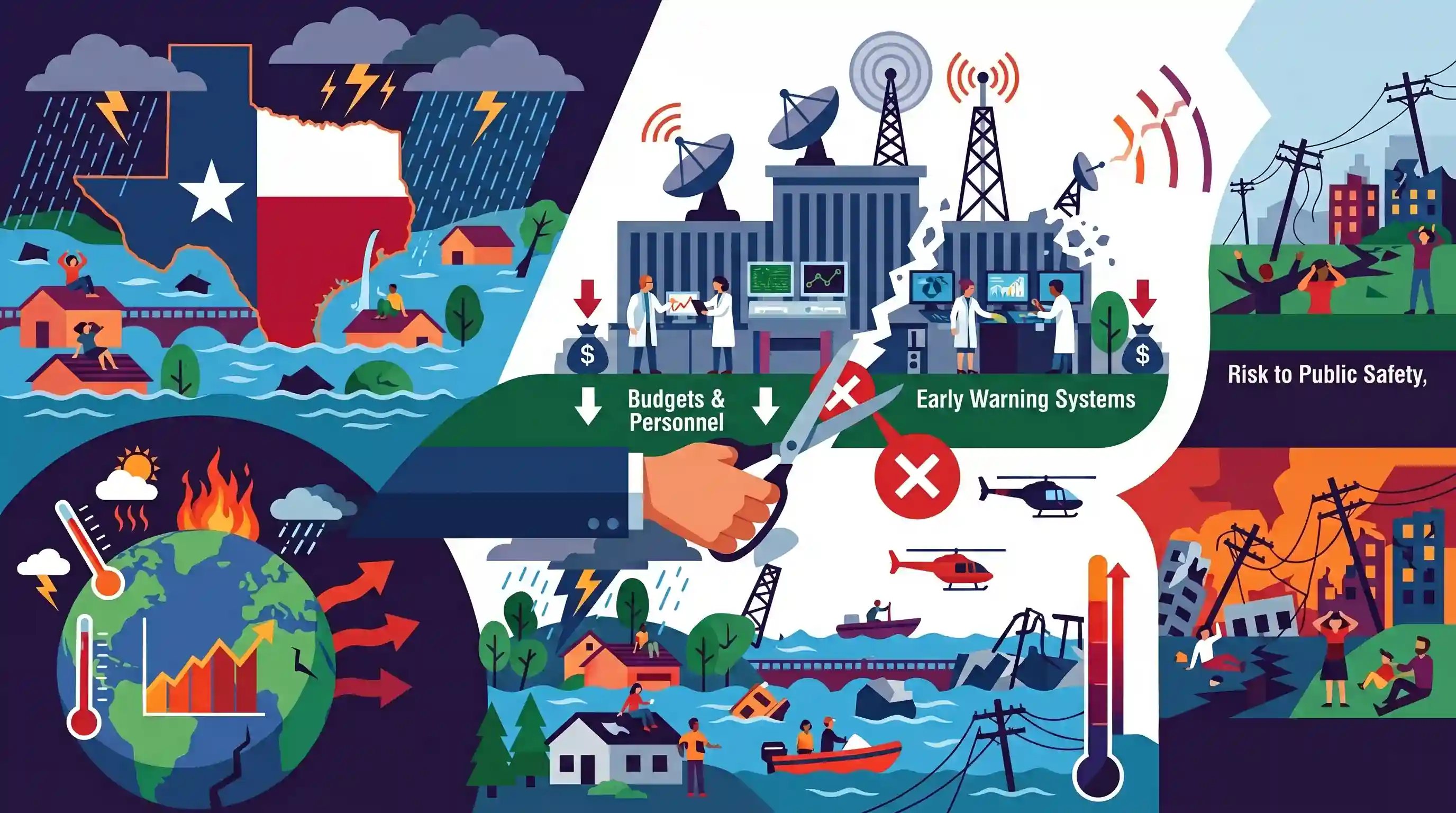
The article discusses the severe flash floods in Texas and examines the potential dangers of proposed job cuts by the incoming Trump administration to US weather forecasting agencies like the National Weather Service (NWS) and NOAA. It emphasizes that reducing personnel and budgets in meteorological institutions threatens the accuracy and timeliness of weather forecasts and early warning systems. This reduction in state capacity comes at a critical time when climate change is increasing the frequency and intensity of extreme weather events, thereby escalating risks to public safety, infrastructure, and effective disaster management.
मुख्य बिंदु
- Texas recently experienced severe flash floods, underlining the growing and persistent threat of extreme weather events.
- Proposed job cuts by the incoming Trump administration to federal meteorological agencies have raised concerns about the future efficacy of weather forecasting in the US.
- Reducing personnel and budgets at institutions like the NWS and NOAA can severely degrade forecast accuracy and delay life-saving early warnings during rapid-onset disasters.
- The situation underscores the necessity of robust, state-funded institutional capacity for effective disaster management and climate adaptation, especially as global warming intensifies extreme weather anomalies.
महत्वपूर्ण शब्द
National Oceanic and Atmospheric Administration (NOAA)

A US scientific agency under the Department of Commerce that monitors ocean and atmospheric conditions, manages fisheries, and conducts environmental research to protect life and property.
UPSC context
GS Paper III: Disaster Management and Environment. Important for understanding international institutional frameworks for weather monitoring and climate data.
National Weather Service (NWS)
A subdivision of NOAA responsible for providing official weather forecasts, warnings for hazardous events (like hurricanes and floods), and climate data to ensure public safety.
UPSC context
GS Paper III: Disaster Management. Relevant for topics on early warning systems and the role of meteorological institutions in hazard mitigation.
Flash Floods
Sudden, high-intensity flooding occurring within six hours of heavy rainfall, cloudbursts, or dam breaches, characterized by rapid water rise and high destructive potential.
UPSC context
GS Paper I & III: Geophysical Phenomena and Disaster Management. Tests knowledge of localized disasters, their causes (like cloudbursts), and management strategies.
Early Warning Systems (EWS)
An integrated system of monitoring, forecasting, and communication designed to provide timely information about hazards, enabling individuals and communities to take preemptive protective action.
UPSC context
GS Paper III: Disaster Management. Key for the Sendai Framework and India's efforts in multi-hazard risk reduction and climate resilience.
Climate Change Adaptation
Adjustments in ecological, social, or economic systems to moderate potential damages or benefit from opportunities associated with actual or expected climate change impacts.
UPSC context
GS Paper III: Environment. Crucial for understanding resilience building, National Adaptation Plans (NAPs), and differentiating between mitigation and adaptive responses.
Disaster Management
The organized management of resources and responsibilities for dealing with all humanitarian aspects of emergencies—specifically prevention, preparedness, response, and recovery.
UPSC context
GS Paper III: Core topic. Covers institutional capacity, legislative frameworks (like the Disaster Management Act, 2005), and hazard-specific mitigation strategies.
प्रारंभिक ट्रैप
"The India Meteorological Department (IMD) is the nodal agency for issuing riverine flood forecasts in India."
While IMD operates the Flash Flood Guidance System and predicts rainfall, the Central Water Commission (CWC) is the nodal agency for riverine flood forecasting.
संबंधित अवधारणाएँ
What is the South Asian Flash Flood Guidance System (SAsiaFFG)?
- Nodal Agency: Operated by the India Meteorological Department (IMD) as the designated regional center for South Asian nations.
- Alert Window: Provides actionable 6-12 hour advance warnings for rapid-onset flash floods to disaster response agencies.
- Regional Coverage: Extends critical meteorological forecasting coverage across India, Bangladesh, Bhutan, Nepal, and Sri Lanka.
What is Target G of the Sendai Framework for Disaster Risk Reduction?
- Core Mandate: Substantially increase the availability of and access to multi-hazard early warning systems (EWS) globally.
- Strategic Shift: Focuses on transitioning nations from reactive relief-centric approaches to proactive disaster mitigation by 2030.
अंतर-विषय पैटर्न
Weather data as a public good
Defunding state meteorological capacity shifts the climate risk burden to vulnerable populations, linking GS2 governance (role of the state) with GS3 disaster management.
Climate anomalies + Urban drainage
Flash floods are increasingly urban disasters where extreme rainfall intersects with concretization and poor drainage, linking GS1 urbanization with GS3 extreme weather.

Expect a GS3 Mains question on how weakening institutional capacity degrades Early Warning Systems and Sendai Framework Target G goals.
संबद्ध PYQ · 3
संबद्ध PYQ · 3
- 2024MainsGS3
Flooding in urban areas is an emerging climate-induced disaster. Discuss the causes of this disaster. Mention the features of two such major floods in the last two decades in India. Describe the policies and frameworks in India that aim at tackling such floods.
- 2019MainsGS3
Disaster preparedness is the first step in any disaster management process. Explain how hazard zonation mapping will help disaster mitigation in the case of landslides.
- 2024MainsGS3
What is disaster resilience? How is it determined? Describe various elements of a resilience framework. Also mention the global targets of Sendai Framework for Disaster Risk Reduction (2015–2030).
