SIT arrests mastermind wife in Patna over TET paper leak
Source:Indian Express ↗
Why It Matters
Frequent examination paper leaks undermine the integrity of public recruitment systems and erode public trust in governance. The involvement of interstate organised networks in compromising exams like TET and JEE highlights the need for stringent laws, robust digital security measures in assessments, and effective interstate law enforcement coordination.
Summary
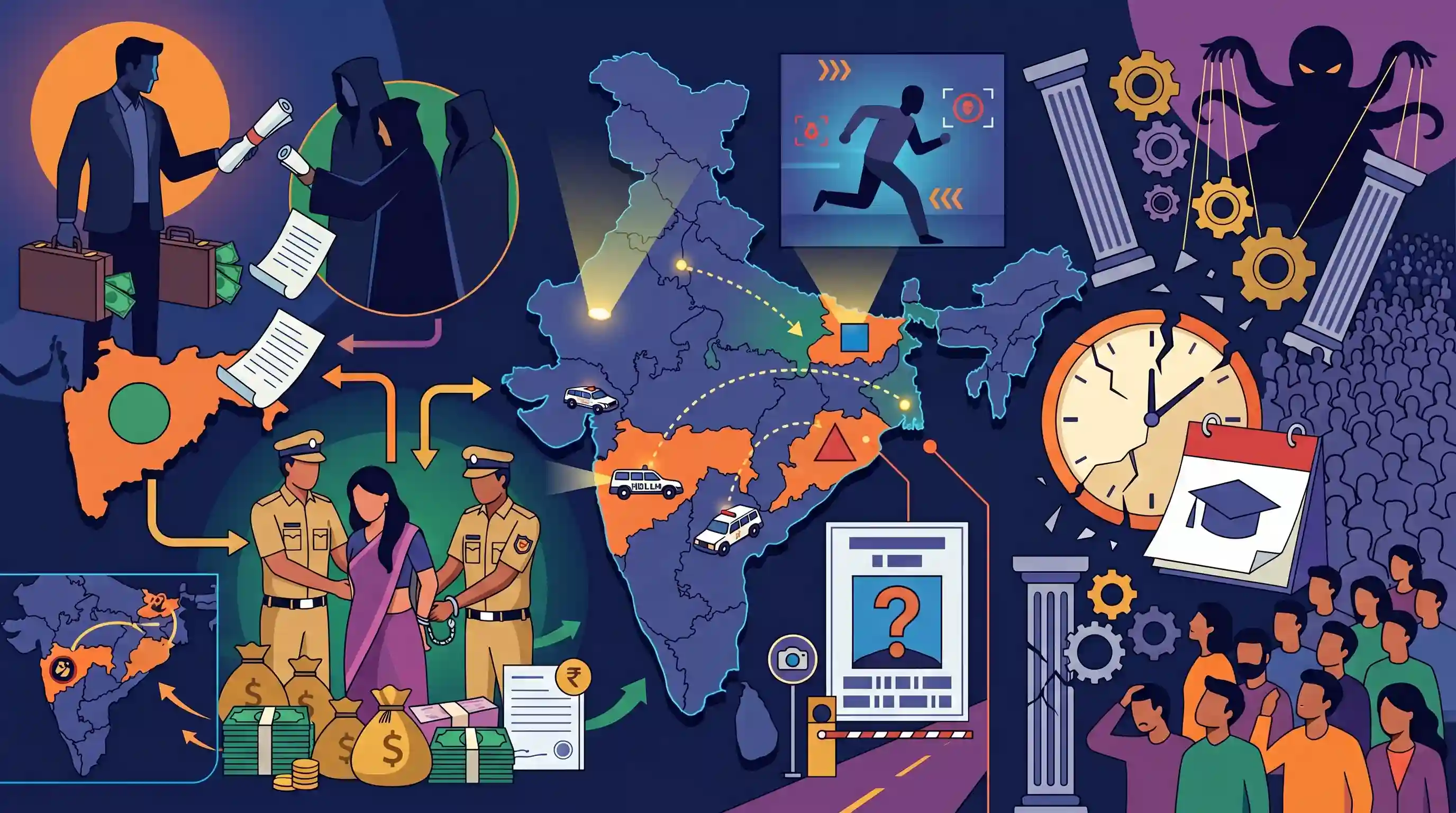
The Maharashtra Special Investigation Team (SIT) has arrested Suman Gupta from Patna, the wife of the alleged mastermind behind the Maharashtra Teacher Eligibility Test (TET) paper leak. She is accused of managing the financial transactions for the illicit sale of leaked question papers, which were being sold for Rs 3-5 lakh. The mastermind, Bijendra Kumar Gupta, remains at large and is known to be involved in previous examination frauds, including the 2023 JEE paper leak in Odisha. The ongoing interstate manhunt includes the initiation of a Look-Out Circular (LOC) against another suspect. The TET examination, which was scheduled for 2.45 lakh candidates, was postponed, highlighting significant systemic vulnerabilities and the influence of organised crime in public recruitment.
Key Points
- A Special Investigation Team (SIT) from Maharashtra arrested the wife of the alleged mastermind behind the Maharashtra TET paper leak from Patna.
- The mastermind, Bijendra Kumar Gupta, is absconding and is a repeat offender, previously implicated in the 2023 JEE paper leak in Odisha.
- The accused operated a syndicate selling leaked exam papers to candidates for Rs 3-5 lakh each, with the arrested wife handling the illicit financial transactions.
- The TET exam, which was to be taken by 2.45 lakh candidates across 1,028 centres, was postponed following the discovery of the leak.
- Police are issuing a Look-Out Circular (LOC) against an absconding co-accused and are conducting an interstate manhunt.
Important Terms
Teacher Eligibility Test (TET)

A mandatory qualifying examination in India for individuals seeking teaching positions in primary and upper primary schools, ensuring minimum professional standards for educators.
UPSC context
GS Paper 2 (Governance/Education); mandatory requirement under the Right to Education (RTE) Act, 2009.
Special Investigation Team (SIT)
An ad hoc investigative body constituted to probe serious or high-profile crimes when regular police investigations are insufficient or potentially biased.
UPSC context
GS Paper 3 (Internal Security); related to police reforms, transparency, and judicial oversight.
Look-Out Circular (LOC)
A notice issued by law enforcement to immigration checkpoints to monitor or prevent the travel of individuals suspected of crimes or involved in legal proceedings.
UPSC context
GS Paper 3 (Internal Security); mechanism for border control and tracking absconding criminals.
Organised Crime
Systematic, profit-driven illegal activities carried out by structured syndicates, often involving cross-border networks and exploiting administrative vulnerabilities.
UPSC context
GS Paper 3 (Internal Security); impact on governance, national security, and public recruitment integrity.
Right to Education (RTE) Act, 2009
Legislation mandating free, compulsory education for children aged 6-14 and establishing minimum qualifications like the TET for teacher recruitment.
UPSC context
GS Paper 2 (Social Justice); critical for understanding educational governance and statutory mandates.
Prelims Trap
The Public Examinations Act, 2024 automatically applies to all state-level eligibility tests.
False. The 2024 Central Act applies primarily to designated central authorities (UPSC, SSC, NTA, RRB). State exams are governed by respective state laws.
Static Concepts Connected
What is a Look-Out Circular (LOC) and which authority issues it?
- Issuing Authority: Issued by the Bureau of Immigration under the Ministry of Home Affairs (MHA).
- Requesting Agencies: Requested by state police, CBI, ED, or intelligence agencies to restrict movement of suspects.
- Primary Purpose: To prevent suspects of cognizable offenses from fleeing India via international checkpoints or airports.
How does a Special Investigation Team (SIT) function in the Indian justice system?
- Ad-hoc Nature: SITs are specialized, temporary task forces created to investigate sensitive, high-profile, or highly complex crimes.
- Formation Authority: They can be constituted by the Supreme Court, High Courts, or Central and State governments.
Cross-Topic Patterns
Paper leaks as organized crime
The evolution of exam leaks into multi-state syndicates elevates this topic from a mere governance failure to a GS-3 Internal Security challenge involving sophisticated organized crime networks.
Proceeds of Crime and PMLA
Financial transactions handled by syndicate members from selling leaked papers generate 'proceeds of crime', triggering potential Enforcement Directorate (ED) investigations under the Prevention of Money Laundering Act (PMLA).

Expect a GS-2 mains question in 2026 assessing the efficacy of the Public Examinations Act 2024 against multi-state exam mafias.
Linked PYQs · 4
Linked PYQs · 4
- 2024MainsGS2
The Doctrine of Democratic Governance makes it necessary that the public perception of the integrity and commitment of civil servants becomes absolutely positive. Discuss.
- 2024MainsGS4
“The 'Code of Conduct' and 'Code of Ethics' are the sources of guidance in public administration. There is code of conduct already in operation, whereas code of ethics is not yet put in place. Suggest a suitable model for code of ethics to maintain integrity, probity and transparency in governance.”
- 2013MainsGS4
What do you understand by the following terms in the context of public service? Integrity
- 2026PrelimsGS1
Match List I with List II and select the answer using the code given below the Lists : List I (INTERPOL Notice) A. Silver Notice B. Blue Notice C. Black Notice D. Green Notice List II (Description) 1. To seek information on unidentified bodies 2. To collect additional information about a person's identity, location, or activities in relation to a criminal investigation 3. To provide warning about a person's criminal activities, where the person is considered to be a possible threat to public safety 4. To identify and trace criminal assets Code :
