Provisional GDP data reveals structural imbalances in India economy
Source:The Hindu ↗
Why It Matters
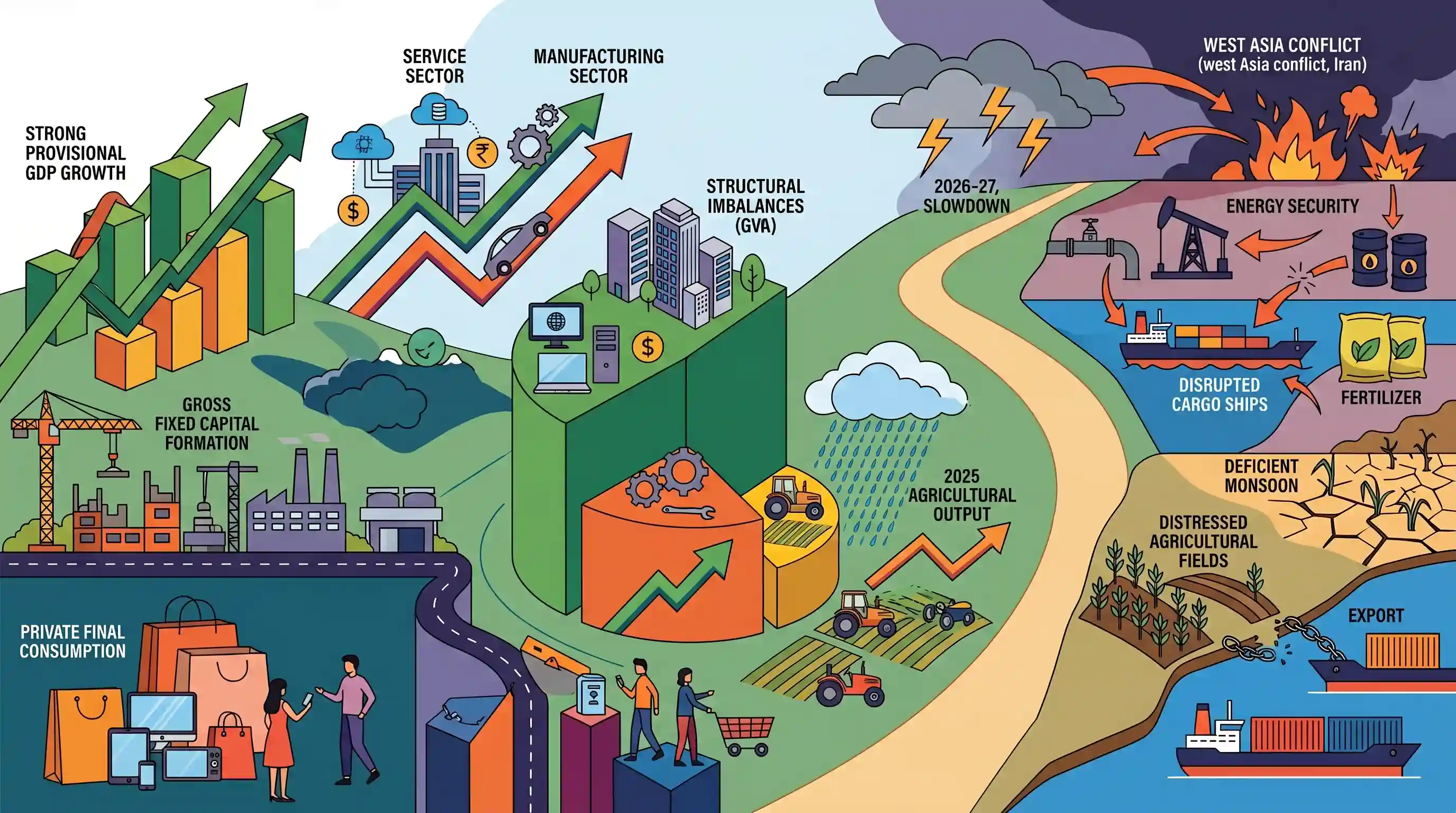
The article connects core macroeconomic indicators (GDP, GVA, Gross Fixed Capital Formation) with real-world vulnerabilities (monsoon dependence, fertilizer supply constraints, West Asia geopolitics). This intersection of structural economic transition (services dominance vs. stagnant manufacturing) and external supply-side shocks is highly relevant for GS3 Economy and GS2 International Relations answers.
Summary
The article analyzes India's GDP growth data for 2025-26, highlighting provisional estimates of an impressive 7.7% expansion. Economic resilience is evident through robust growth in Gross Fixed Capital Formation, Private Final Consumption, and double-digit expansion in services and manufacturing. However, structural imbalances persist: the services sector now contributes 54.3% to total GVA, while manufacturing's share remains stagnant, and agriculture has slipped below 20%. Despite a favorable 2025 monsoon, agricultural growth decelerated to 3%. Looking ahead to 2026-27, the RBI projects a slowdown to 6.6%, primarily threatened by external shocks. The ongoing crisis in West Asia (notably involving Iran) poses severe risks to energy security and crucial fertilizer supply chains, which, compounded by a forecasted deficient monsoon, will heavily test the resilience of India's agrarian economy and export sectors.
Key Points
- India's provisional GDP growth for 2025-26 stands at 7.7%, outperforming expectations and driven by double-digit growth in the manufacturing and services sectors.
- Gross Fixed Capital Formation and Private Final Consumption Expenditure saw accelerated growth, with consumption recovering from a previously tepid 5.8%.
- Despite a strong 2025 monsoon (108% of LPA), agricultural growth slowed to 3% from 4.2% the previous year, causing its share in total GVA to drop below 20%.
- The manufacturing sector's share in GVA remains stagnant, indicating that value-added manufacturing isn't growing fast enough, while services now account for 54.3% of GVA.
- Growth is projected to slow to 6.6% in 2026-27 due to external risks, including a forecasted sub-par monsoon (90% of LPA) and energy/fertilizer supply chain disruptions stemming from the West Asia crisis and Iran war.
Important Terms
Gross Value Added (GVA)

Supply-side indicator measuring the value of goods and services produced in an economy after deducting the cost of inputs and raw materials (intermediate consumption).
UPSC context
GS-III (Economy); essential for sectoral analysis (Agriculture, Industry, Services) and understanding structural shifts in the Indian economy.
Gross Fixed Capital Formation (GFCF)
A macroeconomic indicator representing the total investment in physical fixed assets like buildings, machinery, and infrastructure, reflecting an economy's expansion in productive capacity.
UPSC context
GS-III (Economy); tests knowledge of investment-led growth and components of the Expenditure Method of GDP calculation.
Private Final Consumption Expenditure (PFCE)
The total spending by resident households and non-profit institutions on final goods and services for direct consumption, excluding business investments.
UPSC context
GS-III (Economy); primary driver of India's GDP, testing ability to analyze domestic demand and consumer confidence.
Energy Security
The uninterrupted availability of energy sources at an affordable price, crucial for India due to high import dependency on crude oil and natural gas.
UPSC context
GS-III (Security & Infrastructure); linked to geopolitical risks (West Asia crisis) and India’s strategic petroleum reserves.
Reserve Bank of India (RBI)
India's central bank responsible for monetary policy, currency issuance, and economic forecasting; it sets interest rates to balance growth and inflation.
UPSC context
GS-III (Economy); central to topics on mobilization of resources, monetary policy committee (MPC), and macroeconomic stability.
Supply Chain Management
The strategic oversight of flow of goods and services, particularly critical inputs like fertilizers and fuel, from production points to consumers during global disruptions.
UPSC context
GS-III (Economy); focuses on vulnerability to external shocks, 'Fertilizer Trap', and logistics security during geopolitical conflicts.
Prelims Trap
"The services sector dominates the Indian economy, contributing over 54% to both total GVA and national employment."
While the services sector contributes over 54% to GVA, it does NOT dominate employment. Agriculture still employs the largest share of the workforce (~45%) despite contributing less than 20% to GVA.
Static Concepts Connected
How does Gross Value Added (GVA) differ from GDP?
- Core Difference: GVA measures sector-specific output from the producer's side (supply). GDP captures aggregate economic activity from the consumer's side (demand).
- Formula Link: GDP = GVA + Product Taxes - Product Subsidies. If tax collections rise faster than subsidies, GDP growth will outpace GVA growth.
What does Gross Fixed Capital Formation (GFCF) indicate?
- Definition: It measures the net additions to capital assets (e.g., machinery, equipment, infrastructure) within an economy during a specific accounting period.
- Significance: It is the primary macro-indicator of investment. High GFCF indicates robust capacity expansion by government and private sectors, signaling future economic growth.
Cross-Topic Patterns
Geopolitics + Fertilizer Subsidies
West Asian instability directly threatens India's LNG and finished fertilizer imports. This drives up domestic subsidy burdens and heavily strains the government's fiscal deficit targets.
Stagnant Manufacturing & Demographics
The stagnant share of manufacturing in GVA highlights 'premature deindustrialization', explaining India's structural inability to absorb excess agricultural labor and fully reap its demographic dividend.

The '3F' vulnerability (Fuel, Fertilizer, Forex) triggered by West Asian geopolitical shocks is highly likely to feature in 2026 GS3 Mains.
Linked PYQs · 4
Linked PYQs · 4
- 2024PrelimsGS1
With reference to physical capital in Indian economy, consider the following pairs: Items | Category 1. Farmer's plough | Working capital 2. Computer | Fixed capital 3. Yarn used by the weaver | Fixed capital 4. Petrol | Working capital How many of the above pairs are correctly matched?
- 2025MainsGS3
Elaborate the scope and significance of supply chain management of agricultural commodities in India.
- 2025MainsGS2
"Energy security constitutes the dominant kingpin of India's foreign policy, and is linked with India's overarching influence in Middle Eastern countries.” How would you integrate energy security with India's foreign policy trajectories in the coming years?
- 2017MainsGS2
The question of India's Energy Security constitutes the most important part of India's economic progress. Analyze India's energy policy cooperation with West Asian countries.
