Kulgam Militant Attack on Non-Local Labourers and Security
Source:The Hindu ↗
Why It Matters
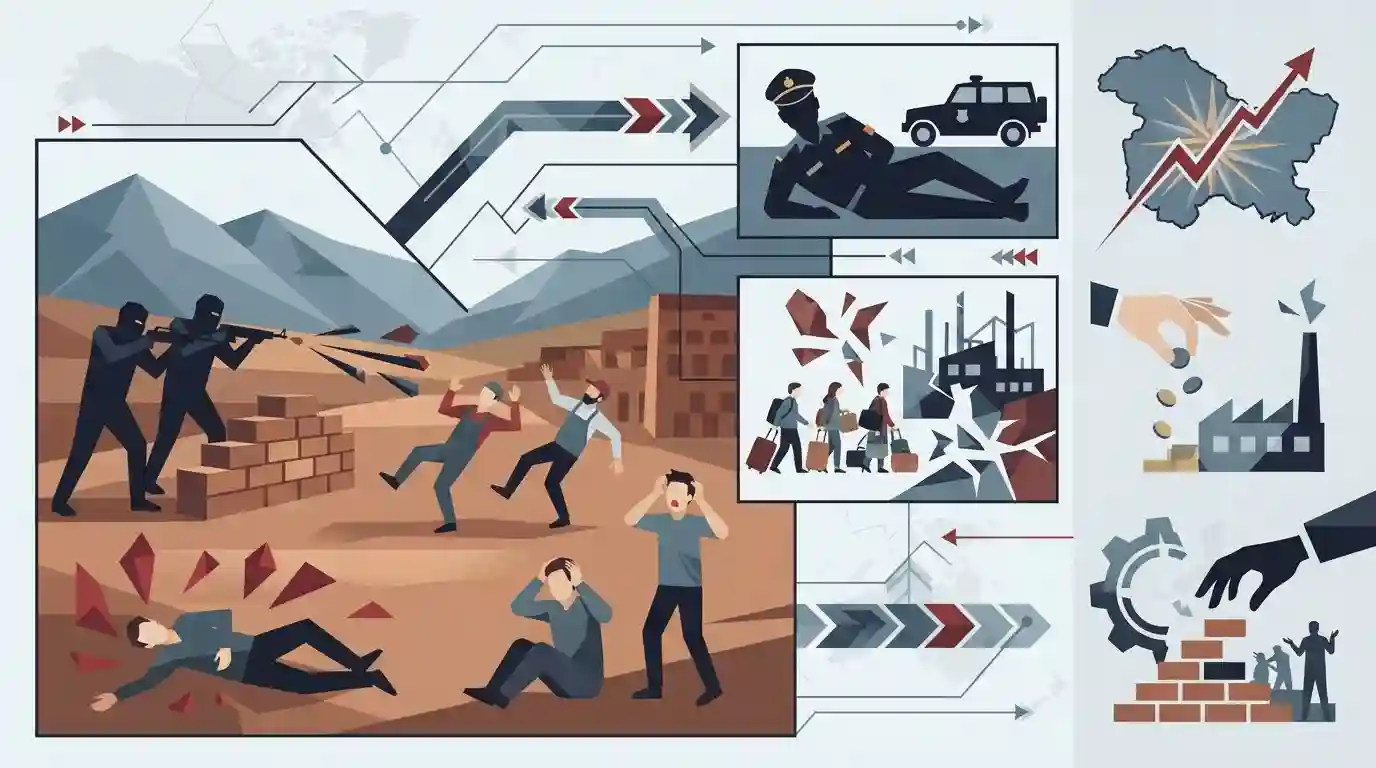
This article highlights the evolving nature of internal security threats in Jammu and Kashmir, where militants deploy asymmetrical warfare tactics against 'soft targets' (non-local labourers) to sabotage local developmental initiatives, panic the workforce, and challenge the post-Art. 370 security and economic normalisation narratives.
Summary
On July 31, 2026, suspected terrorists shot at non-local migrant labourers at a brick kiln in Kelam, Kulgam district of Jammu and Kashmir, killing one worker and injuring another. Coming shortly after the assassination of a police officer in Anantnag, this incident underscores the tactical shift of militant outfits targeting vulnerable, unarmed civilians to trigger fear and disrupt the region's socio-economic stability.
Key Points
- Suspected terrorists targeted non-local migrant labourers working at a brick kiln in Kelam, Kulgam district, J&K on July 31, 2026, leading to one fatality and one injury.
- The incident reflects a continuing security challenge in Jammu and Kashmir, where militant networks are shifting tactics to target 'soft targets' like unarmed migrant workers and minority populations.
- Such attacks aim to instill fear, create a demographic chill, and disrupt the local economy—especially sectors like construction, brick manufacturing, and agriculture that are heavily dependent on migrant labour.
- The shooting occurred within ten days of another targeted attack in which a police officer was assassinated by terrorists in nearby Anantnag town, highlighting persistent security threats in South Kashmir.
- Addressing these threats requires a robust security apparatus, localized safety grids for vulnerable workers, micro-intelligence networks, and efforts to disable the support networks of Over Ground Workers (OGWs).
Important Terms
Targeted Killings

The deliberate, politically motivated execution of specific individuals—such as minorities, security personnel, or migrant workers—by militant groups to instill terror and destabilize a region.
UPSC context
GS-3: Internal Security; analyzes tactical shifts in militant warfare targeting unarmed civilians to disrupt socio-economic normalcy.
Non-Local Migrant Labourers
Temporary, out-of-state workers employed in sectors like construction or brick kilns in Jammu and Kashmir, targeted by extremists to undermine development and regional integration.
UPSC context
GS-3: Internal Security; evaluates the link between developmental stability and extremist strategies targeting economic pillars.
Hybrid Militants
Radicalized individuals with clean police records who execute brief terrorist tasks and immediately blend back into civilian life, posing severe intelligence challenges.
UPSC context
GS-3: Internal Security; examines modern proxy warfare, counter-insurgency tactics, and the transition from structured outfits to dispersed networks.
Over Ground Workers (OGWs)
Civilian sympathizers who provide essential logistical support, safe passage, funding, and intelligence to active terrorists, keeping the militancy ecosystem operational.
UPSC context
GS-3: Internal Security; tests policies for dismantling terror funding, local support networks, and state intelligence-gathering mechanisms.
GMC Hospital, Anantnag
Government Medical College Hospital in Anantnag, a critical tertiary healthcare center in South Kashmir that serves as a primary hub for trauma care during security emergencies.
UPSC context
GS-2: Social Justice; explores healthcare infrastructure preparedness and emergency crisis management in conflict-prone border territories.
Prelims Trap
Hybrid terrorists in J&K refer to foreign-trained mercenary squads with established records in active security databases.
They are actually unlisted, self-radicalized local civilians with no prior police records who blend back into daily routines post-attack, making detection difficult.
Static Concepts Connected
What are Over Ground Workers (OGWs) and how are they legally prosecuted?
- Core Role: They act as the vital, non-combat logistics arm of terror groups, providing shelter, funds, recruitment, and local intelligence.
- Legal Framework: They are primarily prosecuted under the stringent provisions of the Unlawful Activities (Prevention) Act (UAPA), 1967.
- Security Threat: By remaining embedded within civil society without carrying weapons, they serve as the invisible force multiplier sustaining active militancy.
What is the concept of Hybrid Warfare in internal security?
- Definition: A strategy combining conventional tactics with irregular warfare, decentralized proxy cells, cyber operations, and systematic disinformation.
- Soft Targets: Focuses on unarmed civilian populations and critical infrastructure to cause maximum psychological panic and economic paralysis.
- Deniability: Utilizes localized, fluid front groups to obscure links to parent foreign organizations, bypassing international regulatory watchdogs.
Cross-Topic Patterns
Interstate migration and security dynamics
Targeted attacks on non-local labor show how demographic migration intersects with asymmetric warfare, directly threatening regional infrastructure projects, economic integration, and federal labor mobility.
Terror financing and multilateral oversight
The emergence of shadow outfits in J&K demonstrates tactical adaptation to bypass FATF scrutiny on parent state sponsors, directly linking domestic security challenges to global compliance frameworks.

Mains 2026 will likely test the structural shift from organized militant infiltration in J&K to decentralized hybrid and soft-target warfare.
Linked PYQs · 2
Linked PYQs · 2
- 2023MainsGS3
Winning of 'Hearts and Minds' in terrorism-affected areas is an essential step in restoring the trust of the population. Discuss the measures adopted by the Government in this respect as part of the conflict resolution in Jammu and Kashmir.
- 2019MainsGS3
The banning of 'Jamaat-e-Islami' in Jammu and Kashmir brought into focus the role of over-ground workers (OGWs) in assisting terrorist organizations. Examine the role played by OGWs in assisting terrorist organizations in insurgency affected areas. Discuss measures to neutralize influence of OGWs.
