J and K Police Conduct Raids Across Kashmir in Terror Module Case
Source:The Hindu ↗
Why It Matters
Highlights the evolving nature of internal security threats, such as 'white-collar terror modules,' and the role of specialized state and central intelligence agencies in countering urban terrorism and dismantling terror support networks. Relevant for GS-3 Internal Security questions on state responses to terrorism.
Summary
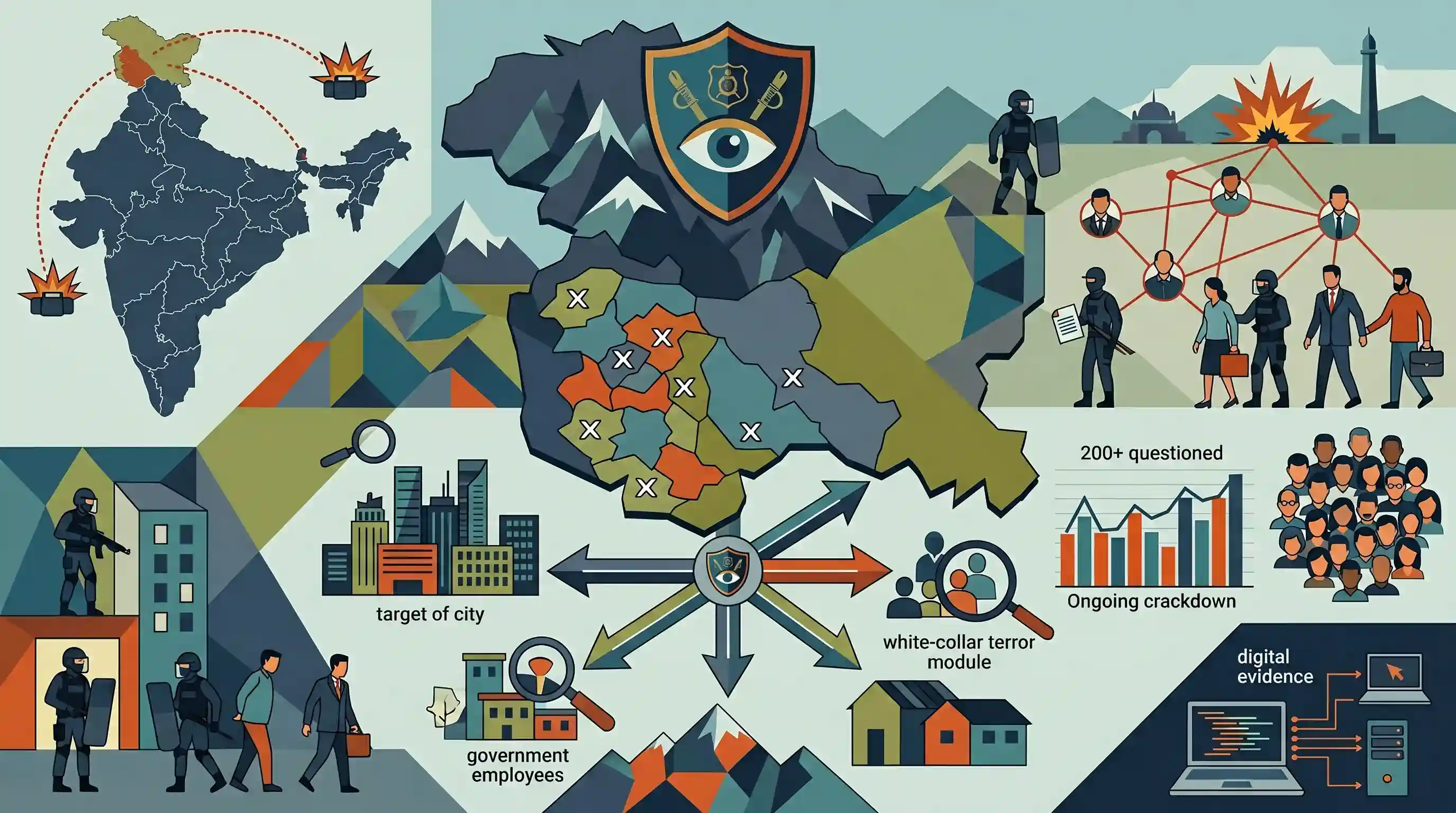
The Counter Intelligence wing of the Jammu and Kashmir Police conducted widespread raids across the Kashmir Valley, targeting a "white-collar terror module" linked to a recent deadly blast near Delhi's Red Fort. Security forces searched 13 locations and detained approximately 15 individuals, including government employees, from districts like Anantnag, Pulwama, and Kulgam. The intensified crackdown reflects ongoing efforts to dismantle the terror ecosystem, with over 200 people questioned and significant digital evidence seized.
Key Points
- The Counter Intelligence Kashmir (CIK) wing of the J&K Police raided 13 locations across the Kashmir Valley.
- The raids targeted a suspected "white-collar terror module" in connection with a recent blast near Delhi's Red Fort that resulted in 12 fatalities.
- Around 15 individuals, including three government employees, were detained for questioning during the crackdowns in Anantnag, Pulwama, and Kulgam districts.
- Security agencies have intensified their crackdown on the local "terror ecosystem," questioning over 200 people and recovering digital devices and incriminating materials.
Important Terms
Jammu and Kashmir Police (JAKP)

The primary law enforcement agency in the Union Territory, crucial for counter-insurgency due to its unique "Human Intelligence" (HUMINT) capabilities, local terrain knowledge, and community ties.
UPSC context
GS Paper III: Internal Security. Tests knowledge of the role of state police in managing cross-border terrorism and insurgency.
Counter Intelligence Kashmir (CIK)
A specialized wing of the J&K Police's Criminal Investigation Department (CID) focused on gathering intelligence and conducting operations to dismantle terror support structures and "white-collar" networks.
UPSC context
GS Paper III: Security Forces and Agencies. Relevant for understanding specialized units in counter-terrorism and intelligence-led operations.
White-collar Terror Module
A network involving radicalized, highly educated professionals (e.g., doctors, engineers) who covertly provide logistical, financial, or ideological support to terrorist organizations while maintaining regular societal roles.
UPSC context
GS Paper III: Terrorism and Radicalization. Tests understanding of evolving terror tactics and the involvement of non-traditional actors in extremism.
Terror Ecosystem
The broader support framework for terrorism, encompassing financial networks (mule accounts), logistical aid, radicalization centers, and individuals who provide shelter or information to militants.
UPSC context
GS Paper III: Internal Security. Key concept for "winning hearts and minds" and addressing the root causes of regional instability.
Overground Workers (OGWs)
Individuals who do not pick up arms but provide vital support to terrorists, such as logistics, safe houses, and intelligence on security force movements.
UPSC context
GS Paper III: Internal Security. Important for discussing the challenges of identifying covert support networks in conflict zones.
Human Intelligence (HUMINT)
Intelligence collected directly from people through observation, interviews, and community engagement; widely considered the most effective tool for local police in J&K.
UPSC context
GS Paper III: Security Forces and Agencies. Essential for evaluating the efficacy of technology versus local intelligence in counter-insurgency.
Prelims Trap
Article 311 absolutely protects civil servants from dismissal without a mandatory prior departmental inquiry.
Article 311(2)(c) explicitly empowers the President or Governor to dismiss a civil servant without a prior departmental inquiry if retaining them threatens state security.
Static Concepts Connected
What are the constitutional safeguards for civil servants and their exceptions?
- Subordinate authority ban: Under Article 311(1), no civil servant can be dismissed or removed by an authority subordinate to the one that appointed them.
- Mandatory inquiry rule: Article 311(2) mandates that no dismissal or reduction in rank can occur without an inquiry offering a reasonable opportunity of being heard.
- Security exception: An inquiry is bypassed if an employee is convicted of a crime, if inquiry is impracticable, or if the President/Governor deems it prejudicial to state security.
What is the operational role of Over Ground Workers (OGWs) in terrorism?
- Non-combatant enablers: Individuals who do not actively take up arms but provide essential logistical, financial, and ideological support to militant networks.
- Institutional shield: They utilize their institutional legitimacy (e.g., as educated professionals or state employees) to evade security radars and coordinate transnational terror networks.
- Core functions: Their activities include arranging safe houses, facilitating terror financing, radicalizing youth, and functioning as sleeper cells.
Cross-Topic Patterns
Terror networks within state machinery
The involvement of government employees in "white-collar terror modules" bridges Internal Security with Polity, specifically highlighting the friction between Article 311 constitutional safeguards and state security imperatives.
Digital footprint in UAPA investigations
Seizure of encrypted devices links cyber-forensics to cross-border terrorism, echoing past UPSC questions on the jurisdiction of Central vs. State intelligence agencies over digital data interception.

Expect a 2026 prelims question merging Article 311(2)(c) exceptions with NIA's inter-state jurisdiction on white-collar terror modules.
Linked PYQs · 3
Linked PYQs · 3
- 2023MainsGS3
What are the internal security challenges being faced by India? Give out the role of Central Intelligence and Investigative Agencies tasked to counter such threats.
- 2019MainsGS3
Indian Government has recently strengthened the anti-terrorism laws by amending the Unlawful Activities (Prevention) Act (UAPA), 1967 and the NIA Act. Analyze the changes in the context of prevailing security environment while discussing the scope and reasons for opposing the UAPA by human rights organizations.
- 2023MainsGS3
Winning of 'Hearts and Minds' in terrorism-affected areas is an essential step in restoring the trust of the population. Discuss the measures adopted by the Government in this respect as part of the conflict resolution in Jammu and Kashmir.
