Cross-Border Terror Module Busted in Punjab
Source:The Hindu ↗
Why It Matters
It provides a practical example of internal security threats stemming from cross-border terrorism and highlights the misuse of encrypted communication platforms by terror handlers, which directly maps to the GS3 syllabus on security challenges and their management in border areas.
Summary
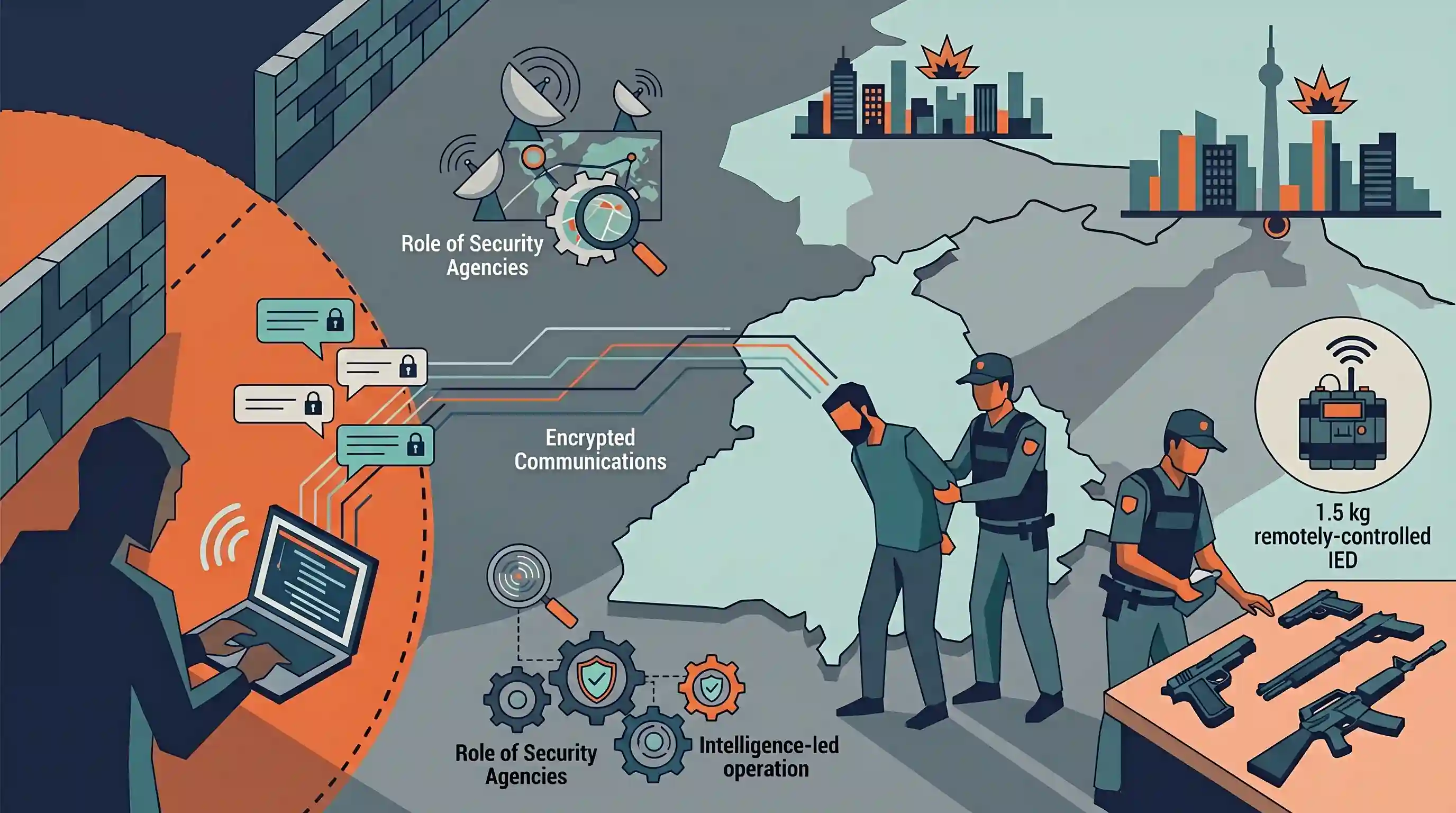
The Punjab Police, in an intelligence-led operation by the State Special Operation Cell (SSOC) Amritsar, busted a Pakistan-backed terror module, arresting one suspect and seizing a 1.5 kg remotely-controlled IED and weapons. The suspect was reportedly in touch with a Pakistan-based handler through encrypted messaging platforms and intended to carry out targeted attacks in Punjab and Delhi. This incident highlights the ongoing challenges of cross-border terrorism, border security, and the misuse of encrypted communications by terror networks.
Key Points
- The Punjab Police’s State Special Operation Cell (SSOC) thwarted a potential terror plot by busting a Pakistan-backed terror module in Amritsar.
- A 1.5 kg remotely-controlled Improvised Explosive Device (IED), a foreign-made pistol, and ammunition were recovered.
- The operation highlighted the continuing threat of cross-border terrorism and the role of Pakistan-based handlers.
- The suspect used encrypted messaging platforms to communicate with handlers, reflecting the growing challenge of modern technology in internal security.
- The recovered IED was intended for targeted attacks across multiple states, including Punjab and Delhi.
Important Terms
State Special Operation Cell (SSOC)

A specialized counter-terrorism and intelligence wing of the Punjab Police tasked with neutralizing espionage, terror modules, and high-stakes organized crime.
UPSC context
GS Paper 3: Internal Security; tests knowledge of state-level security architecture and intelligence-led policing.
Improvised Explosive Device (IED)
A home-made bomb constructed from military or commercial components, often used by non-state actors for asymmetric warfare and targeted attacks.
UPSC context
GS Paper 3: Internal Security; relevant for understanding modern terror tactics and disaster management protocols.
Cross-border Terrorism
The movement of terror operatives or materials across international frontiers to carry out violence in another country, often with foreign state backing.
UPSC context
GS Paper 3: Security challenges and their management in border areas; India-Pakistan relations.
Encrypted Communication
Digital messaging platforms that use End-to-End Encryption (E2EE) to prevent third-party access to message content, often exploited by terror networks for coordination.
UPSC context
GS Paper 3: Cyber Security; tests the challenge of balancing privacy with national security surveillance.
Border Management
The comprehensive strategy involving infrastructure, technology, and personnel to secure national frontiers against infiltration, smuggling, and hostile incursions.
UPSC context
GS Paper 3: Security challenges in border areas; tests knowledge of smart fencing and technology integration.
Prelims Trap
CIBMS is exclusively deployed along the Line of Control (LoC) to counter infiltration.
CIBMS is also heavily deployed along the International Border (IB) in states like Punjab and the India-Bangladesh border, specifically targeting unfenced and riverine gaps.
Static Concepts Connected
What is the Comprehensive Integrated Border Management System (CIBMS)?
- Tech Integration: Integrates human resources, weapons, and high-tech surveillance equipment like thermal imagers and laser-based intruder alarms.
- Target Gaps: Specifically designed to secure difficult terrains, riverine stretches, and unfenced patches where physical fencing is unviable.
- Quick Response: Feeds real-time sensor data to unified command nodes, drastically reducing the BSF's response time to infiltrations.
How does End-to-End Encryption (E2EE) challenge intelligence agencies?
- Decentralized Keys: Cryptographic keys are stored exclusively on user devices, rendering interception at the internet service provider or server level useless.
- Remote Handling: Foreign handlers can radicalize, recruit, and coordinate lone-wolf or sleeper-cell attacks in India without establishing any physical footprint.
- Legal Friction: Global tech platforms often resist India's IT Rules mandating the traceability of the 'first originator' of messages, citing global privacy policies.
Cross-Topic Patterns
Narco-Terrorism & Drone Intrusions
Cross-border IED and weapon drops increasingly utilize the same low-flying drone networks originally established for heroin smuggling from Pakistan.
Traceability vs. Right to Privacy
The state's push to intercept terror communications on platforms like WhatsApp directly tests the proportionality doctrine from the Puttaswamy judgment regarding the Right to Privacy.

Expect a Mains question evaluating the dual-threat of drone-based smuggling and encrypted messaging in sustaining cross-border terrorism.
Linked PYQs · 2
Linked PYQs · 2
- 2024MainsGS3
Social media and encrypting messaging services pose a serious security challenge. What measures have been adopted at various levels to address the security implications of social media? Also suggest any other remedies to address the problem.
- 2020MainsGS3
Analyze internal security threats and transborder crimes along Myanmar, Bangladesh and Pakistan borders including Line of Control (LoC). Also discuss the role played by various security forces in this regard.
