Supreme Court Notice to NIA on Kashmiri Separatist Bail Plea
Source:The Hindu ↗
Why It Matters
The article is relevant for Internal Security as it underscores the mechanisms used to combat terror financing, the role of central investigative agencies like the NIA, and the judicial stance on bail in cases involving national security and separatism.
Summary
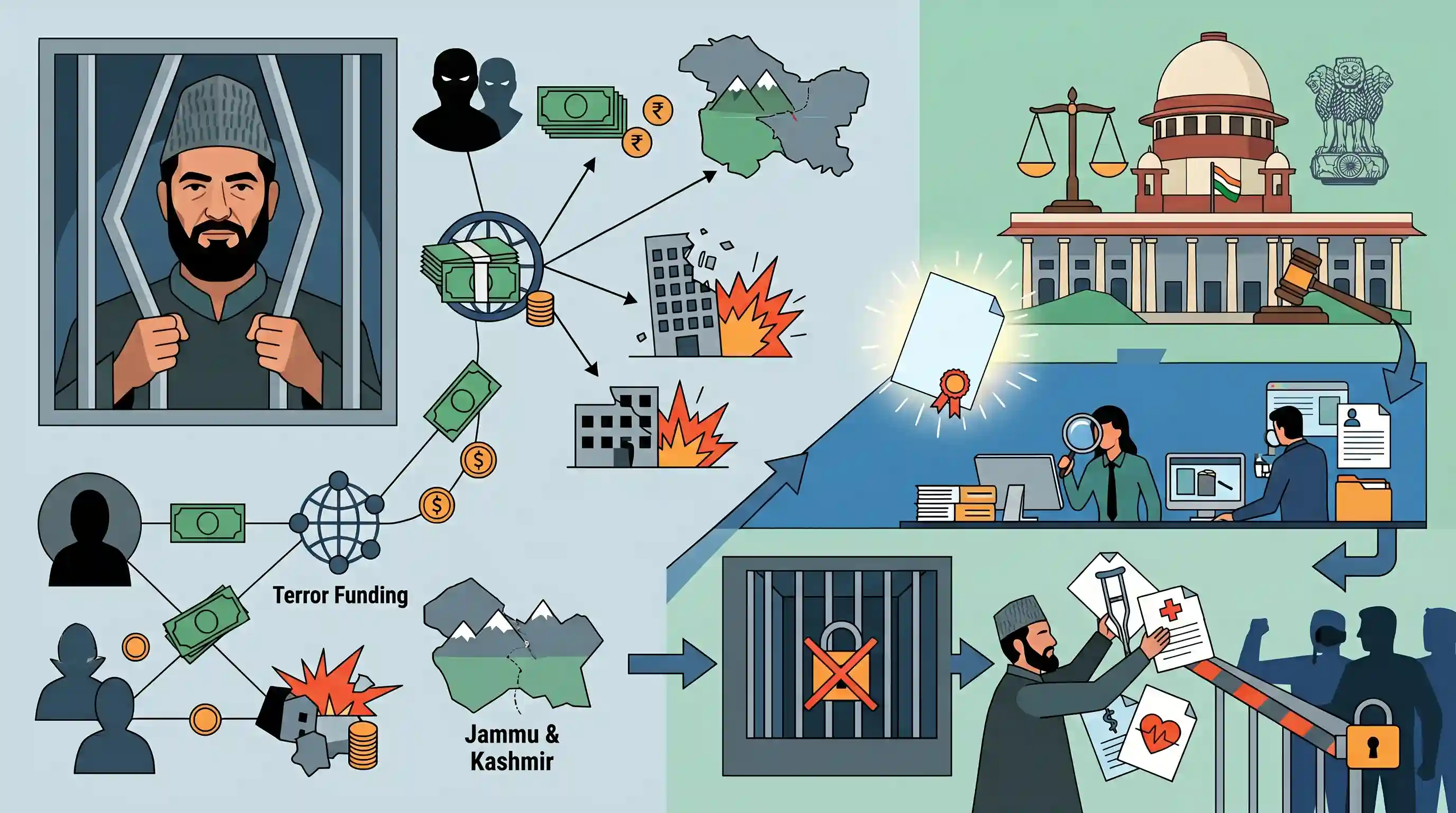
The Supreme Court has issued a notice to the National Investigation Agency (NIA) regarding a bail plea filed by Kashmiri separatist leader Shabir Ahmed Shah in a terror funding case. Shah is challenging a Delhi High Court order that denied him bail due to risks of him continuing unlawful activities. Despite his lawyer citing medical reasons, the Supreme Court refused to grant interim bail. The case, registered in 2017, involves allegations of conspiracy to raise funds for causing disruption and waging war against the Government of India.
Key Points
- The Supreme Court issued a notice to the National Investigation Agency (NIA) regarding the bail plea of Kashmiri separatist leader Shabir Ahmed Shah in a terror funding case.
- The Supreme Court declined his request for interim bail on medical grounds, despite claims of severe illness.
- Shah's plea challenged a previous Delhi High Court order that denied him bail over concerns he might resume unlawful activities or influence witnesses.
- The NIA arrested Shah in 2019 in connection with a 2017 case involving allegations of raising funds for stone-pelting, damaging public property, and conspiring to wage war against India.
Important Terms
National Investigation Agency (NIA)

India's premier federal counter-terrorism agency established under the NIA Act, 2008. It investigates and prosecutes offences affecting national security, sovereignty, and integrity across state borders without needing state permission.
UPSC context
GS Paper II (Statutory Bodies) & GS III (Internal Security). Tests knowledge of federal investigative powers and counter-terrorism architecture.
Unlawful Activities (Prevention) Act (UAPA)
India's primary anti-terror law (1967) designed to prevent 'unlawful activities' threatening sovereignty. It contains stringent bail provisions (Section 43D(5)) where the burden of proof often shifts, making bail difficult.
UPSC context
GS Paper III (Internal Security/Legal Frameworks). Tests understanding of balance between national security and individual fundamental rights.
Terror Financing
The act of providing financial support to individuals or groups to enable terrorist acts. It involves three stages—raising, moving, and using funds—and is a key focus of NIA investigations.
UPSC context
GS Paper III (Internal Security). Tests awareness of non-state actors' funding mechanisms and India's counter-measures (e.g., NMFT Conference).
Supreme Court of India
The highest judicial body in India under the Constitution (Article 124). It acts as the final court of appeal and the guardian of Fundamental Rights via writ jurisdiction.
UPSC context
GS Paper II (Polity/Judiciary). Tests knowledge of judicial oversight on executive agencies and protection of civil liberties.
Interim Bail
A temporary release granted by a court for a short, specific duration while a regular or anticipatory bail application is still being considered or decided.
UPSC context
GS Paper II (Judiciary/Criminal Law). Tests understanding of legal procedures and judicial discretion in safeguarding personal liberty (Article 21).
Prelims Trap
Bail is strictly prohibited under UAPA due to Section 43D(5).
While Section 43D(5) sets a high bar, Constitutional courts can override this and grant bail if prolonged incarceration violates Article 21 rights.
Static Concepts Connected
What are the jurisdictional powers of the National Investigation Agency (NIA)?
- Mandate: Created under the NIA Act 2008 post-26/11 to investigate offences affecting the sovereignty, security, and integrity of India.
- Suo Motu powers: Can take up cases directly from states regarding scheduled offences (e.g., UAPA, FICN, cyber terrorism) with Ministry of Home Affairs approval.
- Extra-territorial reach: Empowered by a 2019 amendment to investigate scheduled offences committed outside India involving Indian citizens or targeting Indian interests.
How do terror networks primarily finance their operations in India?
- Hawala Networks: Informal value transfer systems that bypass formal banking channels to move cross-border funds untraceably.
- Charitable Fronts: Misuse of seemingly legitimate non-governmental organizations and trusts to channel domestic and foreign donations toward subversive activities.
- Counterfeiting: Cross-border smuggling and circulation of Fake Indian Currency Notes (FICN) to destabilize the economy and fund militant operations.
Cross-Topic Patterns
UAPA's Section 43D(5) vs Article 21
The tension between stringent national security laws restricting bail and the right to a speedy trial under Article 21 is a recurrent GS2/GS3 theme.
FATF compliance and domestic enforcement
The NIA's dedicated Terror Funding and Fake Currency (TFFC) cell directly aligns with India's commitments to the FATF to systematically dismantle terrorism's financial backbone.

Expect a 2026 multi-statement Prelims question combining UAPA's strict bail conditions with the NIA's amended extra-territorial powers.
Linked PYQs · 3
Linked PYQs · 3
- 2023MainsGS3
Give out the major sources of terror funding in India and the efforts being made to curtail these sources. In the light of this, also discuss the aim and objective of the 'No Money for Terror (NMFT)' Conference recently held at New Delhi in November 2022.
- 2023MainsGS3
What are the internal security challenges being faced by India? Give out the role of Central Intelligence and Investigative Agencies tasked to counter such threats.
- 2021MainsGS3
Analyse the complexity and intensity of terrorism, its causes, linkages and obnoxious nexus. Also suggest measures required to be taken to eradicate the menace of terrorism.
