India Non Fossil Energy Capacity and Grid Storage Deficit
Source:The Hindu ↗
Why It Matters
The article provides a critical analysis of India's updated climate commitments, making it highly relevant for GS-3 questions on environmental conservation and energy infrastructure. It highlights the crucial distinction between 'installed capacity' and 'actual generation', a nuance candidates must grasp to evaluate the practical challenges of transitioning to renewable energy, such as battery storage limitations and grid integration.
Summary
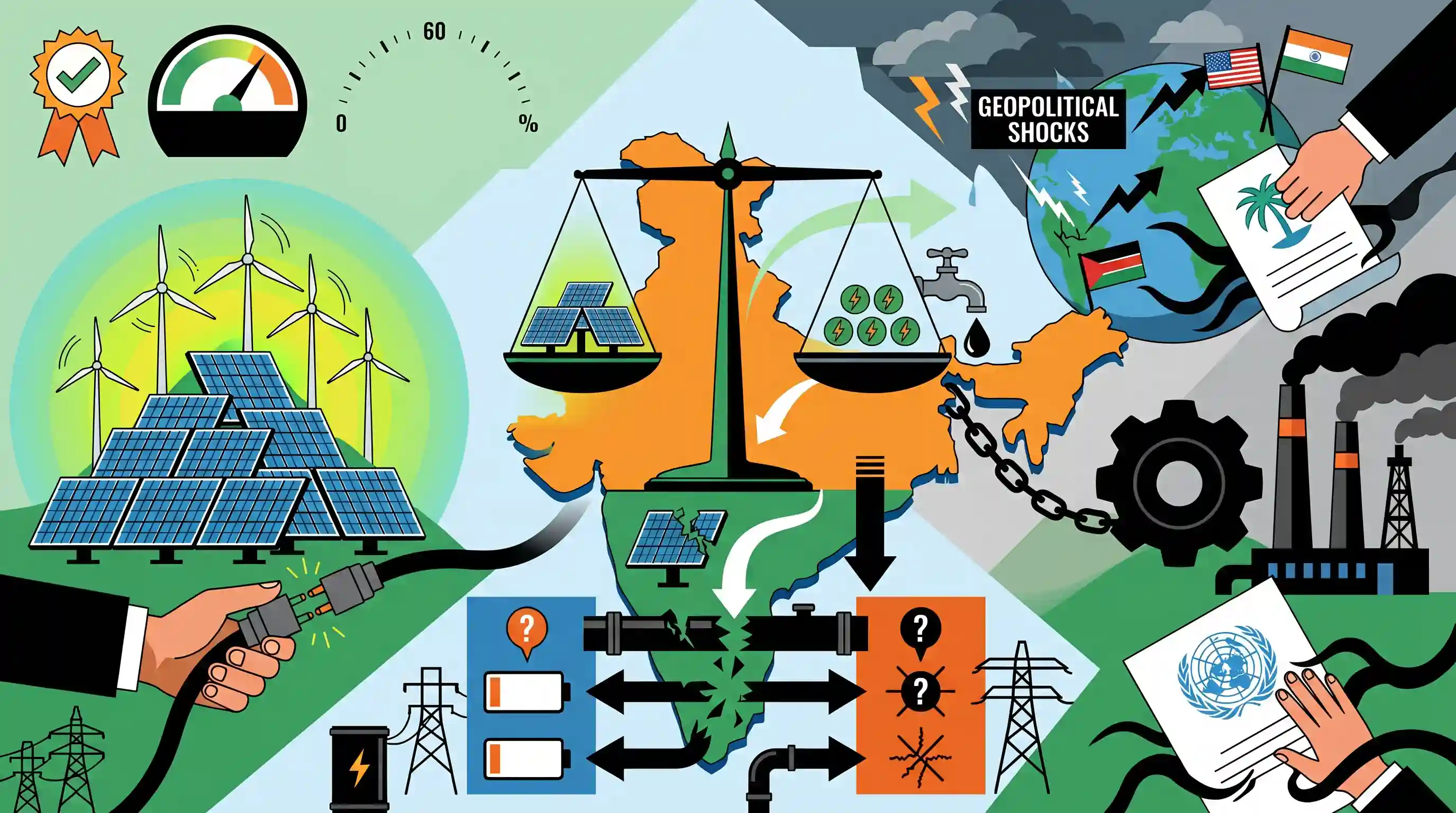
India has submitted its updated Nationally Determined Contributions (NDCs) for 2035 under the Paris Agreement, setting targets of 60% non-fossil electric capacity and a 47% reduction in emissions intensity. Despite successfully reaching its previous capacity targets early, the editorial criticizes these new promises as 'tepid' due to the stark gap between installed capacity and actual power generation. Currently, only about 25% of generated power comes from non-fossil sources, primarily because India lacks the battery storage systems and electric grid infrastructure necessary to harness intermittent solar and wind energy effectively. The piece argues that without resolving these storage and infrastructure challenges, India's energy transition remains constrained, leaving the country vulnerable to fossil fuel dependence and global geopolitical shocks.
Key Points
- India has updated its Nationally Determined Contributions (NDCs) for 2035, aiming for 60% electric capacity from non-fossil sources and a 47% reduction in emissions intensity per unit of GDP.
- The updated NDCs also pledge to create a carbon sink of 3.5 to 4 billion tonnes of CO2 equivalent by 2035.
- Although India achieved its 2030 target of 50% non-fossil capacity early (currently at 52%), actual power generated from non-fossil sources remains low at around 25%.
- The primary bottleneck in utilizing solar and wind capacity is the lack of adequate battery storage systems and grid infrastructure to manage intermittent supply.
- The Union Power Ministry's National Generation Adequacy Plan projects that 70% of the 1,121 GW capacity by 2035-36 will be non-fossil, though achieving this relies heavily on advancements in storage technology.
- Continued reliance on fossil fuels, amidst geopolitical instability in West Asia, highlights significant vulnerabilities in India's energy security and economic stability.
Important Terms
Nationally Determined Contributions (NDCs)

Voluntary national climate action plans under the Paris Agreement where countries outline targets for reducing greenhouse gas emissions and adapting to climate impacts.
UPSC context
GS Paper III (Environment). Tests understanding of India's international climate commitments and progress toward Net Zero 2070.
Paris Agreement
The 2015 legally binding international treaty aiming to limit global warming to well below 2°C, preferably 1.5°C, above pre-industrial levels.
UPSC context
GS Paper II (International Relations) and GS Paper III (Environment). Central to global climate governance and multilateralism.
Emissions Intensity
The amount of greenhouse gas emissions emitted per unit of a country's Gross Domestic Product (GDP), measuring the carbon efficiency of economic growth.
UPSC context
GS Paper III (Economy/Environment). Vital for evaluating India’s strategy of decoupling economic growth from carbon emissions.
National Generation Adequacy Plan
A strategic roadmap by the Central Electricity Authority (CEA) projecting India's power demand and required capacity mix through 2035-36 to ensure grid reliability.
UPSC context
GS Paper III (Infrastructure/Energy). Tests knowledge of domestic energy planning, resource adequacy, and renewable energy integration.
United Nations Framework Convention on Climate Change (UNFCCC)
The 1992 global framework treaty established to stabilize greenhouse gas concentrations; it acts as the parent treaty for the Paris Agreement.
UPSC context
GS Paper II (International Relations). The primary forum for international climate negotiations and reporting of NDCs.
Energy Storage Systems (ESS)
Technologies, including Battery Energy Storage Systems (BESS) and Pumped Hydro, used to store surplus electricity for use during periods of low generation.
UPSC context
GS Paper III (Science & Tech/Environment). Critical for overcoming the intermittency of renewable energy and ensuring energy security.
Prelims Trap
India's updated NDC aims to achieve 60% of its electricity generation from non-fossil fuel sources by 2035.
The 60% target applies to installed electric *capacity*, not actual electricity *generation*. Due to intermittency and low storage, actual generation runs much lower than capacity.
Static Concepts Connected
How do Nationally Determined Contributions (NDCs) work under the Paris Agreement?
- Legal Nature: NDCs are non-binding national climate action plans submitted by countries outlining their emissions reduction targets.
- Ratcheting Mechanism: Countries must update their NDCs every 5 years. Each successive submission must represent an increase in ambition (progression).
- Global Stocktake: A periodic UNFCCC review assesses collective global progress toward Paris goals, which informs the next round of NDC updates.
What are the primary energy storage technologies for grid-scale renewable integration?
- Pumped Storage Hydropower (PSH): Uses off-peak electricity to pump water to an upper reservoir, releasing it through turbines during peak demand. The most established technology.
- Battery Energy Storage Systems (BESS): Utilizes lithium-ion or solid-state batteries. Offers high efficiency and fast response times but is constrained by critical mineral supply chains.
- Grid Inertia Challenge: Unlike thermal plants, solar/wind lack large rotating masses, requiring advanced inverters and storage to maintain grid frequency stability.
Cross-Topic Patterns
Renewables + Critical Mineral supply chains
India's push for 1,121 GW capacity and battery storage requirements directly intersect with geopolitical vulnerabilities in importing lithium, cobalt, and nickel.
Energy Transition + West Asian Geopolitics
Slow transition in actual power generation maintains reliance on fossil fuels, exposing India's macro-economic stability to Middle Eastern supply and price shocks.

UPSC 2026 will likely test the distinction between installed renewable 'capacity' and actual 'generation' alongside BESS constraints.
Linked PYQs · 3
Linked PYQs · 3
- 2025MainsGS3
Write a review on India's climate commitments under the Paris Agreement (2015) and mention how these have been further strengthened in COP26 (2021). In this direction, how has the first Nationally Determined Contribution intended by India been updated in 2022?
- 2022MainsGS3
Do you think India will meet 50 percent of its energy needs from renewable energy by 2030 ? Justify your answer. How will the shift of subsidies from fossil fuels to renewables help achieve the above objective ? Explain.
- 2016PrelimsGS1
The term 'Intended Nationally Determined Contributions' is sometimes seen in the news in the context of
