Supreme Court Slams Telangana Defection Remarks Under Tenth Schedule
Source:Indian Express ↗
Why It Matters
The functioning of the Anti-Defection Law and the impartiality of the Speaker are highly recurring themes in UPSC. This current event provides critical examples for Mains GS2 answers regarding the subversion of electoral mandates, the necessity for reforms in the Tenth Schedule, and the role of the judiciary in ensuring constitutional compliance by legislative officers.
Summary
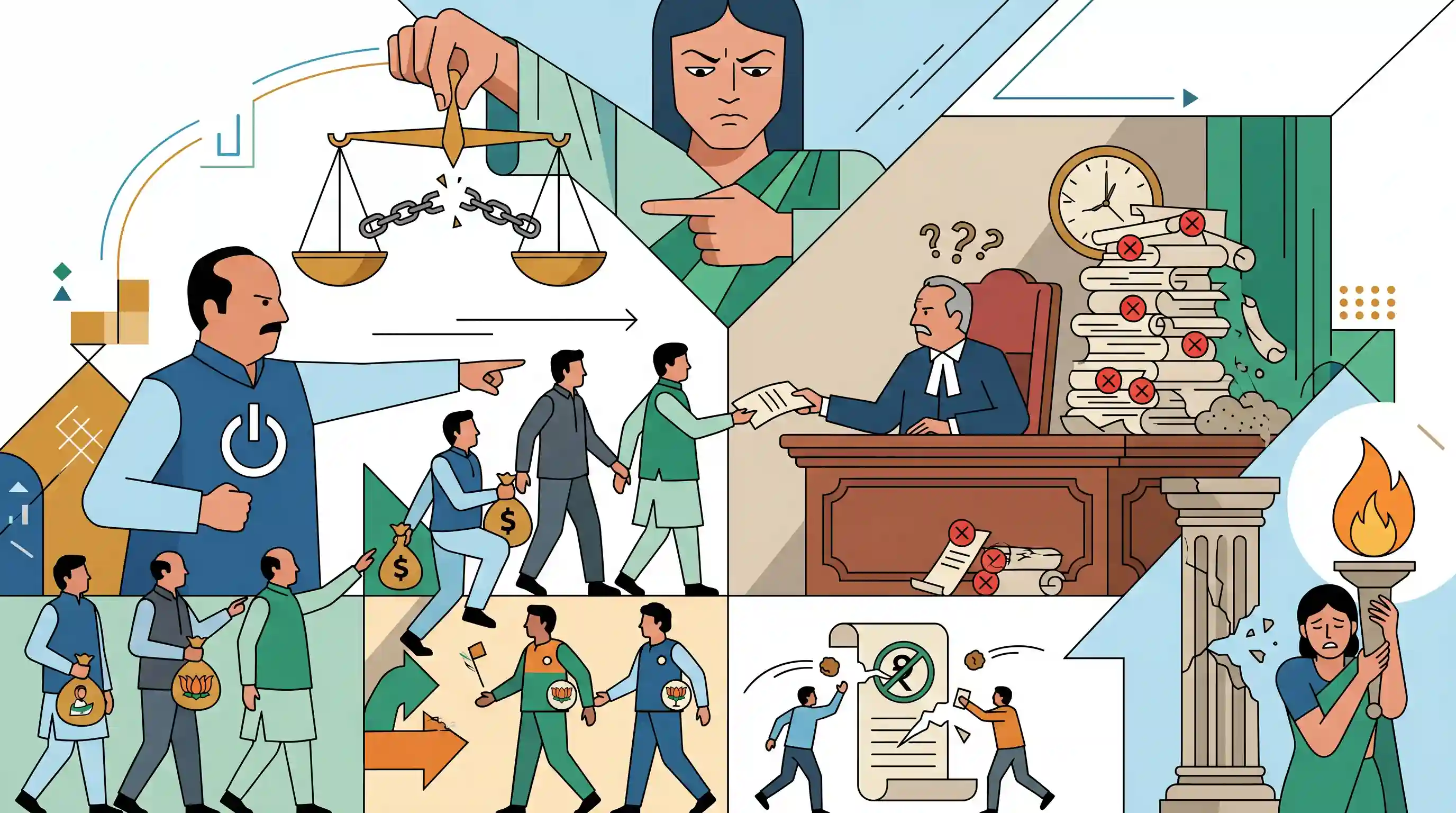
The Supreme Court of India strongly reprimanded Telangana Chief Minister Revanth Reddy for his remarks allegedly encouraging political defections, terming such conduct a 'mockery of the Tenth Schedule' (Anti-Defection Law). The bench highlighted concerns regarding constitutional functionaries publicly flaunting the defection of opposition MLAs while the Speaker of the legislative assembly delays decisions on disqualification petitions. The controversy underscores ongoing systemic issues with the enforcement of the Anti-Defection Law and the partisan role often played by the Speaker in deciding disqualification matters.
Key Points
- The Supreme Court severely criticized Telangana CM Revanth Reddy for public statements allegedly encouraging the defection of opposition MLAs.
- The Court termed the CM's remarks and the open facilitation of defections as a 'mockery of the Tenth Schedule' (Anti-Defection Law).
- The issue highlights the recurring problem of legislative Speakers indefinitely delaying decisions on disqualification petitions, allowing defectors to bypass constitutional penalties.
- The judiciary's remarks emphasize the necessity of constitutional morality and timely action by the Speaker to uphold the sanctity of electoral mandates.
Important Terms
Tenth Schedule

Added by the 52nd Amendment Act (1985), this constitutional provision details the grounds for disqualifying Members of Parliament and State Legislatures for political defection.
UPSC context
GS Paper II (Polity); essential for understanding legislative stability and constitutional amendments.
Anti-Defection Law
A legal framework intended to curb 'Aaya Ram Gaya Ram' politics by penalizing elected representatives who switch parties after being elected on a specific party ticket.
UPSC context
GS Paper II (Governance); relevant for evaluating the impact of party discipline on representative democracy.
Office of the Speaker
The presiding officer of a legislative house who acts as the primary adjudicatory authority (tribunal) for disqualification petitions under the Tenth Schedule.
UPSC context
GS Paper II (Parliament/State Legislatures); focuses on partisan behavior and the demand for independent tribunals.
Constitutional Morality
The principle of adhering to the core values and spirit of the Constitution, requiring public functionaries to act with integrity beyond literal text compliance.
UPSC context
GS Papers II and IV; tests ethical leadership and the judiciary's enforcement of democratic norms.
Kihoto Hollohan Case
The 1992 judgment where the Supreme Court ruled that the Speaker’s decision under the Tenth Schedule is subject to judicial review to prevent arbitrariness.
UPSC context
GS Paper II (Judiciary); critical case law regarding the extent of judicial intervention in legislative matters.
Judicial Review
The doctrine under which the judiciary monitors legislative and executive actions to ensure they conform to the Constitution, including addressing Speaker inaction.
UPSC context
GS Paper II (Basic Structure); tests the checks and balances between the judiciary and legislature.
Prelims Trap
The President decides questions of disqualification under the Tenth Schedule in consultation with the Election Commission.
Unlike general disqualifications (under Article 102/191) decided by the President/Governor via ECI advice, Tenth Schedule cases are exclusively decided by the Speaker/Chairman.
Static Concepts Connected
What is the scope of judicial review over the Speaker's Anti-Defection decisions?
- Tribunal Status: The Supreme Court ruled that the Speaker acts as a tribunal when deciding disqualification cases under the Tenth Schedule.
- Intervention Timing: Courts cannot intervene at the interlocutory stage; judicial review is generally only available after the Speaker makes a final decision.
- Unreasonable Delay: Courts can mandate the Speaker to decide within a specific timeframe (usually 3 months) if there is an unreasonable and partisan delay.
What constitutes 'voluntarily giving up membership' under the Tenth Schedule?
- Not Just Resignation: It is wider than formal resignation. A legislator's explicit conduct can legally infer they have given up membership.
- Inferred Conduct: Voting against the party whip, campaigning for rival candidates, or publicly opposing the party can trigger this clause.
Cross-Topic Patterns
Anti-Defection & Independent Tribunals
The SC has repeatedly suggested amending the Constitution to transfer defection cases from the Speaker to an independent permanent tribunal, aiming to eliminate partisan delays and uphold democratic mandates.
RPA vs. Tenth Schedule Disqualification
UPSC frequently tests the contrast between RPA-based disqualifications (decided by the President/Governor on ECI advice) and Tenth Schedule defection rules (decided by the Speaker alone).

Expect a 2026 Prelims question testing the interplay between 91st Amendment merger exceptions and judicial review of Speaker delays.
Linked PYQs · 3
Linked PYQs · 3
- 2025PrelimsGS1
Consider the following statements : I. If any question arises as to whether a Member of the House of the People has become subject to disqualification under the 10th Schedule, the President's decision in accordance with the opinion of the Council of Union Ministers shall be final. II. There is no mention of the word 'political party' in the Constitution of India. Which of the statements given above is/are correct?
- 2023MainsGS2
Discuss the role of Presiding Officers of state legislatures in maintaining order and impartiality in conducting legislative work and in facilitating best democratic practices.
- 2020MainsGS2
Once a Speaker, Always a Speaker' ! Do you think this practice should be adopted to impart objectivity to the office of the Speaker of Lok Sabha ? What could be its implications for the robust functioning of parliamentary business in India?
