Nihang Sikh Border Standoff Resolved through Administrative Talks
Source:The Hindu ↗
Why It Matters
This event directly highlights key geographic landmarks (Karnaprayag, Rudraprayag, Hemkund Sahib, Paonta Sahib) and cultural aspects (Nihang sect, Sikh pilgrimage) which are frequently tested in the UKPSC PCS Prelims.
Summary
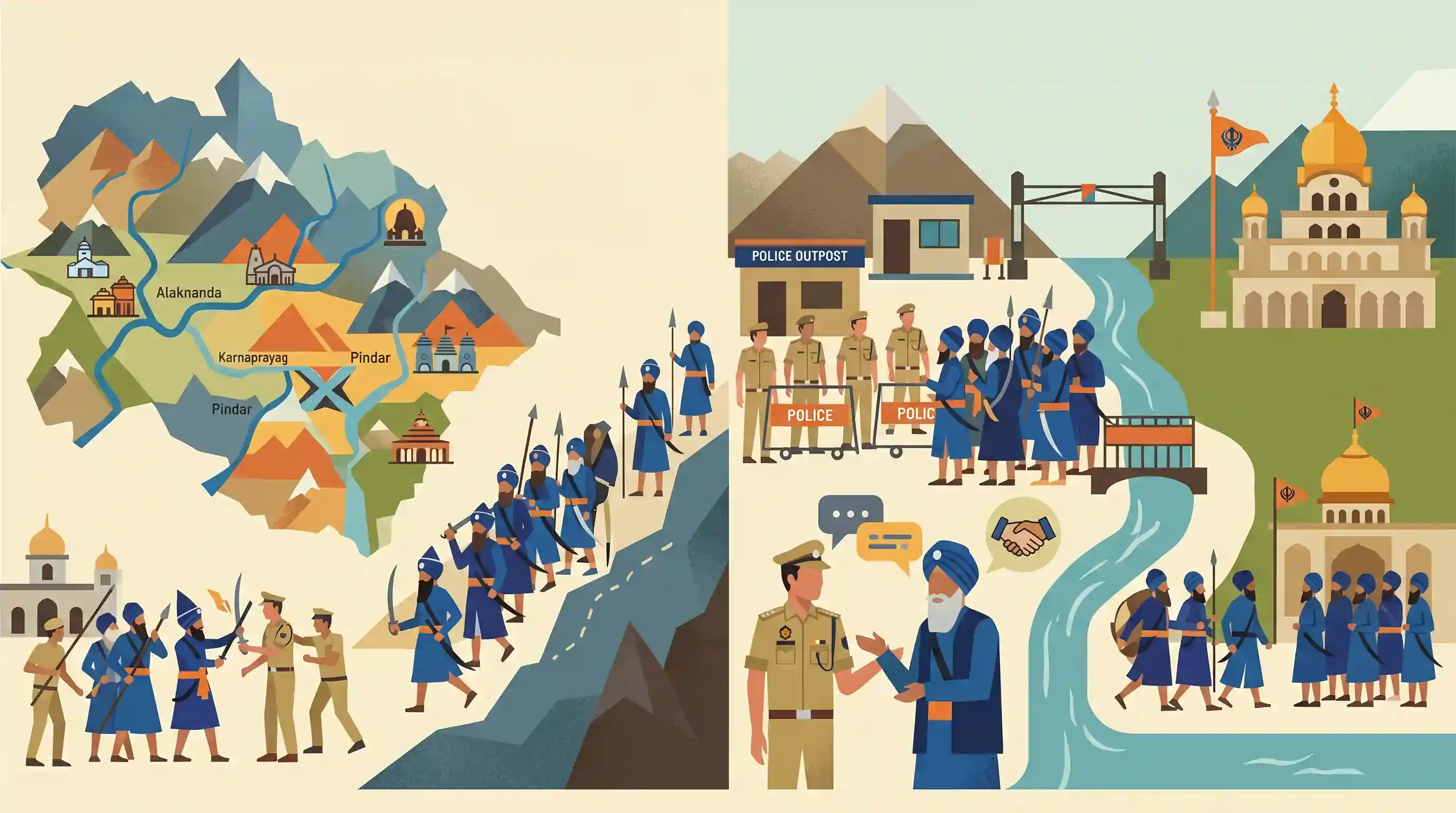
A tense standoff at the Uttarakhand-Himachal Pradesh border (Kulhal checkpoint, Vikasnagar) between armed Nihang Sikhs and the police was peacefully resolved after negotiations. The group of Nihangs, who had traveled from Punjab and Himachal Pradesh, was marching to Hemkund Sahib in protest of the arrest of four sect members following a clash in Karnaprayag (Chamoli) and a subsequent demonstration at a gurdwara in Nagrasu (Rudraprayag). Following assurances from Dehradun's senior administration and police, the group returned peacefully to Gurdwara Paonta Sahib in Himachal Pradesh.
Key Points
- A high-stakes standoff between a group of armed Nihang Sikhs and police personnel at the Kulhal checkpoint (Himachal-Uttarakhand border, Dehradun district) ended peacefully after successful talks.
- The Nihangs had breached barricades to march towards the sacred high-altitude Sikh pilgrimage site of Hemkund Sahib in Chamoli, Uttarakhand.
- The protest was triggered by the arrest of four Nihang members following a violent clash with locals in the Karnaprayag market (Chamoli) on June 16, as well as a protest incident at a gurdwara in Nagrasu (Rudraprayag).
- Under negotiations led by Dehradun SSP Pramendra Dobal, District Magistrate Ashish Chauhan, and local gurdwara representatives, the Nihang group agreed to return to Gurdwara Paonta Sahib in Sirmaur, Himachal Pradesh, resolving the standoff.
- Hemkund Sahib is a critical pilgrimage destination located at an altitude of approximately 4,329 meters in Chamoli, surrounded by the 'Sapt Shring' peaks and dedicated to Guru Gobind Singh.
- The dispute zones are deeply associated with the geography of Uttarakhand's Panch Prayags, specifically Karnaprayag (confluence of Alaknanda and Pindar rivers) and Rudraprayag (confluence of Alaknanda and Mandakini rivers).
Important Terms
Nihang Sikhs

A distinct warrior order within the Sikh community, characterized by their martial traditions, blue attire, high turbans with steel rings (chakrams), and traditional weapons. They trace their history to Guru Gobind Singh.
UPSC context
GS Paper I (Art & Culture) and GS Paper III (Internal Security); relevant for historical martial traditions and security dynamics.
Hemkund Sahib
A highly revered Sikh pilgrimage site and Gurdwara located at over 15,000 feet in Chamoli, Uttarakhand. Dedicated to Guru Gobind Singh, it is situated on a glacial lake surrounded by seven peaks.
UPSC context
GS Paper I (Art & Culture/Pilgrimage Sites) and Geography; tests knowledge of religious architecture and mountainous sacred landscapes.
Gurdwara Paonta Sahib
A prominent historical Gurdwara in Sirmaur, Himachal Pradesh, on the Yamuna's banks. Built in memory of Guru Gobind Singh, who stayed here, established a fort, and compiled the Dasam Granth.
UPSC context
GS Paper I (Art & Culture/Sikh Heritage); relevant for key Sikh historical sites and the life of Guru Gobind Singh.
Gurdwara Singh Shaheedan (Mohali)
A historic Sikh shrine in Sohana, Mohali, Punjab, commemorating martyrs of the Anglo-Sikh wars. It particularly honors Jathedar Baba Hanuman Singh Ji, the 7th leader of the Nihang Budha Dal.
UPSC context
GS Paper I (Modern Indian History); tests knowledge of Anglo-Sikh relations and regional anti-colonial movements in Punjab.
Panch Prayag
The five sacred river confluences in Uttarakhand's Garhwal Himalayas—Vishnuprayag, Nandaprayag, Karnaprayag, Rudraprayag, and Devprayag. They mark the consecutive tributaries of the Alaknanda River that form the Ganges.
UPSC context
GS Paper I (Indian Geography); frequently tested in map-based Prelims questions regarding the Ganga River system and tributaries.
Prelims Trap
The Nihang order is identified by hoisting the saffron Nishan Sahib and was founded during the lifetime of Guru Nanak.
Nihangs traditionally hoist a blue (or yellow) Nishan Sahib, not saffron, and trace their origins to the Khalsa Panth (1699) under Guru Gobind Singh.
Static Concepts Connected
What are the Panch Prayags and their respective river confluences?
- Upper Confluences: Vishnuprayag is the confluence of Alaknanda and Dhauliganga; Nandaprayag is the confluence of Alaknanda and Nandakini.
- Middle Confluences: Karnaprayag marks where Alaknanda meets Pindar; Rudraprayag is where Alaknanda meets Mandakini.
- Final Confluence: Devprayag is the final confluence where Alaknanda meets Bhagirathi to officially form the Ganga River.
What are the core historical features of the Nihang sect?
- Khalsa Origins: They trace their origins directly to the creation of the Khalsa Panth in 1699 by Guru Gobind Singh.
- Distinct Identity: Easily recognized by their blue robes, high turbans (dumala), steel quoits, and hoisting of a blue Nishan Sahib.
- Two Dals: Historically divided into the Buddha Dal (veterans based at Talwandi Sabo) and the Taruna Dal (youth based at Baba Bakala).
Cross-Topic Patterns
Public Order vs Religious Freedoms
The movement of armed groups across borders tests the balance between Article 25/26 religious rights and the State's duty to maintain public order.
Glacial Hydrology and Infrastructure
Ropeway projects near Hemkund Sahib under Parvatmala Pariyojana must navigate the extreme ecological fragility of the Alaknanda and Pindar river basins.

A single 2026 Prelims question may combine the cultural history of the Nihangs with the precise river confluences of the Panch Prayags.
Linked PYQs · 3
Linked PYQs · 3
- 2025UKPSC_PRELIMSGS1
Which of the following is the correct order of rivers from west to east in Uttarakhand?
- 2007UKPSC_PRELIMSGS1
Name the river which flows between Kedarnath | Rudra Prayag?
- 2024UKPSC_PRELIMSGS1
Select the correct pair of the river basins separated by Dudhatoli Mt. Range.
