Paddy field dispute triggers ethnic clashes in Manipur
Source:Indian Express ↗
Why It Matters
This incident serves as a crucial case study for UPSC aspirants on the complexities of internal security, the challenges of restoring peace in deeply divided societies, and the critical role of CAPFs in managing law and order amidst ethnic conflicts.
Summary
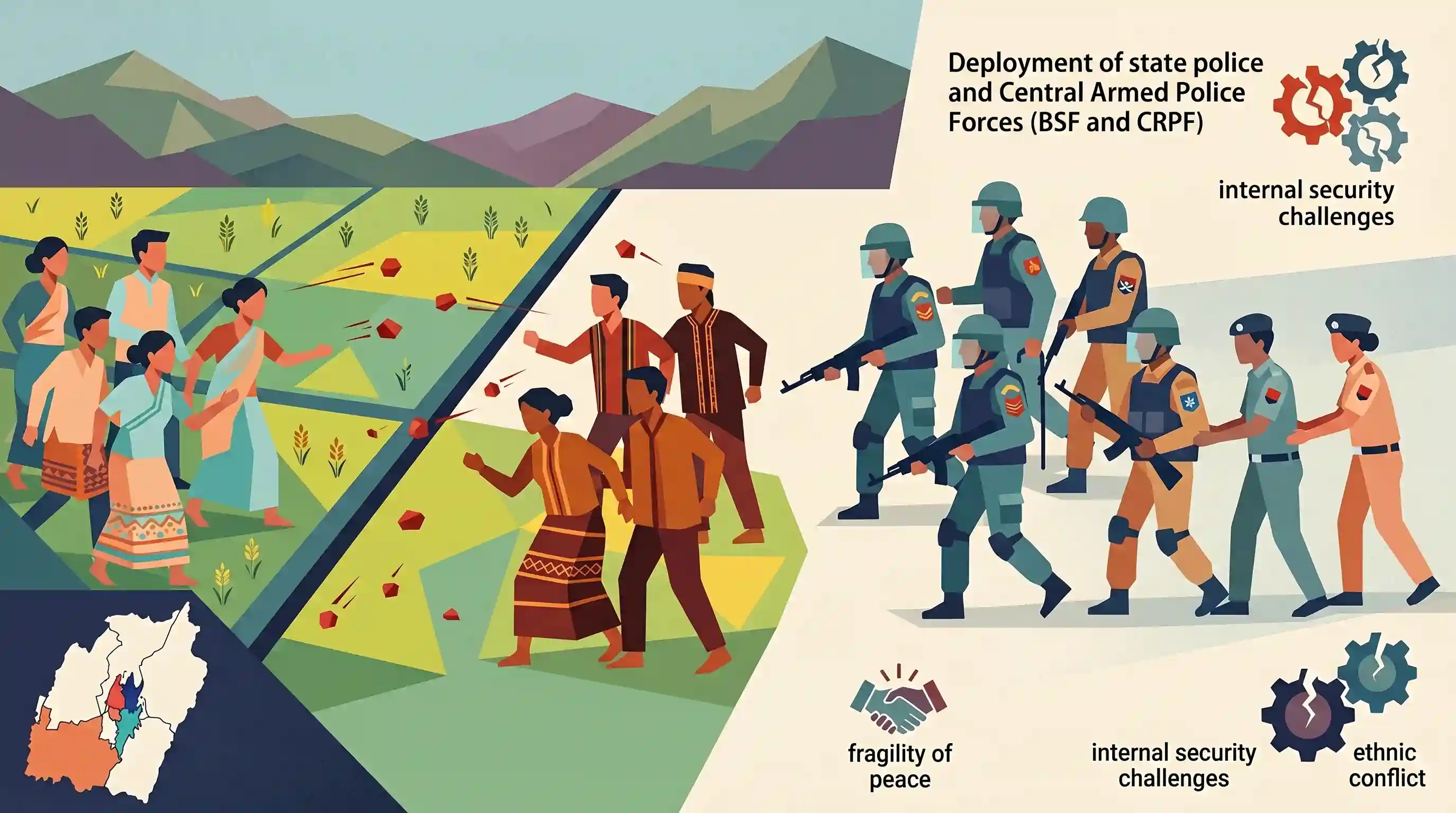
Renewed tensions erupted in Manipur’s Imphal East district following a violent clash between the Meitei and Kuki-Zo communities over a disputed paddy field. The confrontation, which involved stone-pelting, prompted the immediate deployment of state police and Central Armed Police Forces (BSF and CRPF) to restore order. The incident underscores the continued fragility of peace in the volatile border region between Meitei-dominated Imphal East and Kuki-Zo-dominated Kangpokpi since the ethnic conflict broke out in May 2023.
Key Points
- A violent clash erupted between Meitei and Kuki-Zo communities in the Pukhao Leitanpokpi area of Manipur's Imphal East district over a disputed paddy field.
- The confrontation escalated with stone-pelting and the use of catapults after Kuki villagers objected to a Meitei farmer ploughing the land.
- To prevent further escalation, additional security personnel, including state police, BSF, and CRPF, were immediately deployed to the region.
- The incident highlights the lingering volatility and deep-seated mistrust in the area, which sits on the border between the Meitei-dominated Imphal East and the Kuki-Zo-dominated Kangpokpi districts following the ethnic conflict that began in May 2023.
Important Terms
Central Armed Police Forces (CAPF)

A group of seven security forces under the Ministry of Home Affairs responsible for internal security, border guarding, and assisting states in maintaining law and order.
UPSC context
GS Paper III; tests knowledge of 'Various Security forces and agencies and their mandate'.
Central Reserve Police Force (CRPF)
India's largest Central Armed Police Force, primarily tasked with maintaining internal security, counter-insurgency operations, and assisting State/UT police in law and order duties.
UPSC context
GS Paper III; relevant for questions on managing internal disturbances, riots, and counter-insurgency in the Northeast.
Border Security Force (BSF)
A Central Armed Police Force established in 1965 to guard India’s borders with Pakistan and Bangladesh. It also performs internal security and counter-insurgency duties.
UPSC context
GS Paper III; pertains to border management and the role of central forces in state-level conflict resolution.
Meitei
The majority ethnic group in Manipur, primarily inhabiting the Imphal Valley. Their demand for Scheduled Tribe (ST) status is a central issue in the current ethnic conflict.
UPSC context
GS Papers I, II, and III; involves themes of Indian society, social justice, and internal security challenges arising from ethnic identity.
Kuki-Zo
Ethnic tribes primarily inhabiting the hill districts of Manipur. They oppose the Meitei demand for ST status due to concerns over land and reservation benefits.
UPSC context
GS Papers I, II, and III; tests understanding of tribal rights, regionalism, and socio-political dynamics of North-East India.
Internal Security
A broad UPSC topic covering challenges like insurgency, ethnic conflict, and terrorism. It involves understanding security forces' mandates and strategies for national stability.
UPSC context
GS Paper III; core syllabus area covering 'challenges to internal security' and role of state/non-state actors.
Prelims Trap
Manipur's tribal hill districts are administered under the Sixth Schedule of the Constitution.
Manipur does NOT fall under the Sixth Schedule. Instead, Article 371C creates a 'Hill Areas Committee' within the State Legislative Assembly to protect tribal interests.
Static Concepts Connected
What is the constitutional mechanism for governing Manipur's hill areas?
- Article 371C: Inserted by the 27th Amendment Act (1971), it authorizes the President to create a Hill Areas Committee for the state.
- Committee Composition: The committee strictly comprises Members of the Legislative Assembly (MLAs) elected from the designated hill areas of Manipur.
- Governor's Role: The Governor is vested with special responsibility for these areas and must submit an annual administrative report to the President.
What is the Suspension of Operations (SoO) pact in Northeast India?
- Tripartite Agreement: A 2008 tripartite ceasefire agreement between the Central Government, the Manipur State Government, and various Kuki-Zomi insurgent groups.
- Designated Camps: Insurgent cadres are confined to designated camps, and their weapons are secured in double-locked safe rooms to halt hostilities.
- Enforcement Mechanism: State police forces enforce the law of the land, while the pact's primary goal is facilitating a peaceful political dialogue.
Cross-Topic Patterns
Golden Triangle + FMR Suspension
The recent scrapping of the Free Movement Regime (FMR) with Myanmar directly links to local land disputes, as cross-border drug trafficking and alleged illegal immigration fuel demographic anxieties among valley populations.
Topography + ST Status Demand
The strict geographical divide—where 90% of land (hills) is legally protected from the valley majority—structurally drives the Meitei community's push for Scheduled Tribe (ST) status to secure hill land rights.

Expect a Prelims question differentiating Article 371C (Manipur's Hill Areas) from Sixth Schedule states (AMTM) regarding tribal autonomy.
Linked PYQs · 2
Linked PYQs · 2
- 2017MainsGS3
The North-East region of India has been infested with insurgency for a very long time. Analyze the major reasons for the survival of armed insurgency in this region.
- 2020MainsGS3
Analyze internal security threats and transborder crimes along Myanmar, Bangladesh and Pakistan borders including Line of Control (LoC). Also discuss the role played by various security forces in this regard.
