China and Japan diplomatic tensions over Taiwan security policy
Source:The Hindu ↗
Why It Matters
The shifting strategic posture of Japan regarding Taiwan and the escalating tensions with China have major implications for the security architecture of the Indo-Pacific. For UPSC aspirants, understanding this dynamic is crucial for questions related to global geopolitical alignments, maritime security, and the evolving role of the U.S.-Japan alliance in countering Chinese assertiveness.
Summary
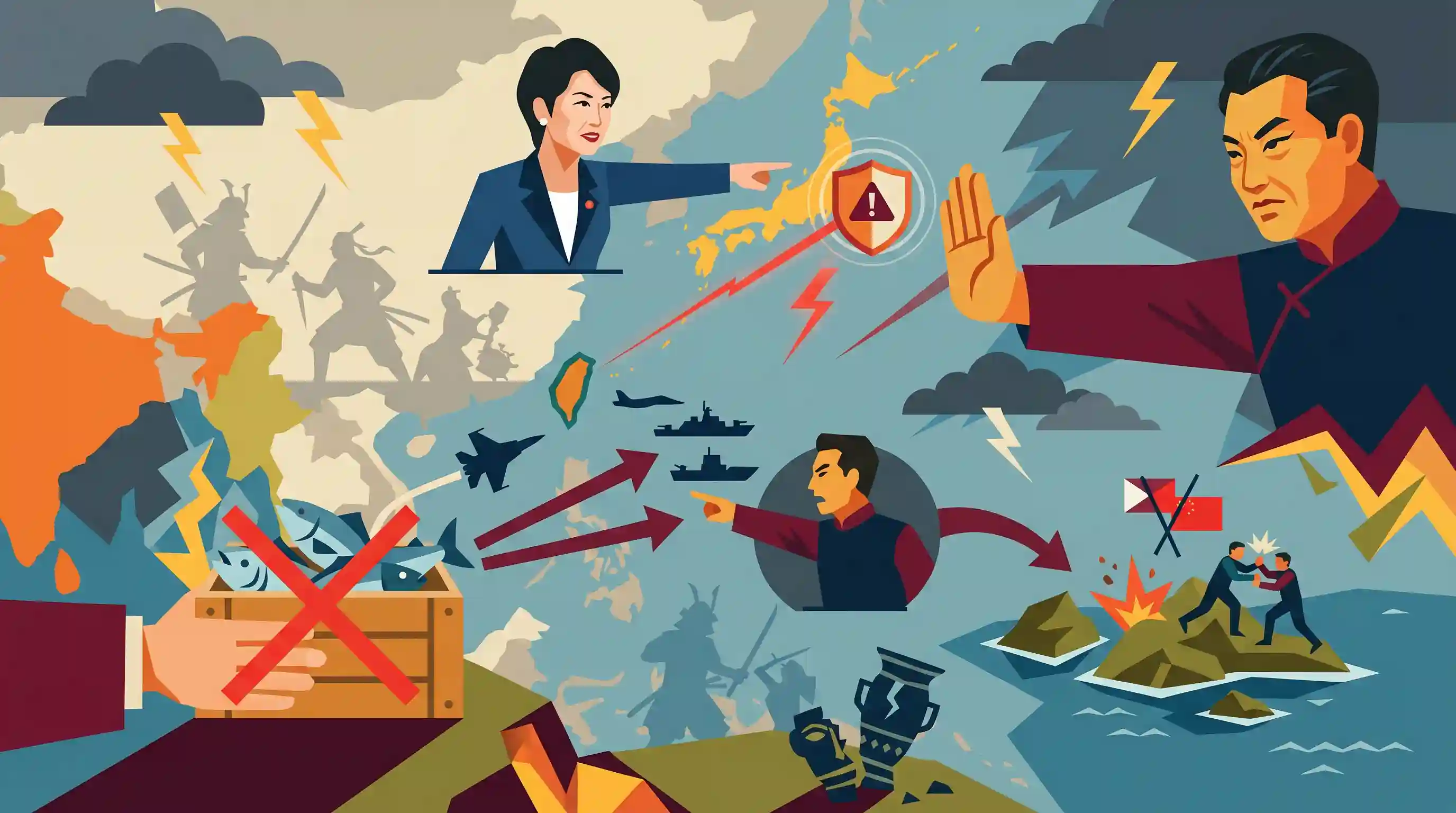
Diplomatic tensions between China and Japan have spiked following Japanese Prime Minister Sanae Takaichi's assertion that any Chinese military action against Taiwan would pose a direct threat to Japan's survival. This significant shift from Japan's traditional strategic ambiguity has drawn swift retaliation from Beijing, including a ban on Japanese seafood imports and accusations of Japanese militarization near Taiwan. The immediate friction is exacerbated by deep-seated historical animosities stemming from Japan's colonial legacy and ongoing maritime territorial disputes over the Diaoyu/Senkaku islands. The escalating rhetoric threatens the delicate status quo in the Indo-Pacific region.
Key Points
- Japanese Prime Minister Sanae Takaichi's statement that a Chinese attack on Taiwan would threaten Japan's survival has escalated diplomatic tensions between Beijing and Tokyo.
- This declaration marks a significant departure from Japan's long-held policy of strategic ambiguity regarding a potential Taiwan contingency.
- China has retaliated with economic and diplomatic measures, including a ban on Japanese seafood imports and travel advisories, while demanding a retraction.
- Tensions are compounded by historical grievances linked to Japan's colonial past (e.g., Treaty of Shimonoseki) and ongoing territorial disputes over the Diaoyu/Senkaku Islands.
- The situation highlights the fragile security architecture of the Indo-Pacific, where any disruption of the status quo could trigger broader conflict involving the U.S. and regional allies.
Important Terms
Treaty of Shimonoseki

1895 agreement ending the First Sino-Japanese War; China ceded Taiwan, the Pescadores, and Liaodong Peninsula to Japan. It remains the historical root of China's "century of humiliation" and Taiwan disputes.
UPSC context
GS1 (World History) and GS2 (International Relations); explains historical baggage fueling contemporary East Asian maritime and territorial conflicts.
U.S.-Japan security alliance
Bilateral pact (1951/1960) establishing Japan as the anchor of U.S. Indo-Pacific strategy. It commits the U.S. to defend Japan—including the Senkaku Islands—while granting the U.S. military basing rights.
UPSC context
GS2 (Bilateral/Global Groupings); vital for understanding regional power balances and the U.S. role in India's extended neighborhood.
Strategic Ambiguity
A diplomatic policy of being intentionally vague about military intervention in a China-Taiwan conflict. It aims to deter Chinese aggression while discouraging Taiwan from making a formal declaration of independence.
UPSC context
GS2 (International Relations); tests knowledge of nuanced diplomatic doctrines in the Taiwan Strait and their impact on global security.
Diaoyu/Senkaku Islands
A group of uninhabited islets in the East China Sea administered by Japan but claimed by China (as Diaoyu) and Taiwan. They are a major flashpoint due to strategic location.
UPSC context
GS2 (IR/Mapping); significant for maritime security, UNCLOS, and East Asian territorial disputes involving major powers.
Article 9 (Japanese Constitution)
Provision in Japan’s post-war constitution renouncing war and the maintenance of "war potential." Recent Japanese leadership has sought to revise or reinterpret this to allow for "collective self-defense."
UPSC context
GS2 (Comparative Constitutions/IR); essential for understanding Japan's transition toward a "normal" military state and regional security implications.
First Island Chain
A strategic defensive perimeter stretching from the Kuril Islands through Japan, Taiwan, and the Philippines. It is vital for controlling maritime access and monitoring naval expansion in the Western Pacific.
UPSC context
GS2 (International Relations/Strategic Geography); tests grasp of geopolitical containment strategies and maritime trade route security in the Indo-Pacific.
Prelims Trap
The Senkaku/Diaoyu islands are located in the South China Sea.
They are located in the East China Sea. UPSC frequently swaps adjacent marginal seas (East vs. South China Sea) in mapping pairs to test precision.
Static Concepts Connected
Where are the major disputed islands in the Western Pacific located?
- Senkaku/Diaoyu: Located in the East China Sea; a major focal point of maritime territorial disputes between Japan, China, and Taiwan.
- Kuril Islands: Located between the Sea of Okhotsk and the North Pacific Ocean; a longstanding territorial dispute between Russia and Japan.
- Spratly & Paracel: Located in the South China Sea; heavily militarized and disputed among China, Vietnam, Philippines, and other ASEAN nations.
What is Article 9 of Japan's Constitution and its regional significance?
- Renunciation of War: Article 9 of the Japanese constitution famously outlaws war as a sovereign right to settle international disputes, establishing a strictly pacifist posture.
- Collective Self-Defense: Recent constitutional re-interpretations allow Japan to defend allies if attacked, marking a shift from strict pacifism toward proactive regional security deterrence.
Cross-Topic Patterns
Economic Coercion as Statecraft
China's seafood ban mirrors past rare-earth embargoes on Japan and trade curbs on Australia, showcasing non-kinetic economic warfare to enforce geopolitical redlines.
Indo-Pacific Minilateralism & Rearmament
Japan's departure from strategic ambiguity accelerates Indo-Pacific militarization, creating deeper interoperability with the Quad and pushing Tokyo closer to AUKUS Pillar II integration.

East China Sea mapping (Senkaku/Diaoyu) or Japan's departure from Article 9 pacifism is highly probable in the 2026 Prelims IR section.
Linked PYQs · 5
Linked PYQs · 5
- 2014MainsGS2
With respect to the South China sea, maritime territorial disputes and rising tension affirm the need for safeguarding maritime security to ensure freedom of navigation and over flight throughout the region. In this context, discuss the bilateral issues between India and China.
- 2019MainsGS2
‘The time has come for India and Japan to build a strong contemporary relationship, one involving global and strategic partnership that will have a great significance for Asia and the world as a whole.’ Comment.
- 2016MainsGS1
South China Sea has assumed great geopolitical significance in the present context. Comment.
- 2020MainsGS2
What is the significance of Indo-US defence deals over Indo-Russian defence deals? Discuss with reference to stability in the Indo-Pacific region.
- 2021MainsGS2
The newly tri-nation partnership AUKUS is aimed at countering China's ambitions in the Indo-Pacific region. Is it going to supersede the existing partnerships in the region? Discuss the strength and impact of AUKUS in the present scenario.
