Systemic exclusion of tenant farmers from welfare benefits
Source:The Hindu ↗
Why It Matters
Tenant farming forms a substantial part of Indian agriculture, but the lack of formal land leasing frameworks excludes actual cultivators from government support, exacerbating agrarian distress. The article highlights the unintended exclusionary consequences of digital governance (like OTPs and land-record linking) and underscores the need for "second-generation" land reforms, making it highly relevant for GS3 Agriculture and GS2 Governance.
Summary
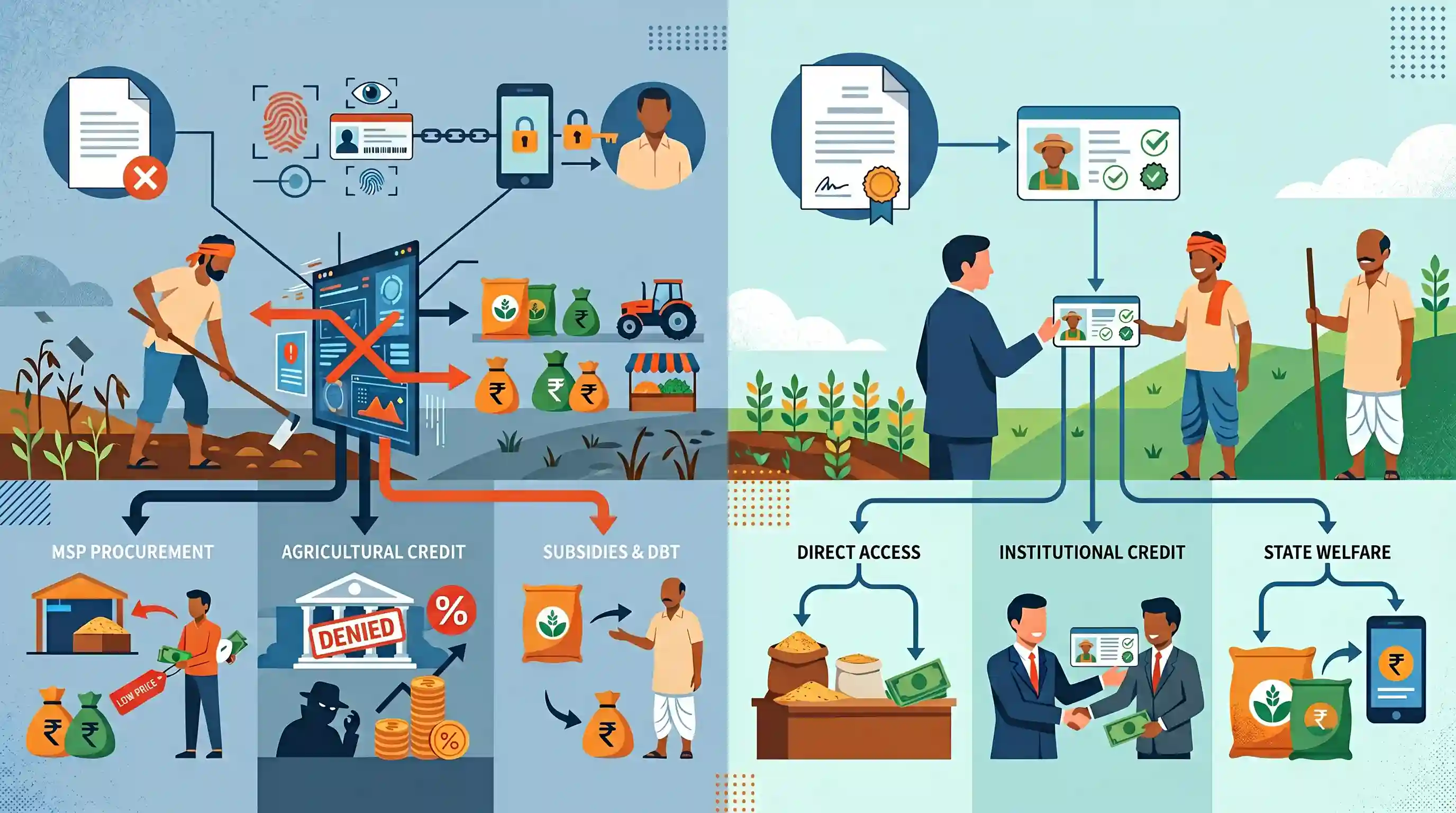
A recent study by the Kaulu Raitula Gurtimpu Sadhana Committee in Telangana sheds light on the systemic marginalization of tenant farmers, who are excluded from government agricultural support systems. Due to digital mechanisms requiring land ownership proofs, Aadhaar linkages, and OTP verifications sent exclusively to landowners, actual cultivators are unable to access Minimum Support Price (MSP) procurement, subsidized fertilizers, disaster compensation, and institutional credit. Consequently, they are forced into severe debt traps by borrowing from informal lenders at high interest rates and selling crops to middlemen at distress prices. The study advocates for the strict enforcement of the 2011 Land Licensed Cultivators Act to formally recognize tenant farmers and provide them with Loan Eligibility Cards, enabling direct access to state welfare without undermining the property rights of landowners.
Key Points
- A study by the Kaulu Raitula Gurtimpu Sadhana Committee highlights the systemic exclusion of tenant farmers in Telangana from agricultural support mechanisms.
- Tenant farmers are unable to sell their crops at Minimum Support Price (MSP) because government procurement platforms require land records, Aadhaar linkage, and landowner OTP verification.
- Subsidized fertilizers, disaster compensation, and institutional crop loans are inaccessible to tenant farmers, as benefits are digitally routed directly to landowners via DBT systems.
- Exclusion from institutional support forces tenant farmers to rely on private moneylenders at high interest rates (24-36%) and sell produce to middlemen below MSP.
- Activists demand the implementation of the 2011 Land Licensed Cultivators Act to issue identity cards to tenant farmers, ensuring their access to government schemes without affecting the landowner's title.
Important Terms
Minimum Support Price (MSP)

A floor price at which the government procures 22 mandated crops from farmers, recommended by the CACP to protect them from price crashes and ensure food security.
UPSC context
GS III: Issues related to direct/indirect farm subsidies, procurement, and agricultural price stabilization.
Direct Benefit Transfer (DBT)
A mechanism transferring government subsidies directly into beneficiaries' Aadhaar-linked bank accounts to reduce leakages, remove intermediaries, and improve transparency in welfare delivery.
UPSC context
GS III: E-technology in the aid of farmers; GS II: Welfare schemes and governance.
Land Licensed Cultivators Act, 2011
State legislation (AP/Telangana) that recognizes tenant farmers as 'Licensed Cultivators' to grant them access to state benefits without affecting the landowner's legal title.
UPSC context
GS III: Land Reforms. Tests legislative solutions to tenancy issues and credit access for landless tillers.
Loan Eligibility Card (LEC)
A formal document issued to tenant farmers under the 2011 Act, enabling them to access institutional credit, insurance, and subsidies as recognized cultivators.
UPSC context
GS III: Agricultural Credit. Significant for understanding barriers to financial inclusion for actual tillers.
Kisan Credit Card (KCC)
A credit delivery scheme launched in 1998 to provide farmers with timely, affordable, and flexible short-term loans for cultivation and post-harvest expenses.
UPSC context
GS III: Agricultural credit and institutional finance; GS II: Government schemes.
MARKFED
State-level cooperative marketing federations that serve as nodal agencies for crop procurement at MSP and the distribution of essential inputs like fertilizers.
UPSC context
GS III: Agricultural Marketing and Food Security. Tests understanding of the institutional procurement framework.
Prelims Trap
"PM-KISAN and MSP procurement systems directly benefit all active agricultural cultivators, including tenant farmers."
DBT schemes like PM-KISAN and most digital MSP platforms are tied to land ownership records (Pattadar passbooks), structurally excluding landless tenant farmers.
Static Concepts Connected
What are the key features of the Model Agricultural Land Leasing Act, 2016?
- Legalization: Legalizes land leasing in all areas to ensure complete security of land ownership right for landowners.
- Protects Owners: Removes the clause of "adverse possession" which historically made landowners hesitant to formally lease land out of fear of losing it.
- Enables Access: Facilitates tenant farmers' direct access to institutional credit, insurance, and disaster relief by recognizing them as cultivators.
What is the "interlocking of agricultural markets" in the rural economy?
- Credit-Product Link: A situation where a farmer borrows from an informal lender (middleman) on the condition that the harvested crop will be sold only to that lender.
- Distress Sales: It forces tenant farmers to sell their produce at distress, below-MSP prices, trapping them in a perpetual cycle of poverty and high-interest debt.
Cross-Topic Patterns
Digital exclusion in e-Governance
Mandating Aadhaar-linked OTPs and digitised land records for DBT creates structural "exclusion errors," denying the most vulnerable (landless tenants) their welfare rights while rewarding absentee landlords.
Unfinished land reforms and PSL credit
The lack of formal tenancy registration blocks financial inclusion, making the RBI's Priority Sector Lending (PSL) targets in agriculture heavily skewed towards propertied farmers rather than actual cultivators.

Expect a 2026 prelims question linking PM-KISAN's structural exclusion of tenant farmers with the Model Agricultural Land Leasing Act.
Linked PYQs · 5
Linked PYQs · 5
- 2021MainsGS3
How did land reforms in some parts of the country help to improve the socio-economic conditions of marginal and small farmers?
- 2024MainsGS3
What were the factors responsible for the successful implementation of land reforms in some parts of the country? Elaborate.
- 2018MainsGS3
What do you mean by Minimum Support Price (MSP)? How will MSP rescue the farmers from the low income trap?
- 2023MainsGS2
“Development and welfare schemes for the vulnerable, by its nature, are discriminatory in approach.” Do you agree? Give reasons for your answer.
- 2020PrelimsGS1
Under the Kisan Credit Card scheme, short-term credit support is given to farmers for which of the following purposes ? 1. Working capital for maintenance of farm assets 2. Purchase of combine harvesters, tractors and mini trucks 3. Consumption requirements of farm households 4. Post-harvest expenses 5. Construction of family house and setting up of village cold storage facility Select the correct answer using the code given below:
