Monsoon Subdued in Tamil Nadu Amid High Temperatures
Source:The Hindu ↗
Why It Matters
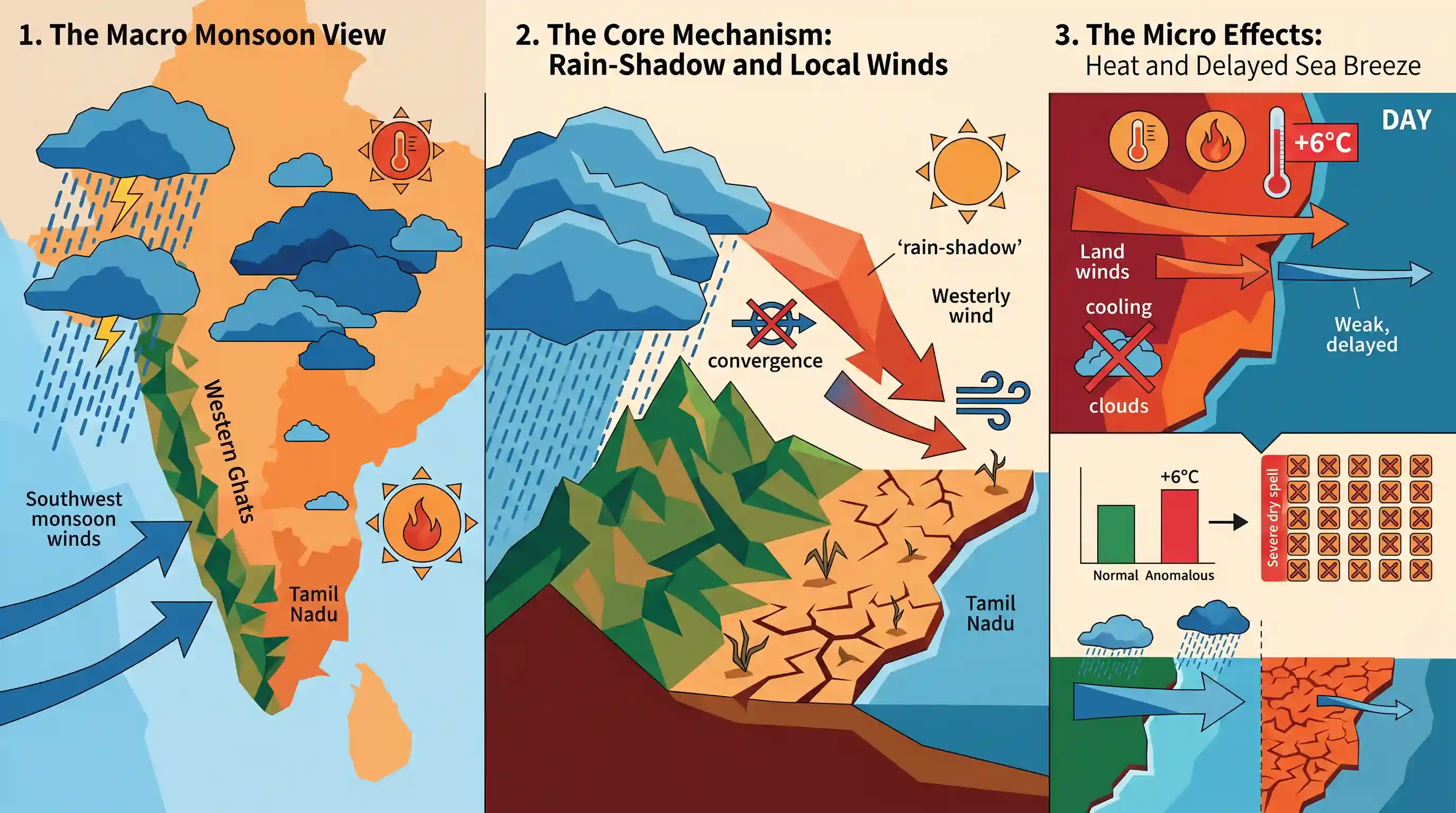
This article offers a practical, micro-level case study of Indian climatology, specifically demonstrating how large-scale monsoon wind patterns interact with localized land-sea thermal gradients (sea breeze delay) and orographic barriers (Western Ghats rain-shadow effect) to dictate coastal weather anomalies.
Summary
The article details how a subdued Southwest monsoon has triggered high daytime temperatures and dry weather across Tamil Nadu. While the monsoon remains strong in central India and the Western Ghats region, Tamil Nadu (which lies in the rain-shadow region) is experiencing elevated heat. Strong westerly land winds are suppressing wind convergence, preventing cloud formation, and delaying the onset of the cooling sea breeze along the eastern coast (including Chennai and Thondi). Consequently, coastal areas are experiencing severe dry spells and temperature anomalies of up to 6°C above normal.
Key Points
- Subdued Monsoon over Tamil Nadu: While the Southwest Monsoon is highly active across central India and windward areas of the Western Ghats (like Coimbatore and Nilgiris), Tamil Nadu's leeward plains remain largely dry and hot.
- The Rain-Shadow Mechanism: During the Southwest Monsoon (June to September), Tamil Nadu falls on the leeward side of the Western Ghats, which act as an orographic barrier blocking moisture-laden winds, resulting in a rain-shadow effect.
- Strong Westerly Winds: Strong southwesterly and westerly continental (dry) winds are prevailing over the state, preventing wind convergence and suppressing the convective cloud formation necessary for rain.
- Delayed Sea Breeze and Thermal Anomalies: The intense land-origin westerly winds delay the onset of the cooling sea breeze in coastal towns like Chennai, Thondi, and Nagapattinam, depriving these regions of afternoon relief and driving temperatures 3°C to 6°C above normal (e.g., Thondi recorded 40.7°C).
Important Terms
India Meteorological Department

The principal government agency under the Ministry of Earth Sciences responsible for meteorological observations, weather forecasting, seismology, and issuing warnings for severe weather events.
UPSC context
GS Paper I (Geography) and GS Paper III (Disaster Management). Tests institutional mandates, forecasting models, and disaster preparedness.
Southwest Monsoon
A seasonal wind system blowing from the southwest (June to September) that brings massive precipitation to the Indian subcontinent through the Arabian Sea and Bay of Bengal branches.
UPSC context
GS Paper I (Indian Geography - Climatology). Tests structural mechanism of monsoons, distribution of rainfall, and economic significance.
Rain-shadow Effect
A dry area on the leeward side of a mountain barrier. As moist air crosses the crest, it descends, warms, and dries, significantly suppressing rainfall in regions like Tamil Nadu.
UPSC context
GS Paper I (Physical Geography). Tests understanding of orographic precipitation, leeward versus windward climates, and regional drought patterns.
Sea Breeze
A local, diurnal wind that blows from the sea toward the land during the day. It is driven by pressure differences created when land heats faster than water.
UPSC context
GS Paper I (Climatology - Local Winds). Tests conceptual clarity on thermal pressure gradients, diurnal wind cycles, and coastal microclimates.
Wind Convergence
The atmospheric phenomenon where different air streams collide, forcing air to rise vertically. This upward movement causes cooling, condensation, and cloud/precipitation formation.
UPSC context
GS Paper I (Physical Geography). Tests knowledge of atmospheric dynamics, low-pressure systems, and rain-bearing mechanism structures.
Prelims Trap
Tamil Nadu remains dry during the SW monsoon solely because the Western Ghats block both the Arabian Sea and Bay of Bengal branches.
The rain-shadow effect only applies to the Arabian Sea branch. The Bay of Bengal branch does not deposit rain because it flows parallel to the Tamil Nadu coastline, not because of an orographic barrier.
Static Concepts Connected
Why is Tamil Nadu dry during the Southwest Monsoon?
- Arabian Sea Branch: The Western Ghats act as a barrier, causing air to descend and warm dryly on the leeward side.
- Parallel Coastline: The Bay of Bengal monsoonal wind flow runs parallel to the Coromandel Coast, preventing orographic precipitation.
- Convective Showers: Up to 30-40% of seasonal rain comes from local convective thunderstorms triggered by afternoon sea breezes, not monsoonal currents.
How do local land and sea breezes interact with regional winds?
- Sea Breeze Mechanism: Differential heating creates a daytime low-pressure zone over land, pulling in cooler, moist air from the sea.
- Synoptic Wind Suppression: Strong continental winds can overpower and push the sea breeze front offshore, delaying its cooling effect.
- Convergence Zone: Where the sea breeze meets dry land winds, localized wind convergence triggers convective cloud formation and rain.
Cross-Topic Patterns
Urban Heat Islands vs Coastal Microclimates
How high urban concrete density in coastal metros like Chennai compounds the delayed sea-breeze effect, turning a local wind anomaly into a severe public health hazard.
Rain-shadow Agrarian Stress
Tamil Nadu's reliance on the Northeast Monsoon makes its dry sowing season vulnerable to Southwest Monsoon anomalies, accelerating deep groundwater extraction.

UPSC may test the dual physical mechanisms of Tamil Nadu's dry SW monsoon: the Western Ghats rain-shadow vs parallel Bay of Bengal winds.
Linked PYQs · 3
Linked PYQs · 3
- 2014PrelimsGS1
The seasonal reversal of winds is the typical characteristic of
- 2012PrelimsGS1
Consider the following statements: 1. The duration of the monsoon decreases from southern India to northern India. 2. The amount of annual rainfall in the northern plains of India decreases from east to west. Which of the statements given above is/are correct?
- 2026PrelimsGS1
With reference to the climate of Andaman and Nicobar Islands, which of the following statements is/are correct ? 1. The climate can be defined as a humid, tropical coastal climate. 2. It receives rainfall from both South-west monsoon and North-east monsoon. 3. Maximum precipitation is between December and May. Select the answer using the code given below :
