Delhi High Court Reviews Legality of Telegram Ban for Exam Security
Source:The Hindu ↗
Why It Matters
This article serves as a perfect case study for the GS3 topic on the role of social media and messaging services in internal security challenges. It highlights the technical difficulties law enforcement faces with platforms offering anonymity, bots, and cloud infrastructure, while simultaneously touching upon the GS2 debate regarding the proportionality of state censorship (Section 69A of the IT Act) and fundamental rights.
Summary
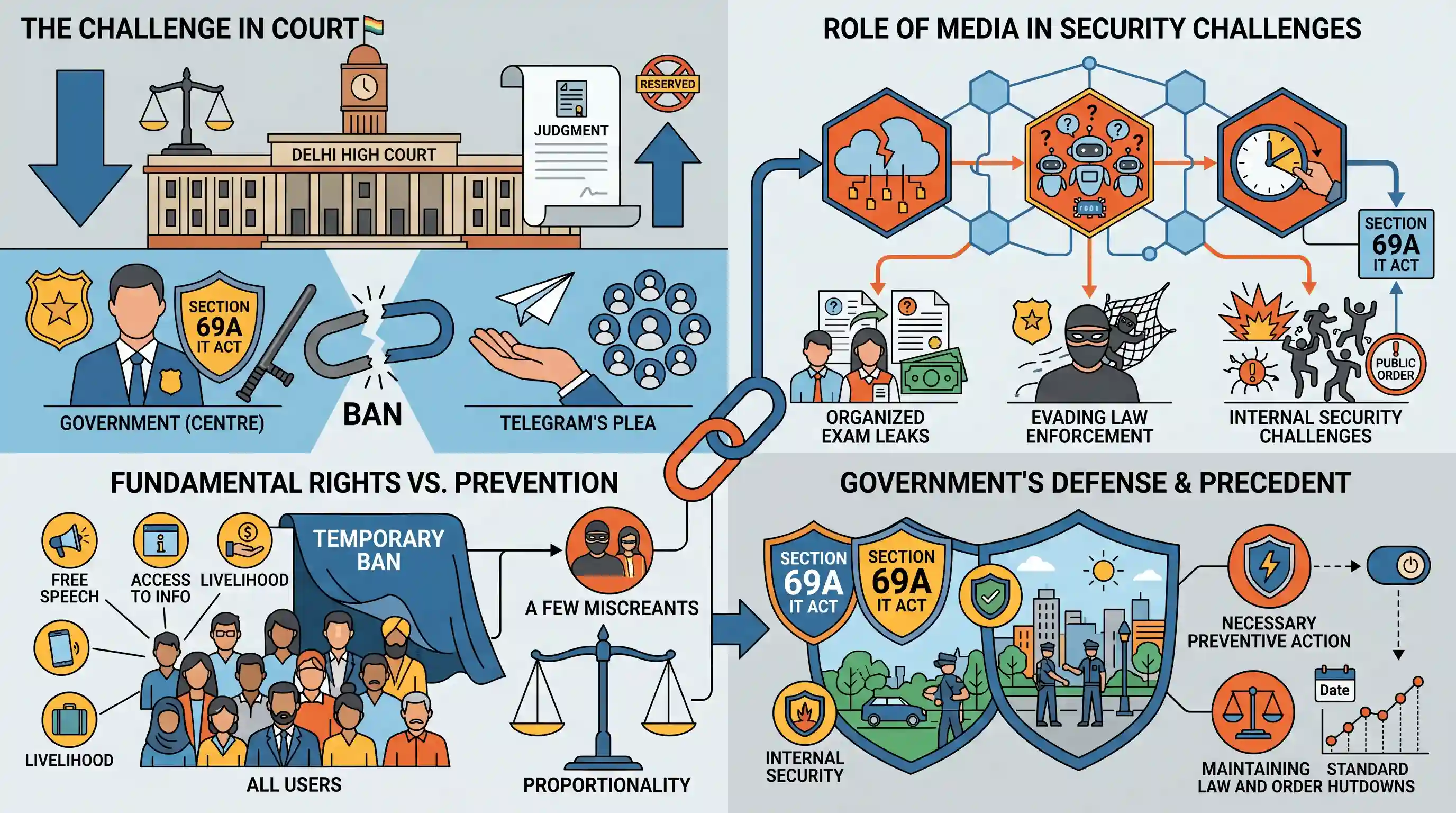
The Delhi High Court has reserved judgment on Telegram's plea challenging a temporary ban imposed by the Centre under Section 69A of the IT Act ahead of the NEET-UG re-examination. The government justified the restriction by citing Telegram's structural vulnerabilities—such as its cloud-based infrastructure, unrestricted bot creation, and the ability to edit message timestamps—which have been exploited to organize exam leaks and evade law enforcement. While the court scrutinized the proportionality of restricting all users' rights to stop a few miscreants, government law officers defended the move as a necessary preventive action for maintaining law and order, likening it to standard internet shutdowns.
Key Points
- The Ministry of Electronics and Information Technology (MeitY) invoked Section 69A of the IT Act to temporarily suspend Telegram ahead of the NEET-UG re-examination.
- The Centre argued that Telegram's architecture, including its cloud infrastructure and mass bot creation capabilities, makes it difficult to track offenders and facilitates organized misuse.
- Telegram's feature allowing users to edit message timestamps was allegedly exploited to create fake evidence of paper leaks.
- The Delhi High Court questioned the proportionality of a blanket ban, asking whether the rights of all users should be curtailed due to the misuse by a small fraction of individuals.
- The government defended the restriction as a necessary preventive measure to maintain law and order, drawing parallels to general internet shutdowns.
Important Terms
Section 69A of the IT Act

A provision empowering the Central Government to block public access to online information in the interests of national sovereignty, integrity, defense, security, friendly foreign relations, or public order.
UPSC context
GS II (Governance/Polity) and GS III (Cyber Security). Tests understanding of executive power vs. digital rights.
Doctrine of Proportionality
A judicial principle requiring that state actions restricting fundamental rights must have a legitimate aim, be necessary, and use the least restrictive means possible to achieve that objective.
UPSC context
GS II (Judiciary). Key concept for assessing the constitutionality of government restrictions on civil liberties.
Ministry of Electronics and Information Technology (MeitY)
The nodal executive agency responsible for IT policy, electronic governance, and the enforcement of the Information Technology Act, including issuing formal blocking orders.
UPSC context
GS II (Governance). Relevant for questions on institutional frameworks for digital regulation.
Information Technology Act, 2000
India's primary legal framework for electronic commerce, digital signatures, and cybercrime prevention, enacted to provide legal recognition to electronic transactions and records.
UPSC context
GS III (Internal Security/Science & Tech). Core legislation for managing India's digital ecosystem.
Intermediary
An entity that receives, stores, or transmits electronic records on behalf of others, including internet service providers, social media platforms, and messaging apps.
UPSC context
GS III (Internal Security). Focuses on the role and liability of platforms in spreading misinformation or illegal content.
Shreya Singhal v. Union of India
A landmark 2015 Supreme Court ruling that struck down Section 66A of the IT Act for violating free speech but upheld Section 69A's validity.
UPSC context
GS II (Polity/Judiciary). Essential case law regarding Article 19(1)(a) and digital expression.
Prelims Trap
"Section 69A of the IT Act allows the government to block digital platforms to prevent any general criminal activity or cheating."
Section 69A is restricted to specific grounds like 'public order' or 'security of the State'. Preventing general crimes or cheating does not automatically qualify unless it disrupts public order.
Static Concepts Connected
What are the constitutional and legal grounds for blocking content under Section 69A?
- Sovereignty & Security: Protecting the sovereignty, integrity, and defense of India.
- Foreign Relations: Maintaining friendly relations with foreign States.
- Public Order: Preventing incitement to any cognizable offense linked to public order or the above grounds.
What are the four prongs of the Doctrine of Proportionality (Puttaswamy test)?
- Legitimate Action: The state restriction on a right must be backed by a valid law.
- Legitimate Goal: The objective of the restriction must serve a legitimate state aim.
- Necessity: The measure must be the least restrictive alternative available to achieve the goal.
- Balancing: The impact on fundamental rights must be proportionate to the public benefit.
Cross-Topic Patterns
Cyber Security & Exam Integrity
The use of Telegram bots and editable timestamps to fabricate leaks links syllabus areas of internal security (cyber threats) to governance (Public Examinations Act 2024).
Free Speech vs. Platform Bans
Treating targeted app suspensions as equivalent to general internet shutdowns invites the Anuradha Bhasin framework, linking digital fundamental rights directly to state security measures.

Expect a Prelims question testing the explicit grounds of Section 69A against the Anuradha Bhasin guidelines for internet suspensions.
Linked PYQs · 2
Linked PYQs · 2
- 2024MainsGS3
Social media and encrypting messaging services pose a serious security challenge. What measures have been adopted at various levels to address the security implications of social media? Also suggest any other remedies to address the problem.
- 2020MainsGS3
Discuss different types of cyber crimes and measures required to be taken to fight the menace.
