Telegram blocked in India over NEET paper leak security concerns
Source:Indian Express ↗
Why It Matters
This development is highly relevant for UPSC candidates as it touches upon multiple syllabus areas: the governance of public examinations (like the recent Public Examination Prevention of Unfair Means Act), the role and regulation of encrypted social media platforms, and internal security challenges posed by information technology. It illustrates practical administrative steps taken to ensure transparency and fairness in national-level assessments.
Summary
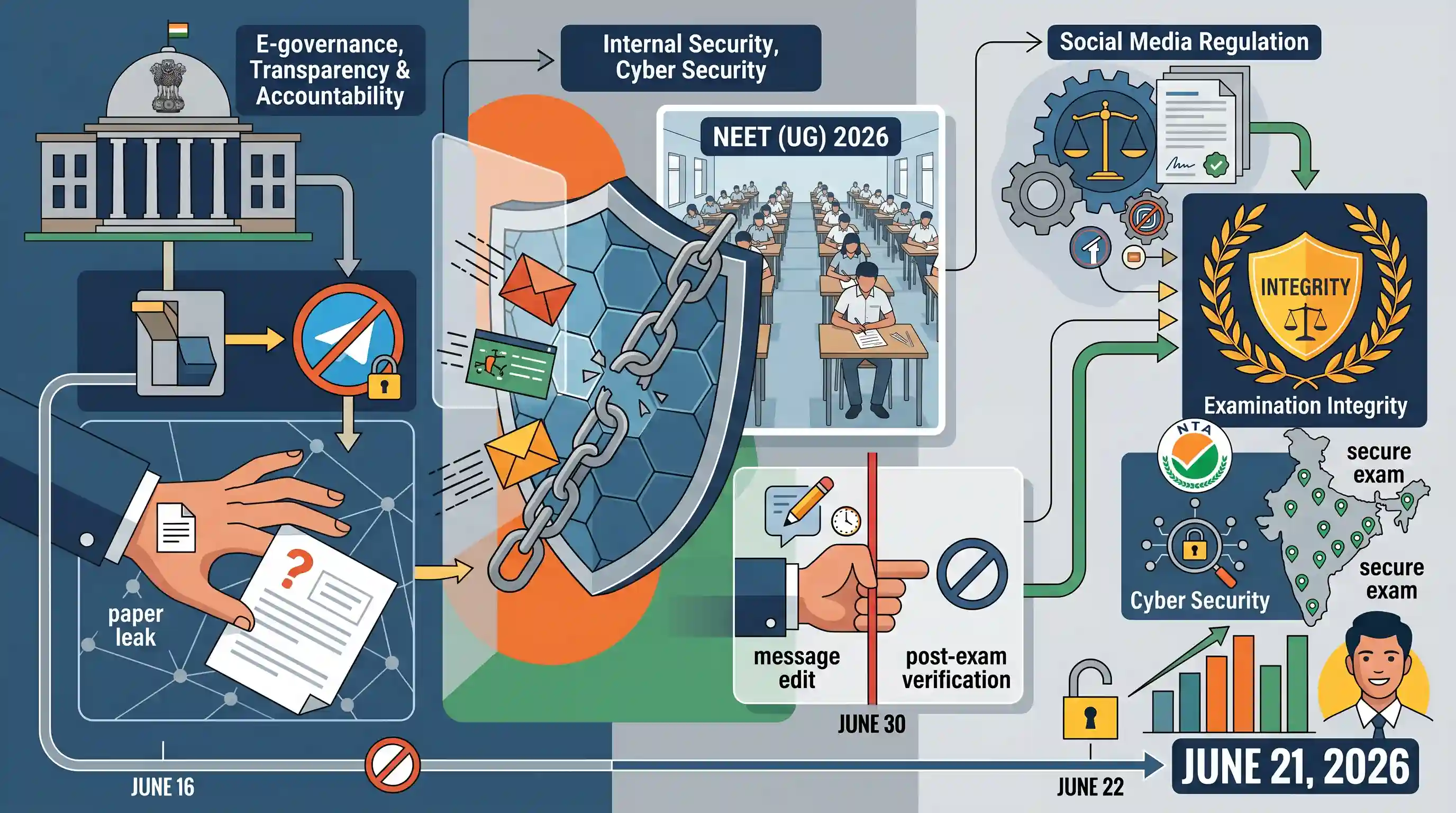
The Ministry of Electronics and Information Technology (MeitY) has temporarily restricted access to the Telegram messaging app in India until June 22, 2026. This preemptive measure was taken to address security concerns and mitigate the risk of paper leaks ahead of the NEET (UG) 2026 re-examination scheduled for June 21. The National Testing Agency (NTA) has supported the decision, underscoring the ongoing governance challenge of maintaining examination integrity against the misuse of encrypted social media platforms.
Key Points
- The Ministry of Electronics and Information Technology (MeitY) has temporarily blocked the Telegram app in India until June 22, 2026.
- The restriction was imposed to address security concerns and prevent paper leaks ahead of the NEET (UG) 2026 re-examination scheduled for June 21.
- The National Testing Agency (NTA), responsible for conducting the exam, has welcomed the preemptive measure.
- The incident highlights ongoing challenges in examination governance and the misuse of encrypted messaging applications for unfair practices.
Important Terms
National Testing Agency (NTA)

An autonomous premier testing organization under the Ministry of Education, mandated to conduct standardized, transparent entrance examinations for admissions and fellowships in higher educational institutions.
UPSC context
GS Paper 2 (Education, Governance). Tests understanding of administrative reforms and transparency in high-stakes public examinations.
Ministry of Electronics and Information Technology (MeitY)
The nodal ministry of the Government of India responsible for IT policy, digital governance, cybersecurity, and promoting the electronics and software industries.
UPSC context
GS Paper 2 (Regulatory Bodies) and GS Paper 3 (Cyber Security). Key for digital sovereignty and e-governance policies.
Section 69A of the IT Act, 2000
A provision in the Information Technology Act empowering the government to block public access to any internet content in the interest of national sovereignty, security, or public order.
UPSC context
GS Paper 2 (Fundamental Rights) and GS Paper 3 (Internal Security). Tests the balance between state security and digital freedom.
Social Media Intermediary
Entities that facilitate the exchange of information between users. Platforms with over 5 million Indian users are "Significant Social Media Intermediaries" (SSMIs) and must follow stricter IT Rules.
UPSC context
GS Paper 3 (Internal Security). Relevant for issues of platform accountability, misinformation, and the IT Rules, 2021.
Information Technology Act, 2000
The primary Indian legislation governing e-commerce and cybercrime, providing legal recognition for electronic records and establishing the regulatory framework for digital activities and intermediary liability.
UPSC context
GS Paper 3 (Cyber Security/Internal Security). The foundation of India's cyber law and digital governance framework.
Prelims Trap
The Public Examination (Prevention of Unfair Means) Act, 2024, penalizes paper leaks across all central, university, and state board examinations.
The 2024 Act strictly applies only to designated Central authorities (UPSC, SSC, RRBs, NTA). State board and university exams remain under state jurisdiction.
Static Concepts Connected
What are the grounds for blocking online access under Section 69A of the IT Act?
- State Security: Sovereignty and integrity of India, defense of India, and the security of the State.
- Public Order: Maintaining public order and friendly relations with foreign States.
- Offense Incitement: Preventing incitement to the commission of any cognizable offense relating to the aforementioned grounds.
What is the organizational and legal structure of the National Testing Agency (NTA)?
- Legal Status: Registered as an autonomous and self-sustained testing organization under the Indian Societies Registration Act, 1860.
- Nodal Ministry: Operates under the Department of Higher Education, Ministry of Education, Government of India.
Cross-Topic Patterns
Encryption vs Law Enforcement
Blocking Telegram highlights a core Internal Security tension: end-to-end encryption protecting user privacy versus the state's mandate to intercept organized syndicates exploiting anonymous networks for crimes.
Evolution of specialized penal statutes
The Public Examination Act 2024 marks a governance shift from general penal provisions (IPC/BNS) to specialized legislation targeting organized cheating networks with severe corporate and individual liabilities.

Expect a Prelims question testing the exact grounds of IT Act Section 69A alongside the jurisdictional limits of the 2024 Public Exam Act.
Linked PYQs · 3
Linked PYQs · 3
- 2024MainsGS3
Social media and encrypting messaging services pose a serious security challenge. What measures have been adopted at various levels to address the security implications of social media? Also suggest any other remedies to address the problem.
- 2016MainsGS3
Use of Internet and social media by non-state actors for subversive activities is a major security concern. How have these been misused in the recent past? Suggest effective guidelines to curb the above threat.
- 2024MainsGS2
What are the aims and objects of recently passed and enforced, The Public Examination (Prevention of Unfair Means) Act, 2024? Whether University/State Education Board examinations, too, are covered under the Act ?
