Telecom Operators Mandated to Display KYC Name on Incoming Calls
Source:The Hindu ↗
কেন এটি গুরুত্বপূর্ণ
This regulatory measure directly addresses the escalating menace of digital and telecom cyber frauds in India, balancing consumer protection, security governance, and privacy concerns in digital communications.
সারসংক্ষেপ
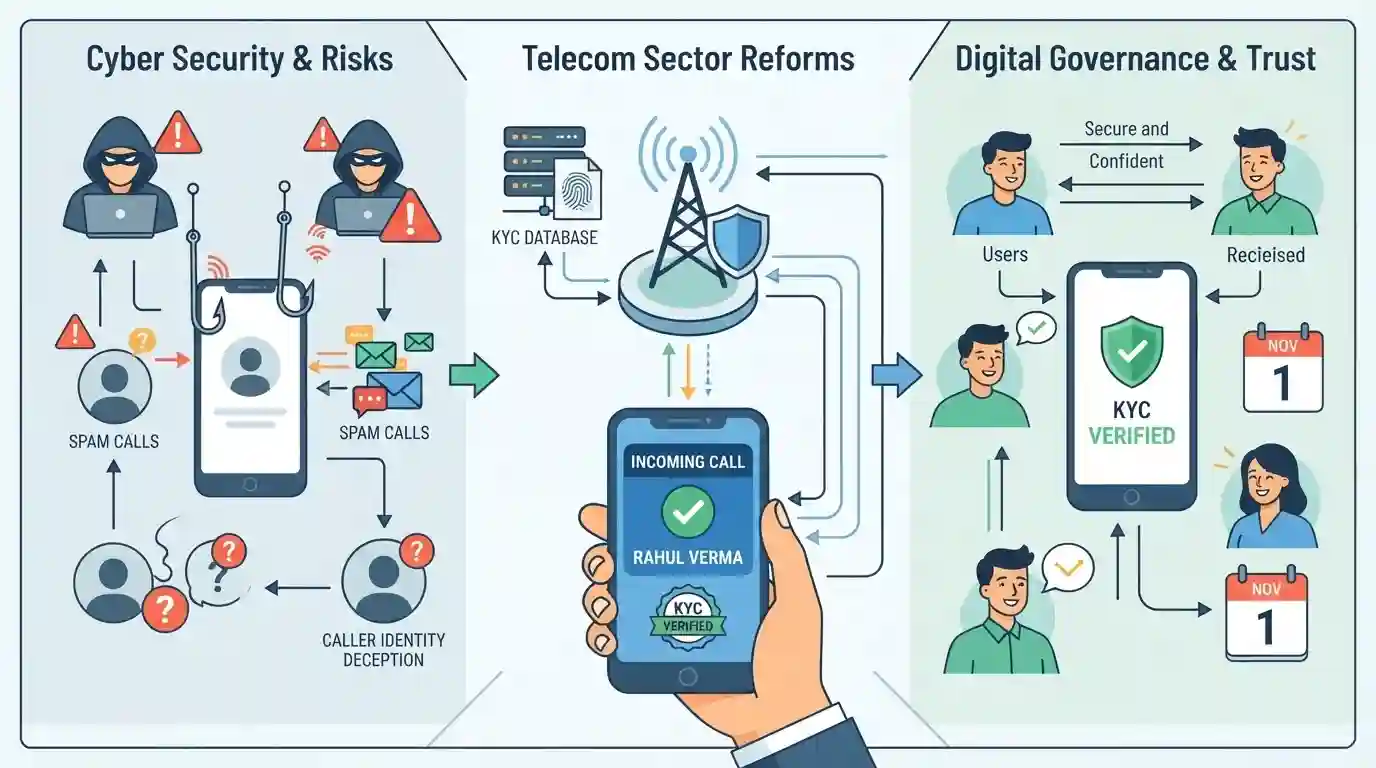
Starting November 1, telecom operators in India will display the KYC-verified name of incoming callers on mobile screens, a major regulatory step aimed at combating cyber frauds, spam calls, and caller identity deception.
মূল বিষয়
- Telecom operators in India are mandated to display the KYC-verified name of incoming callers on mobile screens starting November 1.
- The initiative aims to curb rising cyber frauds, spam calls, and identity impersonation by providing users with verified caller identification.
- It bridges the gap between official telecom records and end-user visibility, enhancing transparency and consumer trust in digital communications.
- Privacy concerns and technical integration across disparate telecom networks and handset operating systems remain critical considerations for implementation.
গুরুত্বপূর্ণ শব্দ
Telecom Regulatory Authority of India (TRAI)

An independent statutory body established to regulate the telecommunications sector in India, ensuring fair competition, protecting consumer interests, and recommending tariff policies and service standards.
UPSC context
UPSC GS Paper III (Economy & Infrastructure / Regulation); tests regulatory governance, institutional frameworks, and policy reforms in India's telecom sector.
Department of Telecommunications (DoT)
The apex executive department under the Ministry of Communications responsible for formulating telecom policies, granting licenses, managing spectrum allocation, and administering digital governance initiatives in India.
UPSC context
UPSC GS Paper II & III (Governance and Infrastructure); tests public administration, regulatory oversight, and cybersecurity policy implementation in telecommunications.
প্রিলিমস ফাঁদ
Crowdsourced third-party caller ID applications like Truecaller are legally equivalent to the government-mandated Calling Name Presentation (CNAP) service.
Aspirants often assume CNAP is a proprietary app-based feature or crowdsourced service. In reality, it is a network-layer regulatory mandate relying on official telecom KYC records.
সংযুক্ত স্থির ধারণা
What are the primary institutional roles of TRAI and DoT in the Indian telecommunications sector?
- TRAI Act 1997: Statutory basis: TRAI was established under the TRAI Act, 1997, to regulate telecom services, fix tariffs, and ensure fair competition.
- DoT Mandate: Policy formulation: The Department of Telecommunications (DoT) under the Ministry of Communications handles policy making, licensing, and spectrum management.
- TDSAT Role: Dispute resolution: TDSAT was established in 2000 to adjudicate disputes and dispose of appeals against TRAI orders or telecom license conditions.
আন্তঃবিষয় প্যাটার্ন
CNAP vs. Crowdsourced Caller ID Apps
While CNAP relies on official telecom KYC databases for authentication, third-party apps depend on crowdsourced contact books, raising distinct data-localization and privacy compliance questions under the DPDP Act.
TRAI Mandates and Digital Governance Expansion
The convergence of telecom policy, cyber fraud mitigation, and consumer protection testing grounds illustrates the expanding regulatory mandate of statutory bodies like TRAI in digital governance.

CNAP vs. Truecaller mechanisms + DPDP Act informational privacy balance is a prime candidate for a Mains analytical question.
সংযুক্ত PYQ · 2
সংযুক্ত PYQ · 2
- 2020MainsGS3
Discuss different types of cyber crimes and measures required to be taken to fight the menace.
- 2024MainsGS3
Social media and encrypting messaging services pose a serious security challenge. What measures have been adopted at various levels to address the security implications of social media? Also suggest any other remedies to address the problem.
