State Led Digital Public Infrastructure for Artificial Intelligence
Source:The Hindu ↗
Why It Matters
The creation of state-level Digital Public Infrastructure specifically for AI demonstrates an advanced stage of digital transformation in India. It shifts the focus from basic e-governance service delivery to utilizing public data for advanced algorithmic policy-making and fostering localized tech innovation. This is directly relevant to GS3 (Science and Tech/Economy) and GS2 (Governance/e-Governance policies).
Summary
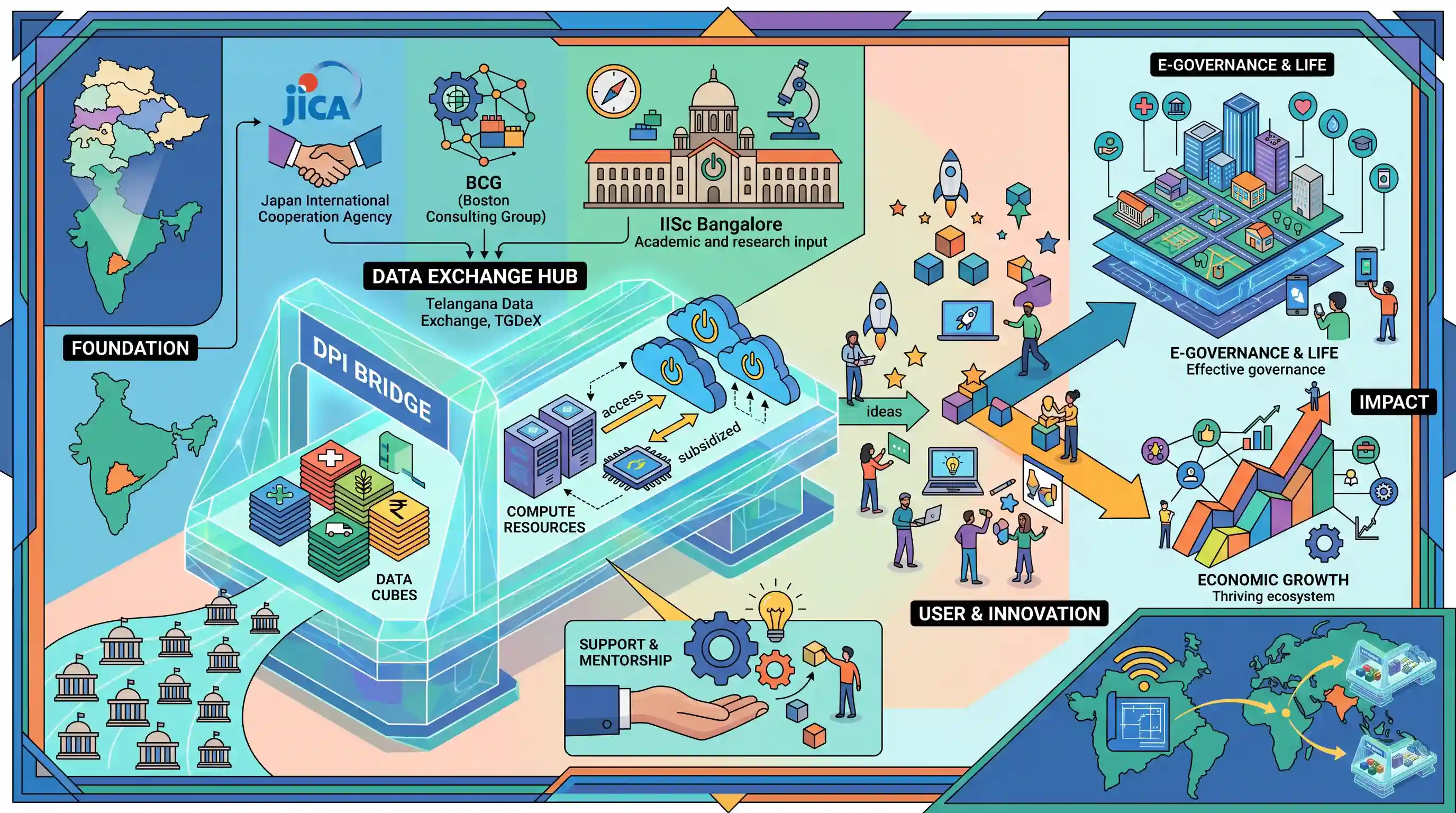
Telangana has launched the Telangana Data Exchange (TGDeX), India's first State-led Digital Public Infrastructure tailored specifically for Artificial Intelligence. Developed in collaboration with JICA, BCG, and IISc Bangalore, the platform aims to democratize AI development by providing startups and innovators with access to clean datasets, subsidized computing resources, and institutional support for scaling solutions. By onboarding over 20 government departments and hosting numerous datasets, TGDeX is intended to serve as a national model and a blueprint for inclusive AI infrastructure in the Global South, bridging the gap between data availability and effective governance.
Key Points
- Telangana has launched the Telangana Data Exchange (TGDeX), the first State-led Digital Public Infrastructure tailored specifically for Artificial Intelligence in India.
- The platform addresses major barriers to AI innovation by providing startups with access to clean datasets, subsidized computing infrastructure, and institutional pathways for scaling beyond pilot stages.
- TGDeX was developed by the State’s Emerging Technologies Wing in collaboration with JICA, Boston Consulting Group, and IISc Bangalore.
- By aiming to democratize AI development, the initiative enables innovators in remote or tier-2 areas to access the same high-quality tech resources as those in major IT hubs.
- A joint White Paper with JICA positions this inclusive AI infrastructure model as a blueprint for the rest of India and the Global South.
Important Terms
Telangana Data Exchange (TGDeX)

India's first state-led Digital Public Infrastructure (DPI) for AI, providing clean datasets, open-source models, and subsidized computing to democratize innovation.
UPSC context
GS III (IT/AI); example of sub-national Digital Public Infrastructure and data governance models.
AI Rising Grand Challenge
An innovation competition to solve public sector challenges (healthcare, education) using AI, offering winners financial aid and pilot implementation opportunities.
UPSC context
GS III (Innovation); illustrates incentive-driven governance and public-private partnerships in technology.
Japan International Cooperation Agency (JICA)
A Japanese bilateral agency providing Official Development Assistance; it supports TGDeX through technical guidance (DXLab) and funding for Telangana's startup ecosystem.
UPSC context
GS II (IR/Bilateral Relations); signifies international cooperation in developing India's digital and social infrastructure.
Center of Data for Public Good (IISc Bangalore)
An IISc-based multidisciplinary hub focused on using data science and ethical AI to address societal challenges in agriculture, health, and urban development.
UPSC context
GS III (S&T/R&D); highlights the role of academic institutions in building national digital utilities.
Telangana AI Mission (T-AIM)
A joint initiative between Telangana and NASSCOM to implement the state's AI strategy and establish it as a global innovation hub.
UPSC context
GS III (Government Policies); representative of institutional frameworks for managing emerging technologies at the state level.
Emerging Technologies Wing
A specialized unit within Telangana's IT department responsible for identifying and scaling technologies like AI, blockchain, and drones for better governance.
UPSC context
GS II (e-Governance); demonstrates administrative evolution to integrate high-tech solutions into public service delivery.
Prelims Trap
TGDeX is a Central government DPI launched under the IndiaAI Mission.
Aspirants often assume large-scale DPIs and AI initiatives are exclusively run by MeitY or the Union government. TGDeX is strictly State-led.
Static Concepts Connected
What are the three foundational pillars of Digital Public Infrastructure (DPI)?
- Identity: A verifiable digital identity layer to authenticate users (e.g., Aadhaar).
- Payments: An interoperable, fast, and cheap digital payment system (e.g., UPI).
- Data Exchange: A secure mechanism for consent-based sharing of personal and non-personal data (e.g., Account Aggregator / DEPA).
What is the National Data Governance Framework Policy (NDGFP)?
- Objective: Aims to enhance access, quality, and use of non-personal data for governance and AI innovation in India.
- India Datasets Program: Creates a repository of anonymized, non-personal datasets from government entities accessible to researchers and startups.
- Institutional Setup: Establishes the India Data Management Office (IDMO) under MeitY to design and enforce data standards.
Cross-Topic Patterns
DPI diplomacy for the Global South
India uses platforms like UPI, and now state-level AI exchanges, as soft-power exports to the Global South to counter Western big-tech monopolies and build digital diplomacy.
Non-Personal Data and AI Monopolies
Aligns with the Gopalakrishnan Committee on Non-Personal Data, treating anonymized public datasets as a commons to democratize AI and break private tech oligopolies.

Expect a 2026 multi-statement Prelims question testing the distinction between Union DPIs (India Stack) and State-led AI-data exchanges.
Linked PYQs · 5
Linked PYQs · 5
- 2023MainsGS3
Introduce the concept of Artificial Intelligence (AI). How does Al help clinical diagnosis? Do you perceive any threat to privacy of the individual in the use of Al in healthcare?
- 2023MainsGS3
What is the status of digitalization in the Indian economy? Examine the problems faced in this regard and suggest improvements.
- 2024MainsGS2
e-governance is not just about the routine application of digital technology in service delivery process. It is as much about multifarious interactions for ensuring transparency and accountability. In this context evaluate the role of the 'Interactive Service Model' of e-governance.
- 2023MainsGS2
e-governance, as a critical tool of governance, has ushered in effectiveness, transparency and accountability in governments. What inadequacies hamper the enhancement of these features ?
- 2025MainsGS2
e-governance projects have a built-in bias towards technology and back-end integration than user-centric designs. Examine.
