Telangana Ranks Second in Cybercrimes with Low Conviction Rates
Source:The Hindu ↗
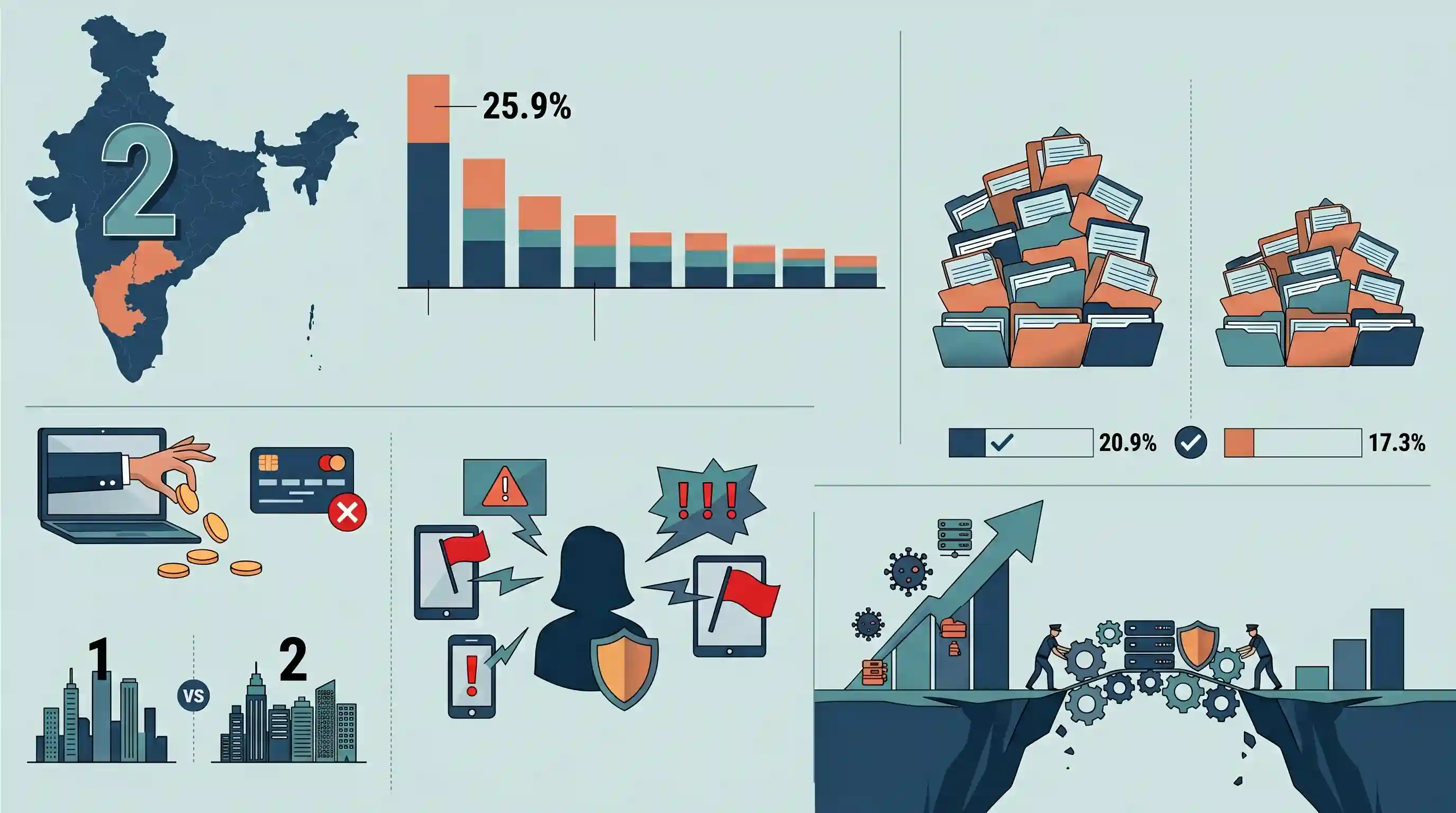
Why It Matters
Provides concrete NCRB data on the geographic concentration of cybercrimes in major IT hubs (like Bengaluru and Hyderabad) and exposes the critical capacity deficit in the criminal justice system to handle digital investigations, evidenced by poor chargesheeting rates. Valuable for GS-3 answers on cyber security and police reforms.
Summary
According to the latest National Crime Records Bureau (NCRB) data, Telangana has emerged as the state with the second-highest number of cybercrimes in India, only behind Karnataka. In 2023, the state accounted for over a fifth of the nation's total cybercrime cases, with Hyderabad ranking as the second worst-affected metropolitan city after Bengaluru. The majority of these crimes are financial frauds, alongside significant rates of cyber abuse targeting women. However, a major concern is the highly inefficient investigation process; the chargesheeting rates in Telangana and Hyderabad stand at a dismal 20.9% and 17.3%, respectively. This data underscores a widening gap between the rapid escalation of digital crimes and the technical capabilities of law enforcement to effectively investigate and prosecute offenders.
Key Points
- Telangana registered 18,236 cybercrime cases in 2023, ranking second nationally behind Karnataka, accounting for 21.1% of the country's total cybercrimes.
- Hyderabad is the second worst-hit metropolitan city for cybercrimes, trailing only Bengaluru, with a high incidence of digital offenses.
- Financial fraud, including OTP, online banking, and credit/debit card scams, constituted the majority of the reported cyber offenses.
- Law enforcement faces significant hurdles in investigating these crimes, reflected in abysmal chargesheeting rates of 20.9% for Telangana and 17.3% for Hyderabad.
Important Terms
National Crime Records Bureau (NCRB)

An agency under the Ministry of Home Affairs established in 1986 to collect and analyze crime data across India, notably through its annual 'Crime in India' report.
UPSC context
GS Paper II (Governance) & III (Internal Security); essential for citing authentic crime statistics and evaluating law enforcement performance.
Cybercrime
Criminal activities involving computers or digital networks, categorized under the IT Act, 2000, including financial fraud, identity theft, and cyberstalking.
UPSC context
GS Paper III (Internal Security); a core topic regarding challenges to internal security through communication networks and critical infrastructure protection.
Chargesheeting Rate
A performance metric representing the percentage of cases where police file a formal charge sheet in court out of the total cases investigated and disposed of.
UPSC context
GS Paper II (Governance) & III (Police Reforms); measures the efficiency of investigative processes and the criminal justice system's effectiveness.
Information Technology (IT) Act, 2000
The primary law in India providing legal recognition for electronic commerce and prescribing penalties for cybercrimes like hacking and data theft.
UPSC context
GS Paper III (Cyber Security); the foundational legal framework for regulating digital activities and prosecuting cyber offenses in India.
Indian Cyber Crime Coordination Centre (I4C)
A Ministry of Home Affairs initiative to provide a framework and eco-system for Law Enforcement Agencies to handle cybercrimes in a comprehensive and coordinated manner.
UPSC context
GS Paper III (Internal Security); crucial for questions on capacity building of law enforcement and inter-state security coordination.
Crime and Criminal Tracking Network & Systems (CCTNS)
A Mission Mode Project under the National e-Governance Plan aimed at creating a comprehensive and integrated system for effective policing through a nationwide IT network.
UPSC context
GS Paper II (E-Governance) & III (Internal Security); relevant for police modernization and digital tracking of criminals.
Prelims Trap
"The investigation and prosecution of cybercrimes are exclusively handled by the Indian Cyber Crime Coordination Centre (I4C)."
'Police' and 'Public Order' are State subjects. State police investigate cybercrimes. I4C only provides a coordination framework, not direct investigation.
Static Concepts Connected
What is India's institutional framework for tackling cyber threats?
- CERT-In: Nodal agency under MeitY for responding to computer security incidents, issuing advisories, and tracking vulnerability alerts.
- NCIIPC: Created under the IT Act to protect the nation's Critical Information Infrastructure (CII) like power grids and banking systems.
- I4C: Functions under MHA to help states coordinate cybercrime investigations. It hosts the National Cyber Crime Reporting Portal.
Why do cybercrimes suffer from abysmal chargesheeting rates?
- Jurisdictional friction: The borderless nature of digital offenses requires complex inter-state and international cooperation, which severely delays investigations.
- Capacity deficit: State police forces face acute shortages of trained digital forensic personnel and modern labs to process volatile electronic evidence.
- Anonymity tools: The increasing use of VPNs, dark web networks, and cryptocurrency creates dead-ends in tracing identities and financial trails.
Cross-Topic Patterns
Digital Inclusion vs. Digital Literacy
The rapid expansion of UPI and the JAM trinity has structurally outpaced grassroots digital literacy, making citizens highly vulnerable to social engineering and OTP frauds.
Cyber-violence and Women's Safety
Connects GS-1 (Society) and GS-3 (Cybersecurity). High rates of cyber-abuse and dismal prosecution deter women from digital spaces, threatening gender parity in India's digital economy.

Expect a GS-3 Mains question on the capacity deficit of State police in handling borderless cybercrimes versus Central agencies like I4C.
Linked PYQs · 4
Linked PYQs · 4
- 2020MainsGS3
Discuss different types of cyber crimes and measures required to be taken to fight the menace.
- 2022MainsGS3
What are the different elements of cyber security ? Keeping in view the challenges in cyber security, examine the extent to which India has successfully developed a comprehensive National Cyber Security Strategy.
- 2017MainsGS3
Discuss the potential threats of Cyber attack and the security framework to prevent it.
- 2021MainsGS3
Keeping in view India's internal security, analyse the impact of cross-border cyber attacks. Also discuss defensive measures against these sophisticated attacks.
