Telangana Industrial Relocation Policy and Urban Governance
Source:The Hindu ↗
Why It Matters
Provides a concrete case study for Mains answers on sustainable urbanization, managing industrial pollution in metropolitan cities, and the practical application of e-governance for transparent regulatory compliance.
Summary
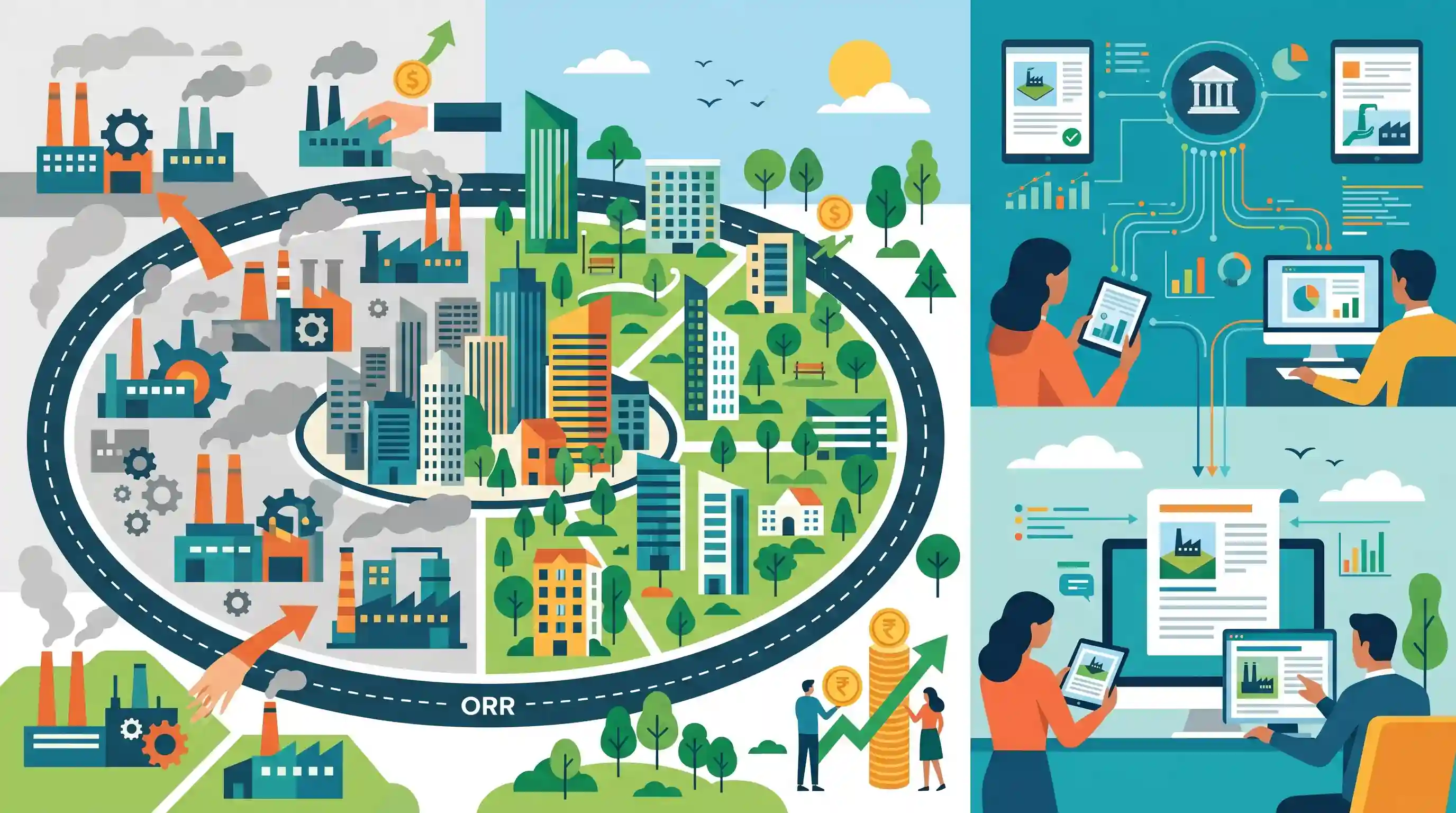
The Telangana government has issued implementation guidelines for the Hyderabad Industrial Lands Transformation Policy (HILTP), aiming to relocate polluting industrial units outside the Outer Ring Road (ORR) and repurpose the vacated land into multi-use zones. The move targets 21 industrial parks in the city's core, offering relocating units incentives such as subsidies and priority plot allotments. Additionally, an online portal was launched to facilitate transparent, technology-driven processing of conversion applications, reinforcing the state's focus on e-governance and sustainable urban development.
Key Points
- Telangana has issued operational guidelines for the Hyderabad Industrial Lands Transformation Policy (HILTP) to relocate polluting industries beyond the Outer Ring Road (ORR).
- The vacated industrial spaces within the Core Urban Region (CURE) will be converted into multi-use zones to promote sustainable urban planning and decongestion.
- Relocating industries will benefit from subsidies, adjusted statutory fees, and priority allotment of plots in industrial parks outside the ORR.
- To ensure transparent and citizen-centric governance, a dedicated online portal was launched to process and monitor land conversion applications.
Important Terms
Hyderabad Industrial Lands Transformation Policy (HILTP)

A Telangana state policy aimed at converting aging or unviable industrial lands within Hyderabad's core into multi-use zones for residential, commercial, and IT purposes to optimize land use.
UPSC context
GS Paper III (Industrial Policy); relevant for urban land-use management and balancing industrial growth with urban redevelopment.
Telangana Industrial Infrastructure Corporation (TGIIC)
The nodal state agency in Telangana responsible for developing industrial infrastructure, managing industrial parks, and implementing land conversion and relocation policies like HILTP.
UPSC context
GS Paper II (Governance) and Paper III (Infrastructure); tests the role of state-level bodies in industrial development.
Multi-use Zones
A land-use planning category that permits a combination of residential, commercial, institutional, and recreational activities, intended to create self-sufficient urban districts and reduce commuting.
UPSC context
GS Paper I (Urbanization); significant for sustainable urban planning and addressing the challenges of rapid urban expansion.
Outer Ring Road (ORR)
A 158-km, 8-lane expressway circling Hyderabad that facilitates regional connectivity and acts as a strategic boundary for relocating polluting industries outside the city core.
UPSC context
GS Paper III (Infrastructure); illustrates transport-led decentralization and infrastructure's role in guiding urban growth patterns.
TG-iPASS
A single-window system in Telangana that provides time-bound industrial clearances and land-use conversion approvals through a transparent online portal to improve the ease of doing business.
UPSC context
GS Paper II (E-governance) and GS Paper III (Economy); tests knowledge of administrative reforms and investment facilitation.
Industrial Relocation Policy
A strategy of shifting polluting or non-viable factories from densely populated urban centers to peripheral areas to mitigate environmental risks and facilitate city-core renewal.
UPSC context
GS Paper III (Environment and Pollution); relevant for environmental governance and reconciling public health with industrialization.
Prelims Trap
HILTP mandates the immediate, uncompensated coercive shutdown of polluting MSMEs in core urban areas.
The policy strictly focuses on 'incentivized relocation' offering subsidies, adjusted fees, and alternative plots. It specifically avoids coercive shutdowns to prevent MSME economic distress.
Static Concepts Connected
How does the CPCB classify industries based on their pollution index (PI)?
- Red Category: High pollution index (score 60 or more); includes heavily polluting industries like petrochemicals, pharmaceuticals, and tanneries.
- Orange Category: Moderate pollution index (score 41 to 59); includes medium-impact units like food processing and printing presses.
- White Category: Practically non-polluting (score up to 20); these units are exempt from requiring formal environmental clearance or consent to operate.
What are the key localized drivers of Urban Heat Islands (UHI) in Indian cities?
- Surface Materials: Dense deployment of concrete, asphalt, and glass which absorb and re-emit significant solar radiation compared to natural landscapes.
- Anthropogenic Heat: Waste heat released continuously from heavy industrial units, air conditioning, and dense vehicular traffic in city cores.
- Loss of Vegetation: Reduced evapotranspiration due to the replacement of natural water bodies and vegetation with built structures.
Cross-Topic Patterns
Urban Decongestion vs MSME Economic Survival
Relocating core city industries often disrupts MSME supply chains and informal labour access. Incentivized relocation links urban environmental planning (GS1) directly to industrial economic viability (GS3).
Spatial Zoning as a Public Health Intervention
Shifting legacy polluting units outside city limits mitigates localized groundwater heavy metal contamination and toxic emissions, explicitly linking urban geography to public health outcomes.

Expect a GS1/GS3 Mains question linking urban decongestion, heat island mitigation, and MSME relocation policies as a single framework.
Linked PYQs · 3
Linked PYQs · 3
- 2024MainsGS3
Industrial pollution of river water is a significant environmental issue in India. Discuss the various mitigation measures to deal with this problem and also the government's initiatives in this regard.
- 2024MainsGS2
e-governance is not just about the routine application of digital technology in service delivery process. It is as much about multifarious interactions for ensuring transparency and accountability. In this context evaluate the role of the 'Interactive Service Model' of e-governance.
- 2025MainsGS2
e-governance projects have a built-in bias towards technology and back-end integration than user-centric designs. Examine.
