Telangana Phone Tapping Case and Digital Privacy Constitutional Debate
Source:The Hindu ↗
Why It Matters
This case provides a tangible, contemporary example of the clash between state investigative powers and individual constitutional rights, particularly focusing on digital privacy and whether compelling a password violates the right against self-incrimination. It is highly relevant for GS-2 (Constitution) and GS-3 (Cyber Security) questions.
Summary
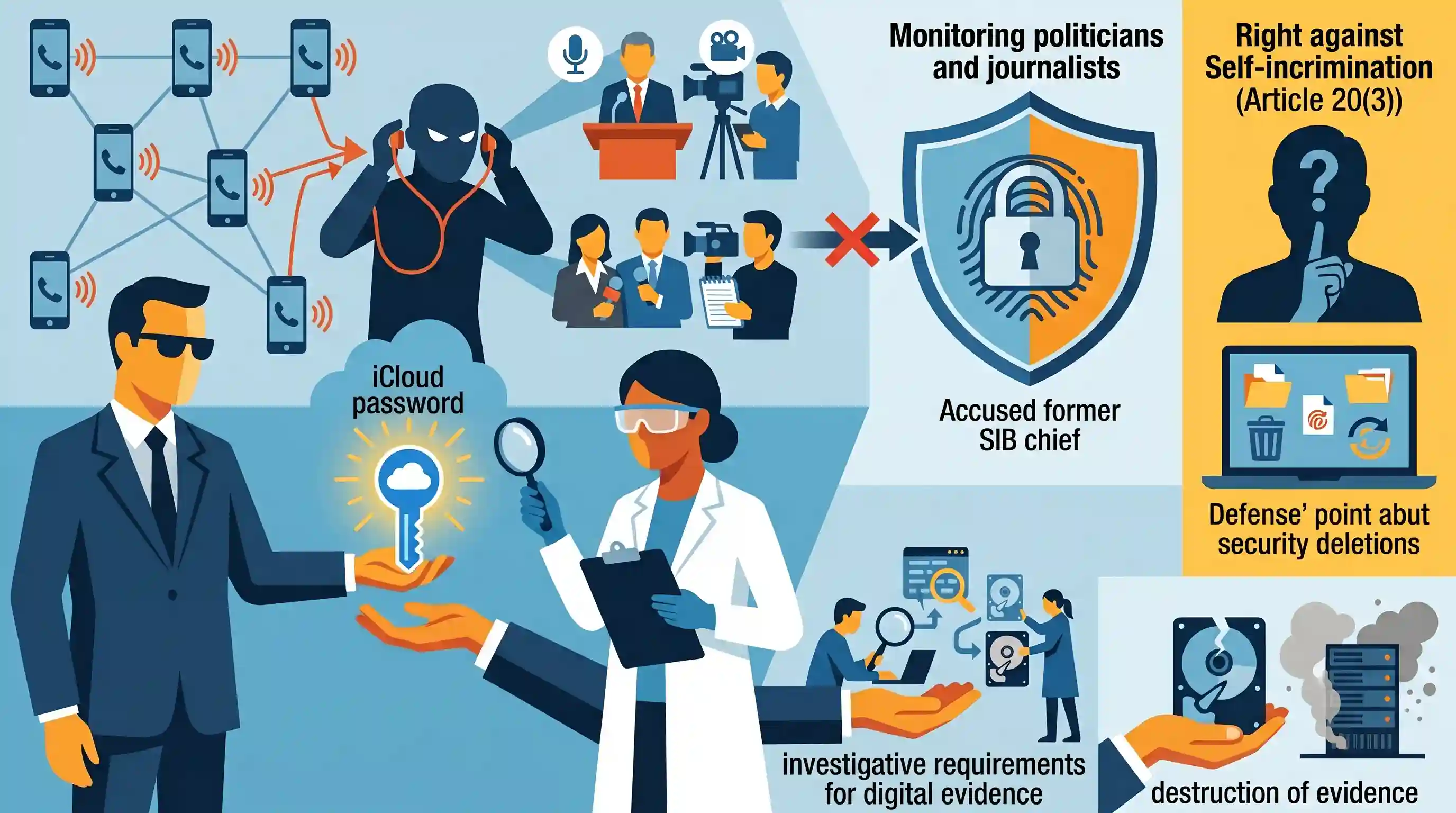
The Supreme Court has directed the former chief of the Telangana Special Intelligence Bureau (SIB), accused of illegal phone tapping and surveillance of politicians and journalists, to provide his iCloud password to investigators in the presence of forensic experts. While the State claims the accused destroyed critical electronic evidence by formatting devices, the defense attributes the deletions to standard security norms. The case brings to the forefront the critical legal tension between investigative requirements for digital evidence and the constitutional protections of the right to privacy and the right against self-incrimination.
Key Points
- The Supreme Court ordered a former Telangana SIB chief accused of illegal phone tapping to share his iCloud password in the presence of forensic experts.
- The case involves allegations of unauthorized surveillance of politicians, journalists, and judges during the previous state government regime.
- The State argued the accused had formatted devices to destroy electronic evidence, while the defense claimed standard security protocols were followed.
- The court directive touches upon significant constitutional questions concerning the right to privacy, the use of digital evidence, and the right against self-incrimination.
Important Terms
Right against Self-incrimination (Article 20(3))

Fundamental Right under Article 20(3) stating no person accused of an offence shall be compelled to be a witness against himself, protecting 'mental privacy' and the right to silence.
UPSC context
GS Paper II: Fundamental Rights. Tests the balance between state investigative powers and constitutional safeguards in the digital age.
Right to Privacy
Affirmed by the Supreme Court (Puttaswamy, 2017) as an intrinsic part of the Right to Life (Article 21), requiring state surveillance to meet legality, necessity, and proportionality.
UPSC context
GS Paper II: Indian Constitution. Central to debates on phone tapping, data protection, and individual liberty.
Special Intelligence Bureau (SIB)
A specialized unit within the state police (e.g., Telangana) responsible for gathering internal intelligence, counter-intelligence, and monitoring security threats like left-wing extremism.
UPSC context
GS Paper III: Internal Security. Relates to the architecture of state-level security agencies and the potential for executive misuse.
Indian Telegraph Act, 1885
The primary statute governing telecommunications in India; Section 5(2) empowers the government to intercept messages on grounds of 'public emergency' or 'public safety'.
UPSC context
GS Paper II: Government Policies. Tests understanding of the legal basis for surveillance and its procedural safeguards (PUCL guidelines).
Central Forensic Science Laboratory (CFSL)
Apex scientific body under the Ministry of Home Affairs providing expert analytical support for criminal investigations, including cyber forensics and digital evidence recovery.
UPSC context
GS Paper III: Science & Technology. Relevant for the modernization of criminal justice through digital forensics.
Testimonial Compulsion
The act of forcing an accused to communicate personal knowledge (e.g., passwords), which the Supreme Court distinguishes from physical evidence like fingerprints.
UPSC context
GS Paper II: Judiciary. Key legal concept for analyzing recent rulings on digital privacy and police questioning.
Prelims Trap
"Providing passwords or giving voice samples is explicitly banned as it violates the right against self-incrimination."
The Supreme Court previously ruled that physical evidence (voice, fingerprints) does NOT violate Article 20(3). However, compelling digital passwords currently remains a legally contested grey area.
Static Concepts Connected
What is the scope of protection under Article 20(3) against self-incrimination?
- Accused only: It extends only to a person formally accused of an offense at the time of making the statement, not merely a witness or suspect.
- Testimonial compulsion: It protects against forced oral or written statements imparting personal knowledge about the crime (testimonial compulsion).
- Physical evidence excluded: Compelling an accused to give blood samples, fingerprints, handwriting, or voice samples does not violate this right (State of Bombay v. Kathi Kalu Oad).
Under what conditions is lawful phone interception permitted in India?
- Governing statute: Phone tapping is primarily authorized under Section 5(2) of the Indian Telegraph Act, 1885, not the Information Technology Act.
- Strict grounds: It is permitted only on two primary preconditions: the occurrence of a "public emergency" or in the interest of "public safety."
- Procedural safeguards: As per the PUCL judgment (1997), interception orders must be issued by the Home Secretary and vetted by a Review Committee.
Cross-Topic Patterns
DPDP Act exemptions vs Right to Privacy
Section 17 of the 2023 DPDP Act exempts state instrumentalities from data protection rules, directly linking data sovereignty debates to state surveillance and Article 21 rights.
Evidence law and digital forensics
Cloud backups and extracted device data must pass strict certification requirements (formerly Section 65B of the Indian Evidence Act, now under Bharatiya Sakshya Adhiniyam) to be admissible.

Expect a Prelims statement comparing Art 20(3) protections (passwords vs biometrics) alongside Telegraph Act interception grounds in 2026.
Linked PYQs · 4
Linked PYQs · 4
- 2017MainsGS2
Examine the scope of Fundamental Rights in the light of the latest judgement of the Supreme Court on Right to Privacy.
- 2024MainsGS2
Right to privacy is intrinsic to life and personal liberty and is inherently protected under Article 21 of the constitution. Explain. In this reference discuss the law relating to D.N.A. testing of child in the womb to establish its paternity.
- 2023MainsGS2
“The Constitution of India is a living instrument with capabilities of enormous dynamism. It is a constitution made for a progressive society.” Illustrate with special reference to the expanding horizons of the right to life and personal liberty.
- 2020MainsGS3
Discuss different types of cyber crimes and measures required to be taken to fight the menace.
