Telangana Agricultural Schemes and Crop Loan Waivers
Source:The Hindu ↗
Why It Matters
Provides a real-world case study on state-level agricultural interventions—specifically direct income support (Rythu Bharosa), farm loan waivers, and the practical challenges of implementing e-governance in land records (Dharani portal).
Summary
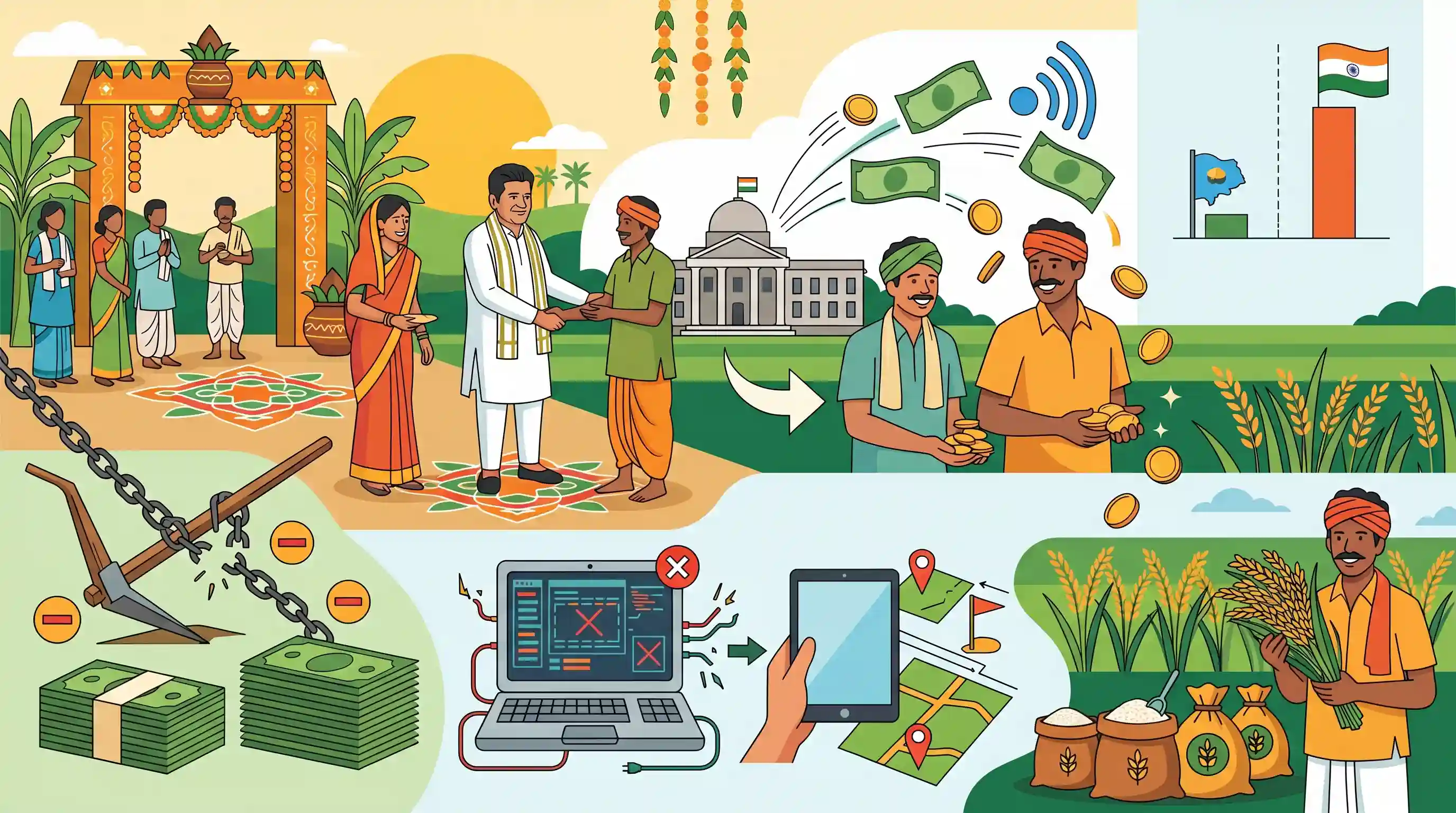
During the Ugadi festival celebrations, Telangana Chief Minister A. Revanth Reddy reaffirmed the government's commitment to agricultural development, highlighting key initiatives such as a ₹2 lakh crop loan waiver and the ₹18,000 crore Rythu Bharosa scheme. He emphasized that the state's farmer debt burden remains among the lowest nationwide. Furthermore, the state scrapped the problematic Dharani land records portal to better resolve farmers' land issues and announced bonuses for fine rice cultivators.
Key Points
- Telangana Chief Minister A. Revanth Reddy dedicated the Telugu New Year (Paraabhava Nama Samvatsaram) to farmers' welfare, noting that over 70% of the state's families depend on agriculture.
- The state government implemented a crop loan waiver of up to ₹2 lakh and provides bonuses to farmers cultivating fine rice, maintaining one of the lowest farmer debt burdens in the country.
- A total of ₹18,000 crore has been spent on the 'Rythu Bharosa' investment support scheme, with the upcoming Yasangi (Rabi) instalment to be disbursed in March.
- The controversial 'Dharani' land records digitization portal was scrapped for being detrimental to farmers, with the government now opting for amicable resolution of land disputes.
Important Terms
Rythu Bharosa

Telangana's flagship investment support scheme providing ₹12,000 per acre annually to farmers. It replaces the 'Rythu Bandhu' scheme and extends financial assistance to landless agricultural laborers to meet cultivation costs.
UPSC context
GS-III/Agriculture; tests knowledge of direct income support models and their role in reducing farmer indebtedness compared to traditional subsidies.
Dharani Portal
An integrated land records management system in Telangana currently being overhauled. While it digitized land titles, it faced criticism for technical errors and the lack of a robust grievance redressal mechanism.
UPSC context
GS-II/Governance & GS-III/Land Reforms; relevant for discussing e-governance challenges and the complexities of land titling in India.
Crop Loan Waiver
A policy to cancel agricultural debts (up to ₹2 lakh in Telangana) to provide financial relief to farmers, aiming to break the debt cycle and restore creditworthiness for future seasons.
UPSC context
GS-III/Issues related to farm subsidies; evaluates the fiscal implications and long-term economic efficacy of debt relief in the agricultural sector.
Bonus for Fine Rice
A state-funded incentive (₹500 per quintal in Telangana) paid on top of the Central Minimum Support Price to encourage cultivation of high-quality rice varieties preferred by consumers.
UPSC context
GS-III/PDS & MSP; examines how state-level incentives can influence crop patterns and procurement goals within the federal agricultural framework.
Bhudhar
A proposed unique 12-digit identification number assigned to land parcels in Telangana (under the Bhu Bharati Bill) to provide a permanent record of land ownership and boundaries.
UPSC context
GS-II/E-Governance; highlights technological innovations intended to streamline property registration and reduce land-related litigation.
Prelims Trap
India currently follows a conclusive land titling system across all states under the Digital India Land Records Modernization Programme (DILRMP).
India still legally operates on a presumptive titling system based on the Registration Act 1908. While DILRMP aims to achieve conclusive titling, it is not yet the national standard.
Static Concepts Connected
What is the difference between presumptive and conclusive land titling in India?
- Presumptive Titling: Involves the registration of deeds, not titles. The state does not guarantee ownership, leaving the burden of title proof on the buyer (Current Indian standard).
- Conclusive Titling: The state formally guarantees the land title (Torrens system) and provides compensation in the event of disputes. Transitioning to this is a key goal of state reforms.
Why does the RBI caution against frequent agricultural crop loan waivers?
- Moral Hazard: Creates a culture where farmers who can afford to repay strategically default, anticipating future government-mandated waivers.
- Credit Squeeze: Vitiates overall credit discipline, making banks risk-averse and ultimately choking the flow of fresh formal agricultural credit to the sector.
- Fiscal Crowding Out: Severely strains state exchequers, consuming funds that could otherwise be used for long-term productive agricultural infrastructure, such as irrigation and cold storage.
Cross-Topic Patterns
Shift from Price Support to Income DBT
Schemes like Rythu Bharosa and PM-KISAN reflect a policy shift away from market-distorting input subsidies toward direct income support, which is more easily compliant with WTO Green Box rules.
Targeted Incentives for Crop Diversification
State-level bonuses for specific crops act as direct market interventions. They aim to steer cropping patterns toward demand-driven agriculture, aligning with the Ashok Dalwai Committee's goals for doubling farmers' income.

Expect a 2026 prelims multi-statement question contrasting presumptive vs conclusive land titling and its impact on formal credit access.
Linked PYQs · 4
Linked PYQs · 4
- 2017MainsGS3
How do subsidies affect the cropping pattern, crop diversity and economy of farmers? What is the significance of crop insurance, minimum support price and food processing for small and marginal farmers?
- 2023MainsGS3
What are the direct and indirect subsidies provided to farm sector in India? Discuss the issues raised by the World Trade Organization (WTO) in relation to agricultural subsidies.
- 2023MainsGS3
How does e-Technology help farmers in production and marketing of agricultural produce? Explain it.
- 2024MainsGS3
What were the factors responsible for the successful implementation of land reforms in some parts of the country? Elaborate.
