Telangana Gig Workers Legislation and Social Security Framework
Source:Indian Express ↗
Why It Matters
The gig economy currently employs millions in India who remain outside traditional labor protections. State-level legislative interventions like Telangana's bill represent pivotal governance steps toward extending social security, establishing a precedent for national alignment under the Code on Social Security 2020. This issue bridges GS3 (Economy/Labour) and GS2 (Social Justice/Vulnerable Sections).
Summary
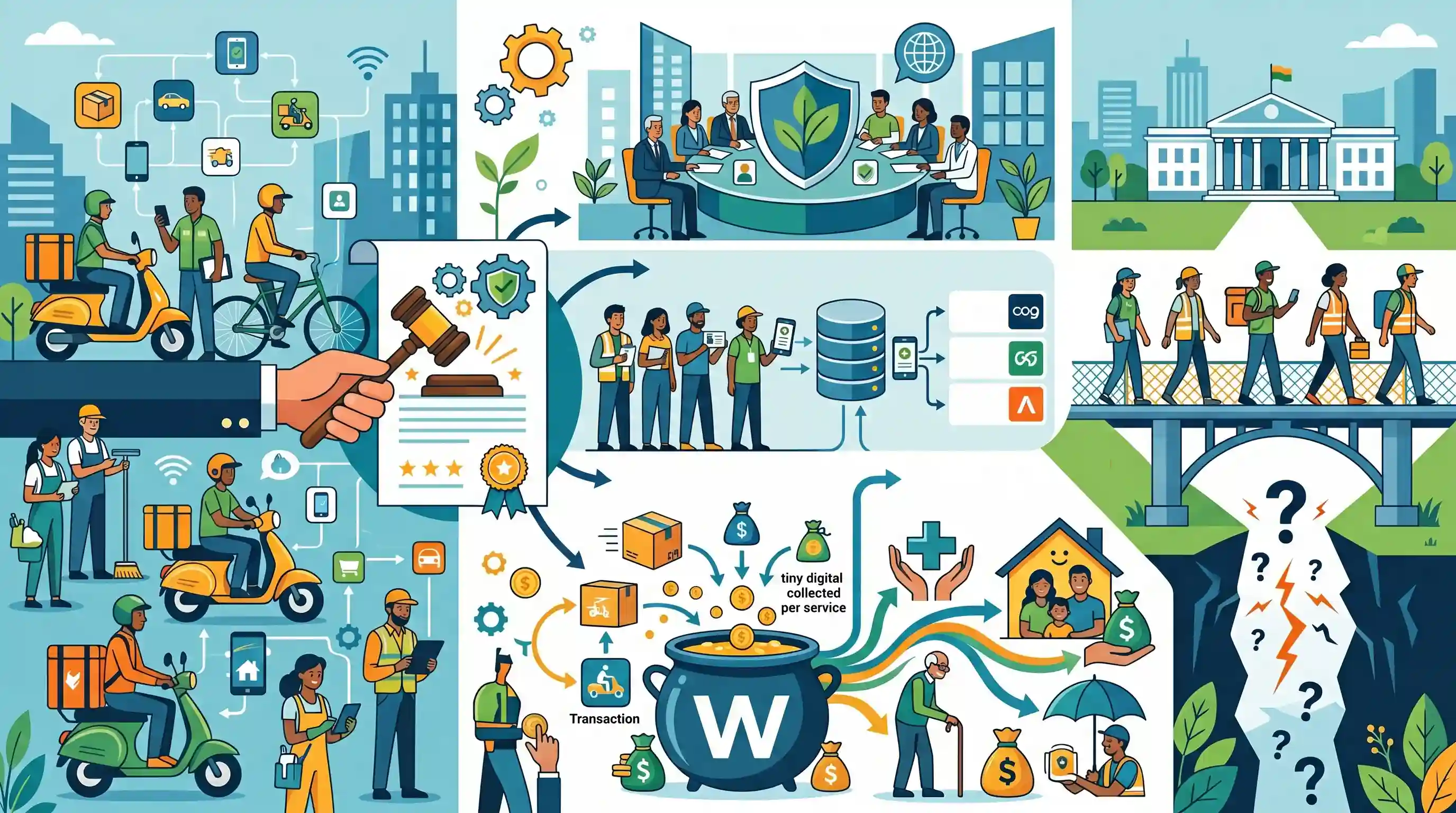
The Telangana Assembly has passed the Gig Workers Bill 2026 to ensure social security and welfare for platform-based workers. Drawing on similar frameworks from Rajasthan and Karnataka, the legislation establishes a welfare board, mandates the registration of both workers and aggregators, and introduces a transaction-based fee to fund social security schemes. The law attempts to bridge the critical gap in labor protections for the unorganized sector in the rapidly expanding gig economy.
Key Points
- Telangana passed legislation to provide social security and welfare benefits to platform-based gig workers, following the precedent set by Rajasthan and draft proposals in Karnataka.
- The Bill mandates the creation of a state-level Gig Workers Welfare Board and a dedicated Social Security Fund to administer benefits.
- The welfare fund will be financed by a specialized fee or cess levied on each transaction facilitated by aggregators (e.g., ride-hailing and food delivery apps).
- It enforces mandatory registration for both gig workers and aggregators, giving workers an institutional grievance redressal mechanism despite lacking traditional employee status.
- Similar laws in other states have faced implementation hurdles, such as aggregators resisting transaction fees, data-sharing reluctance, and debates over worker classification.
Important Terms
Telangana Platform-Based Gig Workers Bill, 2026

State legislation (2026) providing legal recognition to gig workers, establishing a welfare board, and mandating a 1-2% transaction-based levy on aggregators to fund social security.
UPSC context
GS-II: Welfare schemes for vulnerable sections; GS-III: Labour reforms and growth of the gig economy. Tests understanding of state-level labor protections.
Rajasthan Platform-Based Gig Workers (Registration and Welfare) Act, 2023
India's first dedicated legislation (2023) for gig workers, introducing a welfare fund, unique IDs, and a transaction-based 'welfare cess' to provide insurance and pension benefits.
UPSC context
GS-II/III: Federalism and state initiatives in social security. Significant as a pioneering model for other states like Telangana and Karnataka.
Code on Social Security, 2020
A central labor law unifying existing social security legislations; it formally defines 'gig' and 'platform' workers for the first time, enabling their inclusion in welfare schemes.
UPSC context
GS-III: Indian Economy and issues relating to planning, mobilization of resources, and employment. Tests knowledge of national-level labor law consolidation.
Gig Workers Welfare Board
A statutory body comprising government, aggregator, and worker representatives tasked with managing welfare funds, registering workers, and overseeing grievance redressal mechanisms for platform-based labor.
UPSC context
GS-II: Statutory, regulatory and various quasi-judicial bodies. Tests understanding of the governance structure for unorganized sector welfare.
Aggregator
Digital intermediaries (e.g., Zomato, Uber) that connect service providers with users. Recent laws mandate they contribute a percentage of turnover/transactions to worker social security.
UPSC context
GS-III: Changes in industrial policy and their effects on industrial growth. Focuses on the evolving definition of 'employer' in the digital age.
Algorithmic Transparency
A legislative requirement for platforms to disclose how their software assigns tasks, determines ratings, and impacts worker earnings, preventing arbitrary or discriminatory automated decisions.
UPSC context
GS-III: Science and Technology-developments and their applications. Tests awareness of ethical AI and its impact on labor rights.
Prelims Trap
"New State Gig Worker Bills legally classify delivery partners as formal employees with guaranteed minimum wages."
State Acts and the 2020 Code provide a welfare framework and social security fund, but explicitly keep platform workers outside traditional employer-employee classifications.
Static Concepts Connected
How are 'Labour' and 'Social Security' positioned in the Indian Constitution?
- Concurrent List: Both Labour and Social Security are explicitly placed in the Concurrent List (List III) of the Seventh Schedule, enabling both Centre and States to legislate.
- Article 41 (DPSP): Directs the State to make effective provision for securing the right to work, education, and public assistance in cases of unemployment or old age.
- Article 43 (DPSP): Requires the State to strive to secure a living wage, decent standard of life, and full enjoyment of leisure for all workers.
How does the Code on Social Security (2020) define different worker categories?
- Gig Worker: A person who performs work and earns in an arrangement outside the traditional employer-employee relationship.
- Platform Worker: A specific type of gig worker who uses an online algorithmic matching platform or app to connect with customers to provide specific services.
- Unorganised Worker: A home-based, self-employed, or wage worker in the unorganised sector, distinct from those covered by formal provident fund or gratuity acts.
Cross-Topic Patterns
Gig Economy + Urbanisation + Demographic Dividend
The explosion of gig work links to urban distress migration and jobless growth, shifting demographic dividend discussions from formal manufacturing to service-led informal digital work.
E-Shram + Digital Public Infrastructure (DPI)
Linking the e-Shram database with state-level welfare boards represents the next wave of India's Digital Public Infrastructure, moving beyond direct cash transfers to targeted social security for unorganised labor.

Expect a multi-statement Prelims question testing the exact legal distinction between gig, platform, and unorganised workers under 2020 laws.
Linked PYQs · 3
Linked PYQs · 3
- 2021MainsGS1
Examine the role of 'Gig Economy' in the process of empowerment of women in India.
- 2021PrelimsGS1
With reference to casual workers employed in India, consider the following statements : 1. All casual workers are entitled for Employees Provident Fund coverage. 2. All casual workers are entitled for regular working hours and overtime payment. 3. The government can by a notification specify that an establishment or industry shall pay wages only through its bank account. Which of the above statements are correct?
- 2019MainsGS2
Performance of welfare schemes that are implemented for vulnerable sections is not so effective due to absence of their awareness and active involvement at all stages of policy process. Discuss.
