Telangana Composite Backwardness Index for Caste Disparities
Source:The Hindu ↗
Why It Matters
The refinement of backwardness criteria from the Mandal Commission's 11 parameters to Telangana's 43-parameter CBI represents a critical evolution in affirmative action policy and social justice. Furthermore, utilizing comprehensive socio-economic surveys (like SEEEPC) alongside modern AI tools highlights the intersection of evidence-based policymaking, data governance, and privacy.
Summary
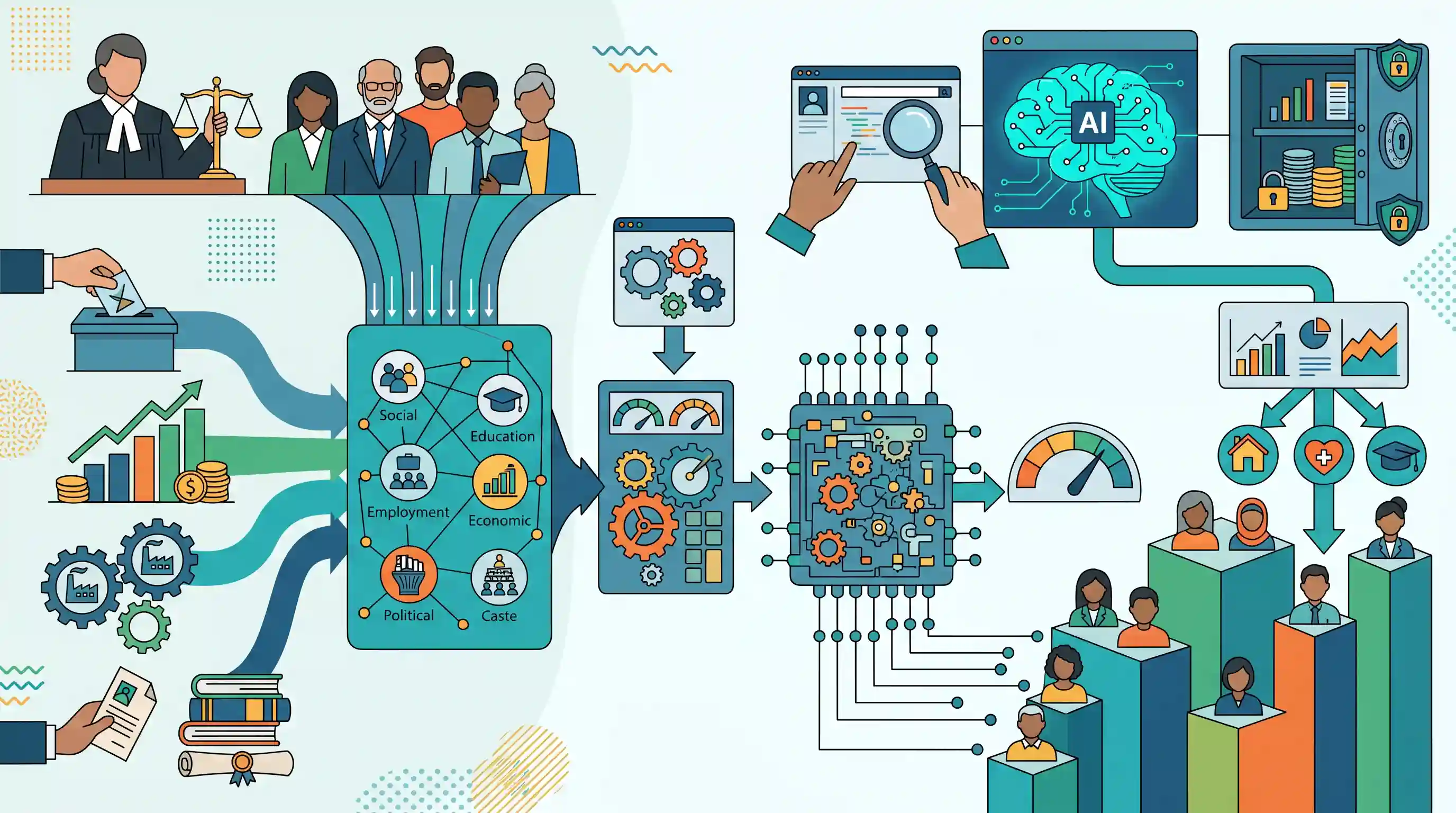
Telangana's Expert Working Group, headed by Justice Sudarshan Reddy, has finalized the methodology for measuring caste-based disparities using a Composite Backwardness Index (CBI). Built on data from the 2024 Social Education Employment Economic Political Caste (SEEEPC) Survey, the CBI evaluates 43 key parameters to provide an objective score of relative backwardness for 243 sub-castes, significantly expanding on the Mandal Commission's original 11 parameters. The group also proposed using an AI-powered interface to allow researchers to query the vast socio-economic dataset while maintaining individual privacy.
Key Points
- The Telangana government's Expert Working Group, led by retired Justice Sudarshan Reddy, has finalised the Composite Backwardness Index (CBI) to measure social and economic disparities among sub-castes.
- The CBI will provide a numerical and objective score for each sub-caste derived from 43 key parameters across seven categories, expanding significantly on the Mandal Commission's 11 parameters.
- The parameters cover social status, education, living standards, occupation, income, assets, and access to banking, utilizing data from the 2024 SEEEPC Survey.
- The 2024 SEEEPC Survey enumerated 3.55 crore individuals across 243 sub-castes, capturing nuanced data while offering options for 'No Caste' and 'Others'.
- The Expert Group recommended establishing a secure, AI-powered Natural Language interface to allow researchers to analyze the SEEEPC dataset without compromising individual privacy.
Important Terms
Composite Backwardness Index (CBI)

A data-driven scoring system (0-126) evaluating deprivation across seven socio-economic domains. It ranks 243 sub-castes by deprivation levels rather than mere population share to improve targeted welfare.
UPSC context
GS Paper II (Social Justice); explores objective, multidimensional criteria for identifying backwardness and refining reservation policies beyond binary classifications.
SEEEPC Survey
Telangana's 2024 state-wide census collecting Social, Educational, Employment, Economic, Political, and Caste data. Covering 97% of households, it provides a granular database for evidence-based policymaking.
UPSC context
GS Paper II (Welfare Schemes); highlights state-led data collection efforts for identifying vulnerable sections and ensuring equitable resource distribution.
Mandal Commission
The 1979 Second Backward Classes Commission which identified "Other Backward Classes" (OBCs) using 11 indicators. Its recommendations for 27% reservation serve as the historical benchmark for Indian affirmative action.
UPSC context
GS Paper I (Society) and GS Paper II (Social Justice); fundamental for understanding the evolution of the reservation system and OBC identification.
Justice Sudarshan Reddy Committee
The Independent Expert Working Group appointed by Telangana to analyze SEEEPC data. Chaired by retired Justice B. Sudershan Reddy, it finalized the CBI methodology to ensure scientific measurement of backwardness.
UPSC context
GS Paper II (Institutions/Bodies for vulnerable sections); demonstrates state-level judicial/expert mechanisms for addressing historical social and economic disparities.
Relative Backwardness
A concept focusing on comparative levels of deprivation among social groups. It justifies sub-categorization within reserved categories (OBC/SC/ST) to ensure benefits reach the most disadvantaged sub-castes.
UPSC context
GS Paper II (Social Justice/Judiciary); relates to the "sub-classification" debate in the Supreme Court for ensuring horizontal equity in reservations.
Prelims Trap
"The Composite Backwardness Index (CBI) is a standardized national metric developed by the NCBC to measure caste disparities."
The CBI discussed here is a state-specific index formulated by Telangana's Expert Working Group, not a central metric by NITI Aayog or NCBC.
Static Concepts Connected
How does the Constitution govern the identification of Backward Classes?
- Article 340: Empowers the President to appoint a commission to investigate the conditions of socially and educationally backward classes (SEBCs).
- Article 342A: Empowers the President to notify the Central List of SEBCs, while explicitly allowing States to maintain their own separate state-level lists (post-105th Amendment).
- Article 338B: Grants constitutional status to the National Commission for Backward Classes (NCBC) to safeguard the rights of SEBCs.
What criteria did the Mandal Commission use to identify backwardness?
- 11 Indicators: Employed 11 specific indicators grouped under three broad headings: Social, Educational, and Economic.
- Differential Weightage: Social indicators were given the highest weight (3 points each), followed by Educational (2 points) and Economic (1 point) to compute the backwardness score.
Cross-Topic Patterns
Empirical Data for Quota Sub-categorization
Telangana's CBI mirrors the national debate around the Justice Rohini Commission and the recent Supreme Court ruling allowing states to sub-categorize reserved classes based on empirical, quantifiable data.
Privacy-Preserving E-governance via AI
Using an AI interface for dataset queries without exposing PII highlights the intersection of the Digital Personal Data Protection (DPDP) Act and open government data initiatives.

Expect a 2026 question linking state-level caste surveys, the 105th Constitutional Amendment, and parameters for sub-categorizing quotas.
Linked PYQs · 4
Linked PYQs · 4
- 2022MainsGS2
Discuss the role of the National Commission for Backward Classes in the wake of its transformation from a statutory body to a constitutional body.
- 2023MainsGS1
Why is caste identity in India both fluid and static?
- 2018MainsGS1
Caste system is assuming new identities and associational forms. Hence, caste system cannot be eradicated in India." Comment.
- 2023MainsGS3
Introduce the concept of Artificial Intelligence (AI). How does Al help clinical diagnosis? Do you perceive any threat to privacy of the individual in the use of Al in healthcare?
