Telangana Land Lease Controversy and Public Resource Transparency
Source:Indian Express ↗
Why It Matters
The controversy over state land leasing to ideologically affiliated institutions touches upon the transparent management of public assets. It highlights the importance of fair governance mechanisms when dealing with trusts, civil society organizations, and educational bodies, which is highly relevant to GS2 topics on governance and the role of NGOs/trusts.
Summary
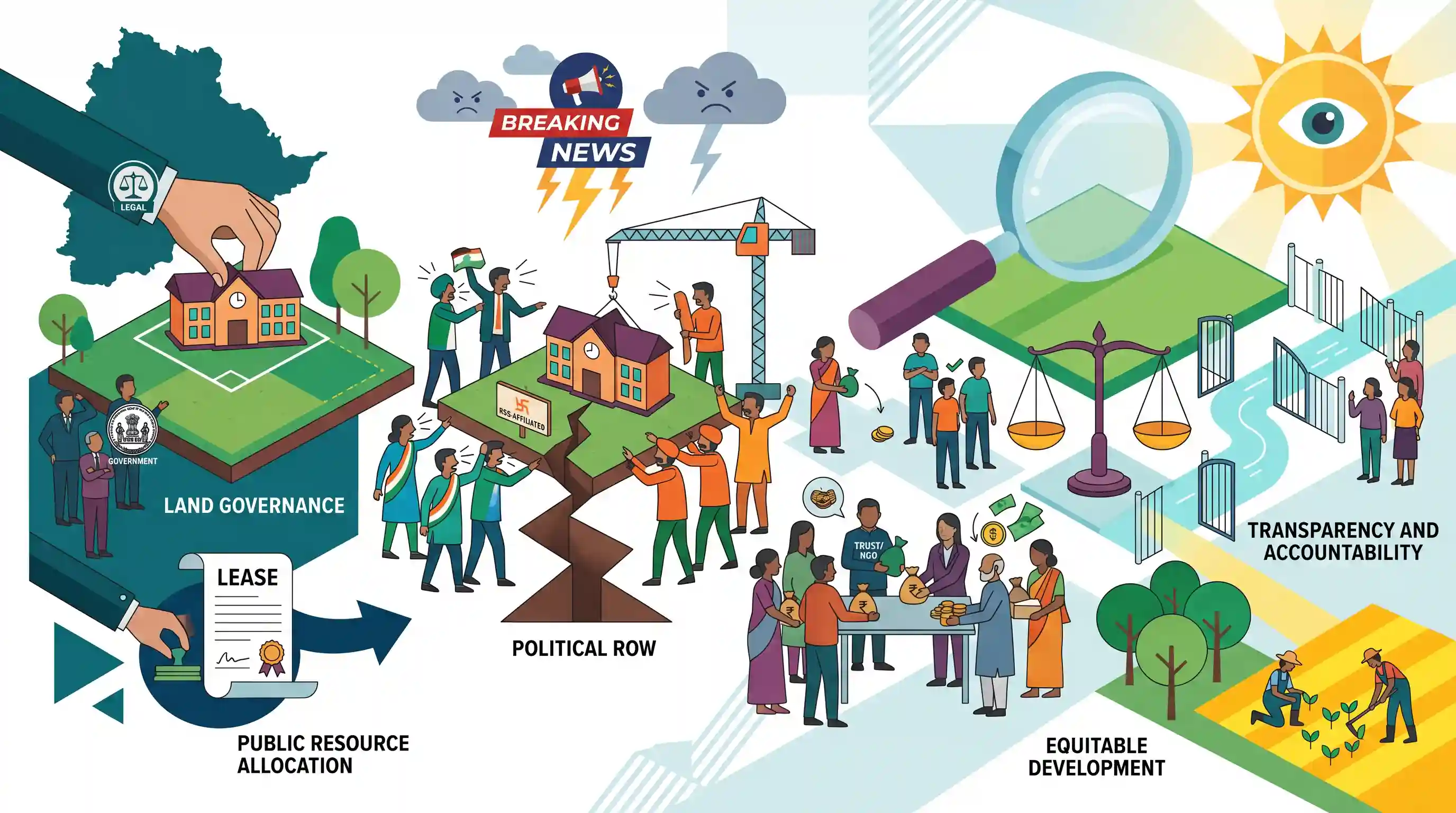
A political row has erupted in Telangana between the ruling Congress government and the BJP concerning the leasing of public land to an RSS-affiliated school. The controversy highlights the administrative and political complexities surrounding the allocation of state-owned land to private educational institutions, trusts, and civil society organizations. The dispute underlines the critical need for transparent policies in distributing public resources to ensure equitable development and prevent political patronage, while drawing attention to the broader role of charitable trusts in the education sector.
Key Points
- A major political controversy has emerged in Telangana between the Congress and the BJP over a land lease granted to an RSS-affiliated school.
- The dispute brings into focus the procedures and criteria used by state governments to allocate public land and resources to private or ideologically aligned trusts and NGOs.
- The incident raises governance questions regarding transparency, potential political patronage, and the role of charitable organizations in providing education.
Important Terms
Rashtriya Swayamsevak Sangh (RSS)

A Hindu nationalist volunteer organization founded in 1925, acting as the ideological fountainhead for various groups. It focuses on cultural unity and character building through a nationwide network.
UPSC context
GS Paper 2: Pressure groups and associations; GS Paper 1: Social empowerment and communalism vs secularism.
Indian National Congress (INC)
One of India's two major political parties, historically associated with the independence movement. It generally advocates for secularism, social democracy, and welfare-oriented governance.
UPSC context
GS Paper 2: Functions and responsibilities of the Union and the States; role of political parties.
Bharatiya Janata Party (BJP)
A major national political party in India that advocates for Hindutva (cultural nationalism) and right-leaning economic policies; it is the current ruling party at the Union level.
UPSC context
GS Paper 2: Role of opposition/ruling parties in governance and legislative processes.
Public Resource Allocation
The administrative process of distributing state-owned assets (land, funds, natural resources) to entities. It requires transparency to ensure equity and prevent political patronage.
UPSC context
GS Paper 2: Transparency and accountability; GS Paper 4: Ethics in public administration.
Land Governance
The legal and institutional framework for managing land rights, leases, and transfers. It involves balancing private development with public interest and equitable access.
UPSC context
GS Paper 3: Land reforms in India; GS Paper 2: Government policies for development.
Charitable Trusts
Non-profit legal entities established for social or educational purposes. They often manage schools and receive state support via land leases or tax exemptions to perform public service.
UPSC context
GS Paper 2: Role of NGOs, charities, and stakeholders in the development process.
Prelims Trap
The Public Trust doctrine applies exclusively to ecological and environmental resources like rivers, air, and forests.
While popularized in India by environmental cases (M.C. Mehta), the underlying principle also restricts the arbitrary disposal of general state largesse (like public land), mandating public benefit.
Static Concepts Connected
How does the Supreme Court view the distribution of state largesse like public land?
- Article 14 mandate: Distribution must be non-arbitrary, transparent, and serve public interest, rejecting absolute discretionary power of the executive.
- Public Trust Doctrine: The State acts as a trustee of public assets, meaning it cannot distribute resources based on political whims or private exploitation.
- Auction principle: Transparent processes like open tenders are the default rule; individual discretionary allotments to trusts are strict exceptions requiring public-interest justification.
What is the legal framework governing public charitable trusts in India?
- Concurrent List: Trusts and Trustees fall under Entry 10 of the Concurrent List, leading to various state-specific Public Trust Acts rather than a single national law.
- Tax Exemptions: They are regulated under the Income Tax Act (Sections 11, 12A, 80G), which mandates strict registration and auditing to prevent misuse of funds.
Cross-Topic Patterns
State Largesse + Digital Land Governance
Digitizing land registries and enforcing e-auctions connects directly to GS-2 transparency goals, reducing political patronage and bureaucratic discretion in resource allocation.
Civil Society + Political Patronage
The overlap between ruling parties and ideologically aligned trusts frequently tests civil service neutrality (GS-4) and highlights gaps in regulating state-funded NGOs (GS-2).

Expect a GS-2 mains question on the 'Public Trust Doctrine' expanding beyond environmental law into the arbitrary allocation of state largesse.
Linked PYQs · 2
Linked PYQs · 2
- 2024MainsGS2
Public charitable trusts have the potential to make India's development more inclusive as they relate to certain vital public issues. Comment.
- 2024MainsGS2
e-governance is not just about the routine application of digital technology in service delivery process. It is as much about multifarious interactions for ensuring transparency and accountability. In this context evaluate the role of the 'Interactive Service Model' of e-governance.
