Telangana Schemes for Women MSMEs and Youth Innovation
Source:The Hindu ↗
Why It Matters
The article highlights practical state-level interventions combined with national (RAMP scheme) and international (World Bank) backing to scale MSMEs and formalize women-led enterprises. It also provides examples of targeted skill development programs for rural and urban youth, which is highly relevant for GS-3 answers on employment, inclusive growth, and industrial policy, as well as GS-2 answers on social justice and women's empowerment.
Summary
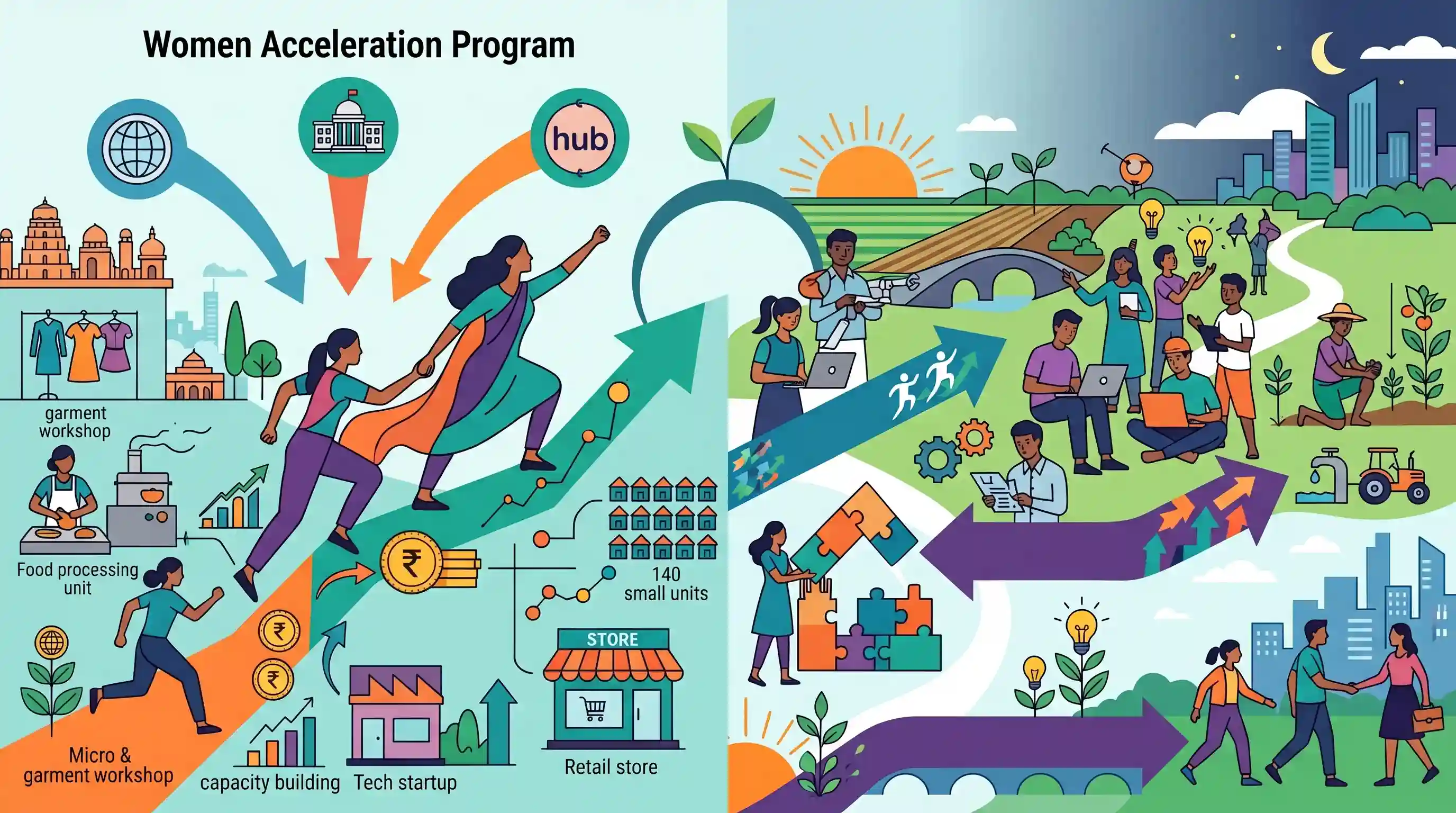
Telangana Chief Minister A. Revanth Reddy has launched two major initiatives—the Women Acceleration Program and the Grassroot Youth Innovation Program (GYIP)—to support existing women-led enterprises and cultivate entrepreneurial skills among the youth. The Women Acceleration Program, implemented by WE Hub and backed by the Union Ministry of MSME and the World Bank under the national RAMP scheme, aims to scale 140 women-led MSMEs by offering financial enablement, capacity building, and market access. Concurrently, GYIP will reach over 6,000 rural and urban youth, equipping them with job-readiness and innovation skills through tailored sub-programs like iLEAP and WE Enable.
Key Points
- Telangana government launched the Women Acceleration Program and Grassroot Youth Innovation Program (GYIP), implemented through WE Hub.
- The Women Acceleration Program aims to scale 140 women-led MSMEs, supported by the Union Ministry of MSME and the World Bank under the national RAMP scheme.
- It focuses on capacity building, tailored mentorship, financial enablement, and expanded market access for women entrepreneurs.
- The GYIP targets over 6,000 students to foster innovation and entrepreneurship, offering job readiness skills and mentorship to rural youth.
- Sub-programs include iLEAP for rural students (17-23 years) and WE Enable for urban students to explore new technology trends.
Important Terms
RAMP scheme

A World Bank-assisted Central Sector Scheme (2022-2027) aimed at improving MSME performance through better credit access, market linkages, and institutional strengthening between Centre and States.
UPSC context
GS-III (Indian Economy); tests knowledge of MSME resilience and World Bank-assisted national development frameworks.
WE Hub
India's first state-led incubator for women entrepreneurs (Telangana); acts as the nodal agency for NITI Aayog's Women Entrepreneurship Platform (WEP) to bridge policy and capital gaps.
UPSC context
GS-II (Governance/Social Justice); tests understanding of institutional models for inclusive economic empowerment and cooperative federalism.
Women Acceleration Program
A Telangana-specific flagship initiative under the RAMP scheme designed to scale 140 existing women-led MSMEs through tailored mentorship, financial enablement, and market access.
UPSC context
GS-III (Inclusive Growth); tests application of national schemes at the state level to promote women-led enterprises.
Grassroot Youth Innovation Program (GYIP)
A skill-development initiative by WE Hub focused on rural youth, providing job-readiness training, mentorship, and innovation exposure to foster grassroots entrepreneurship.
UPSC context
GS-II (Human Resources/Skill Development); tests knowledge of targeted interventions to boost youth employability and local innovation.
Ministry of MSME
The nodal Union ministry responsible for the formulation and administration of policies, laws, and regulations that promote the MSME sector in India.
UPSC context
GS-II (Statutory/Executive Bodies); tests understanding of the administrative framework supporting the 'backbone of the Indian economy'.
iLEAP
A sub-program under GYIP for students aged 17-23, focusing on 21st-century skills like critical thinking, technology trends, and hands-on innovation.
UPSC context
GS-II (Education/Skill Development); tests awareness of specific curricula aimed at bridging the industry-academia gap for youth.
WE Enable
A 12-month program by WE Hub for female college students, offering certifications and corporate exposure to build leadership and an entrepreneurial mindset.
UPSC context
GS-II (Social Justice); tests knowledge of gender-specific vocational training and economic leadership programs for students.
Campuspreneur
A 12-week ideation-to-prototype program within GYIP helping students in Tier 2 and Tier 3 regions transform innovative ideas into viable business models.
UPSC context
GS-III (Innovation/Startups); tests understanding of programs decentralizing the startup ecosystem to non-metropolitan regions.
Prelims Trap
The RAMP scheme is a state-level MSME initiative launched and funded exclusively by the Telangana government.
RAMP is actually a Central Sector Scheme under the Union Ministry of MSME, supported by the World Bank. Telangana's program merely utilizes its backing.
Static Concepts Connected
What are the key features of the RAMP scheme?
- Scheme Type: It is a Central Sector Scheme implemented by the Ministry of MSME.
- Funding: It is assisted by the World Bank to revitalize the MSME sector post-COVID.
- Core Objectives: Focuses on improving market access, credit flow, technology upgradation, and addressing delayed payments to MSMEs.
What are the structural barriers to female entrepreneurship in India?
- Care Economy: Disproportionate burden of domestic unpaid care work restricts transition into the formal monetized economy.
- Credit Gap: Lack of property rights and collateral limits women's access to institutional finance and credit scaling.
- Network Deficit: Restricted mobility and societal norms limit access to professional networks, mentorship, and broader market linkages.
Cross-Topic Patterns
World Bank funding + Cooperative Federalism
State-led incubators (WE Hub) leveraging Central schemes (RAMP) backed by the World Bank showcase collaborative federalism and multilateral support in scaling localized MSMEs.
MSME Incubation + Demographic Dividend
Linking women-led MSME incubation with youth skilling addresses both gender disparity in FLFPR and the macro-economic challenge of realizing India's demographic dividend.

Expect a 2026 Prelims statement linking the World Bank-backed RAMP scheme directly to female MSME formalization and capacity building.
Linked PYQs · 4
Linked PYQs · 4
- 2023MainsGS3
Faster economic growth requires increased share of the manufacturing sector in GDP, particularly of MSMEs. Comment on the present policies of the Government in this regard.
- 2021MainsGS2
Can the vicious cycle of gender inequality, poverty and malnutrition be broken through microfinancing of women SHGs? Explain with examples.
- 2023MainsGS3
Distinguish between 'care economy' and 'monetized economy'. How can care economy be brought into monetized economy through women empowerment?
- 2015MainsGS2
The Self-Help Group (SHG) Bank Linkage Programme (SBLP), which is India's own innovation, has proved to be one of the most effective poverty alleviation and women empowerment programmes. Elucidate.
