Telangana raises concern over central procurement levels at MSP
Source:The Hindu ↗
Why It Matters
Highlights the ongoing Centre-State friction regarding agricultural procurement and the financial burden placed on states. It also touches upon urban environmental conservation (Musi river) and the socio-economic impact of infrastructure-induced displacement.
Summary
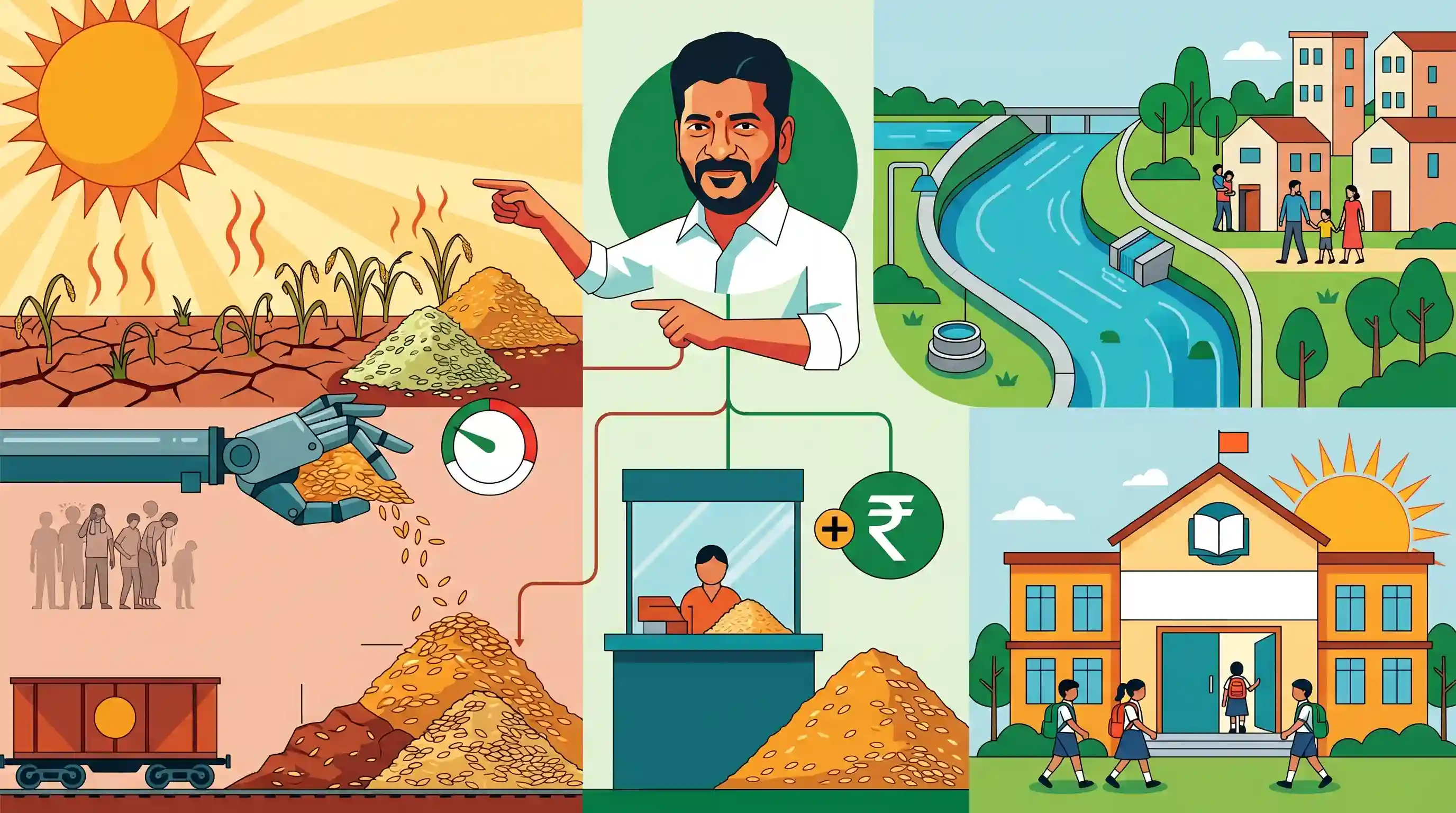
Telangana Chief Minister A. Revanth Reddy raised concerns over the Central government's failure to procure adequate food grains at Minimum Support Price (MSP), stating that less than 30% of the produce was being purchased. This, combined with extreme heat and a labor shortage from West Bengal, forced the state government to shoulder the procurement burden, including offering a ₹500 per quintal bonus for fine rice. Additionally, the Chief Minister announced local rehabilitation plans for families affected by the Musi river rejuvenation project and detailed upcoming educational reforms, such as the opening of Telangana Public Schools.
Key Points
- Telangana CM Revanth Reddy criticized the Central government for procuring less than 30% of the state's food grains at Minimum Support Price (MSP).
- State procurement of paddy faced delays due to a shortage of workers (hamalis) from West Bengal and severe heat conditions.
- The state government stepped in to purchase fine rice, offering an additional bonus of ₹500 per quintal, and also procured maize at support prices.
- Families displaced by the Musi river rejuvenation project will be rehabilitated locally, with plans to develop the riverfront into a major tourist destination.
- The state is advancing educational reforms, including providing quality meals for students and launching Telangana Public Schools.
Important Terms
Minimum Support Price (MSP)

The guaranteed minimum price at which the government purchases crops from farmers to protect them from market fluctuations and ensure food security.
UPSC context
GS Paper III: Agriculture and Food Security; key for understanding farmer welfare, market interventions, and PDS.
Musi River Rejuvenation Project
An initiative to restore the ecological health and urban landscape of the polluted Musi River in Hyderabad through redevelopment, sewage treatment, and riverfront beautification.
UPSC context
GS Paper I & III: Urbanization and Environment; tests knowledge of river ecosystems, displacement, and sustainable urban development.
Rythu Bharosa
A flagship Telangana state scheme providing direct financial assistance (investment support) per acre to farmers for purchasing agricultural inputs like seeds and fertilizers.
UPSC context
GS Paper II & III: Government Schemes and Agriculture; relevant for state-led welfare models and direct benefit transfers (DBT).
Decentralized Procurement (DCP)
A system where state governments procure, store, and distribute food grains for the Public Distribution System (PDS) locally, with expenses reimbursed by the Central Government.
UPSC context
GS Paper III: Public Distribution System (PDS); focuses on the operational efficiency and fiscal dynamics between Centre and States.
Food Corporation of India (FCI)
The central nodal agency under the Ministry of Consumer Affairs responsible for procuring, storing, and distributing food grains to maintain national food security.
UPSC context
GS Paper III: Food Security and PDS; essential for understanding the infrastructure of India's grain management.
Commission for Agricultural Costs and Prices (CACP)
A statutory body that recommends Minimum Support Prices (MSP) for various crops by analyzing production costs, market trends, and demand-supply conditions.
UPSC context
GS Paper III: Agriculture; tests understanding of the institutional framework behind agricultural pricing policy.
Prelims Trap
States providing financial bonuses above the central MSP receive higher procurement quotas from the Food Corporation of India.
False. Under Central guidelines (based on Shanta Kumar Committee inputs), if a state offers a bonus over MSP, FCI restricts its central pool procurement to only the state's local PDS requirement.
Static Concepts Connected
What is the Decentralised Procurement Scheme (DCP) for food grains?
- Mechanism: Introduced in 1997-98, it allows state agencies to procure, store, and distribute grains for PDS on behalf of the Central government.
- Financial Reimbursement: The Centre reimburses the entire 'economic cost' (MSP + incidentals) to the State government.
- Core Objective: Designed to reduce FCI's transit losses and transport costs while expanding the reach of MSP to non-traditional grain-producing states.
What are the key geographical features of the Musi River?
- Origin: It originates in the Ananthagiri Hills of Ranga Reddy district in Telangana.
- Confluence: It is a major left-bank tributary of the Krishna River, ultimately joining it at Wadapally.
- Historic Dams: Osman Sagar and Himayat Sagar reservoirs were constructed across Musi and its tributary Esi by M. Visvesvaraya after the 1908 floods.
Cross-Topic Patterns
Agri-supply chains & migrant labour dependency
The delay in Telangana's paddy procurement due to missing hamalis (workers) from West Bengal underscores how deeply Southern agricultural logistics and mandi operations rely on Eastern Indian migrant labour.
State agricultural bonuses & market distortions
Telangana's ₹500 bonus reflects competitive populism. The Shanta Kumar Committee previously warned that such state-level bonuses distort crop parity, crowd out private trade, and complicate Centre-State procurement equations.

Expect a multi-statement question linking MSP procurement mechanics, state-declared bonuses, and the Decentralised Procurement Scheme (DCP).
Linked PYQs · 5
Linked PYQs · 5
- 2018MainsGS3
What do you mean by Minimum Support Price (MSP)? How will MSP rescue the farmers from the low income trap?
- 2020PrelimsGS1
Consider the following statements: 1. In the case of all cereals, pulses and oil-seeds, the procurement at Minimum Support Price (MSP) is unlimited in any State/UT of India. 2. In the case of cereals and pulses, the MSP is fixed in any State/UT at a level to which the market price will never rise. Which of the statements given above is/are correct?
- 2019PrelimsGS1
The economic cost of food grains to the Food Corporation of India is Minimum Support Price and bonus (if any) paid to the farmers plus
- 2001PrelimsGS1
The prices at which the Government purchases food grains for maintaining the public distribution system and for building up buffer stocks is known as
- 2024MainsGS3
Industrial pollution of river water is a significant environmental issue in India. Discuss the various mitigation measures to deal with this problem and also the government's initiatives in this regard.
