Telangana Chief Minister Surveys Flood Hit Districts After Cyclone
Source:The Hindu ↗
Why It Matters
Highlights the immediate administrative response to natural disasters and underscores the vulnerability of the agricultural sector to extreme weather events (like cyclones and floods), demonstrating the need for robust disaster relief and crop insurance mechanisms.
Summary
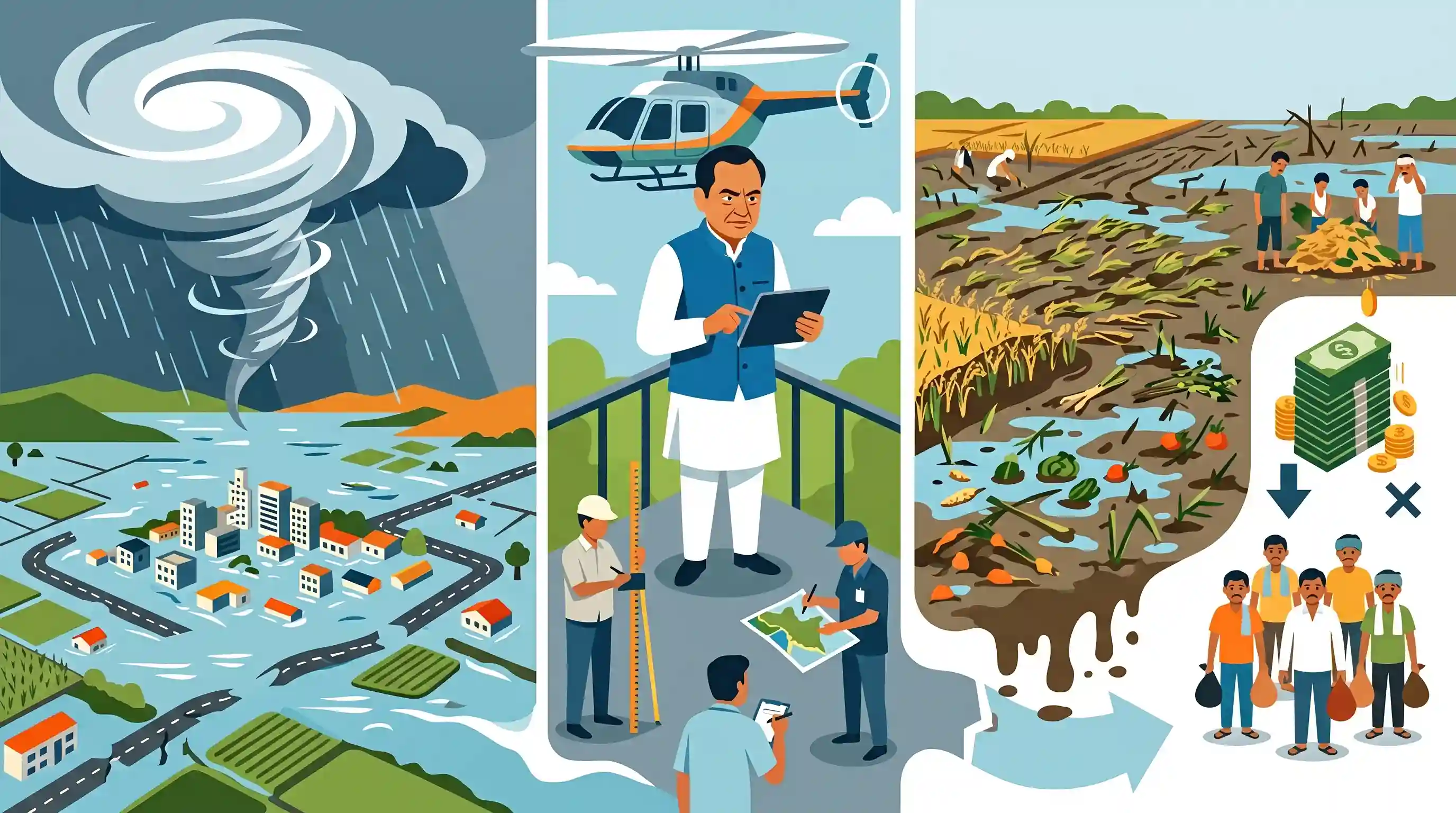
Telangana Chief Minister A. Revanth Reddy undertook an aerial survey of the Warangal and Hanamkonda districts, which experienced severe flooding due to cyclone Montha. The state government is evaluating the widespread agricultural damage, with initial estimates indicating crop loss over 4.48 lakh acres impacting more than 2.53 lakh farmers, highlighting the significant economic toll of extreme weather events on agriculture.
Key Points
- Telangana Chief Minister A. Revanth Reddy conducted an aerial survey of flood-hit Warangal and Hanamkonda districts.
- The flooding and damage were caused by cyclone Montha.
- Extensive crop damage was reported, with Agriculture Minister Tummala Nageswar Rao estimating losses across 4.48 lakh acres affecting 2.53 lakh farmers.
- The state government is assessing the ground-level damage to expedite relief and compensation for affected farmers.
Prelims Trap
SDRF norms compensate farmers for crop loss only if it exceeds 50%.
The threshold was reduced in 2015. Farmers are eligible for input subsidies under SDRF/NDRF if the assessed crop loss is 33% or more, making 50% an outdated trap.
Static Concepts Connected
How does SDRF differ from PMFBY for agricultural crop loss?
- Nature of relief: SDRF provides immediate, basic input subsidies as a relief measure. PMFBY is a structural financial safety net providing comprehensive yield-based insurance compensation.
- Damage threshold: SDRF triggers relief for farmers when assessed crop damage reaches or exceeds 33%. PMFBY relies on actuarial crop-cutting experiments to determine exact shortfall.
- Funding structure: SDRF is a center-state fund (75:25 for general states). PMFBY involves upfront farmer premiums heavily subsidized by both central and state governments.
Why do cyclones cause severe flooding in non-coastal inland districts?
- Moisture dumping: As cyclones move inland, they lose their oceanic energy source but dump their massive accumulated moisture as intense, localized freshwater rainfall.
- Orographic lift: Inland topography and terrain gradients force moist cyclonic air masses upwards, drastically exacerbating precipitation and causing rapid flash floods in river catchments.
Cross-Topic Patterns
Cyclone decay and inland hydrology
Inland flooding from decaying cyclones accounts for massive agricultural damage, requiring GIS-based Flood Hazard Zonation mapping for inland districts rather than just traditional coastal evacuation plans.
Climate extremes vs. PMFBY viability
Increasing frequency of inland flooding events strains the actuarial viability of PMFBY, prompting a need to integrate climate-resilient cropping patterns with agricultural insurance frameworks.

Expect a multi-statement question linking inland cyclonic rainfall, SDRF crop loss thresholds (33%), and PMFBY post-harvest loss coverage.
Linked PYQs · 2
Linked PYQs · 2
- 2020MainsGS3
Discuss the recent measures initiated in disaster management by the Government of India departing from the earlier reactive approach.
- 2017MainsGS3
How do subsidies affect the cropping pattern, crop diversity and economy of farmers? What is the significance of crop insurance, minimum support price and food processing for small and marginal farmers?
