Telangana Government Rehabilitation Package for Surrendered Maoists
Source:The Hindu ↗
Why It Matters
The mass surrender of Maoists demonstrates the impact of effective surrender and rehabilitation policies in addressing internal security threats. It is highly relevant for GS Paper 3 (Internal Security) regarding strategies to counter Left Wing Extremism (LWE) and the role of socio-economic reintegration in lasting peace.
Summary
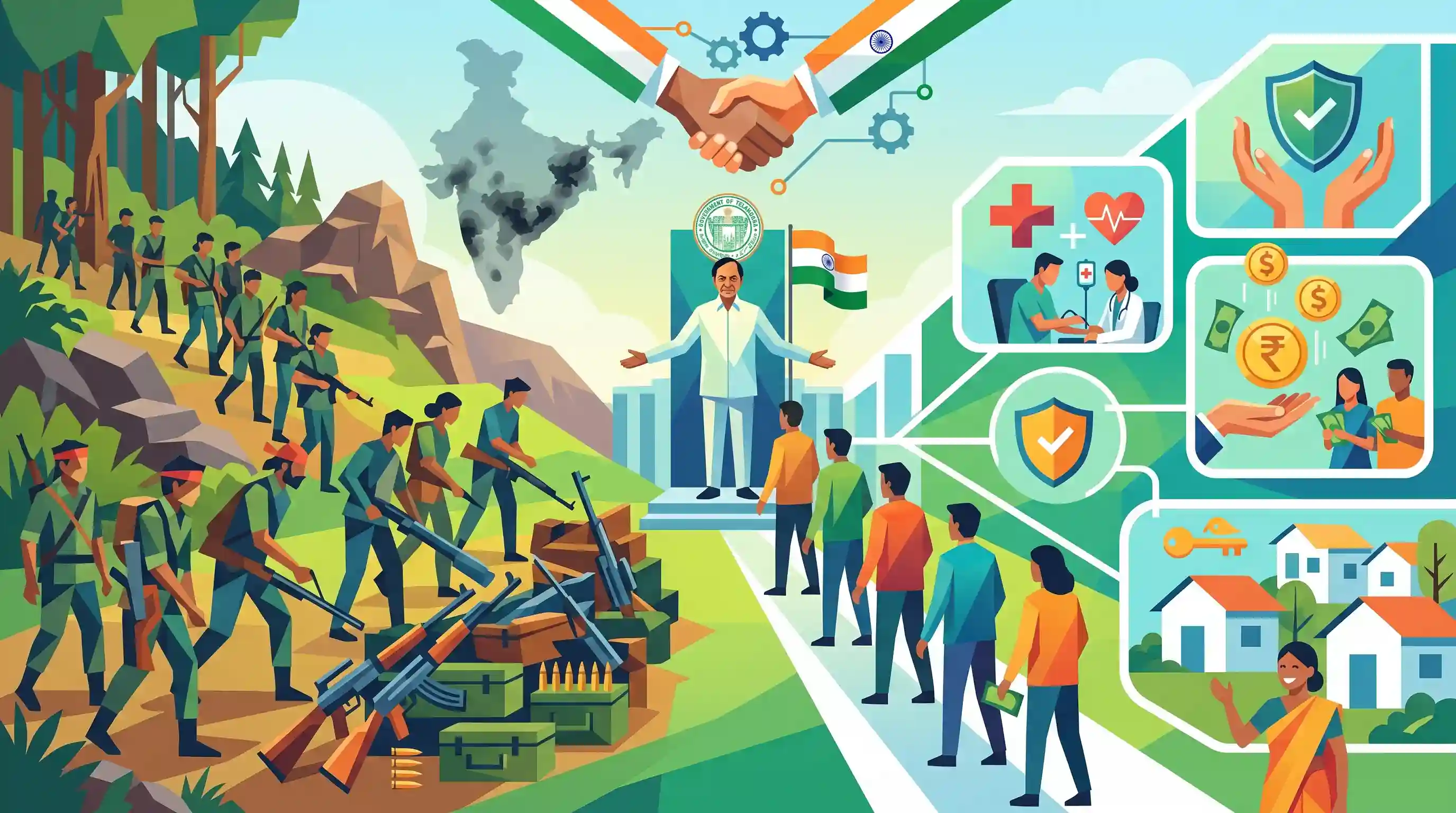
In a significant development for internal security, 130 Maoist cadres surrendered to the Telangana government, surrendering a substantial cache of arms and ammunition. Chief Minister A. Revanth Reddy appealed to underground cadres of the banned CPI (Maoist) to join the mainstream, assuring them of safety and support. The state government announced a robust rehabilitation package, including healthcare access under the Arogya Bhadratha scheme, financial rewards, and housing under the Indiramma scheme. This mass surrender highlights the effectiveness of state-led rehabilitation policies in countering Left Wing Extremism (LWE) and underscores the need for continued coordination between state governments and the Centre to eliminate Naxalism across affected regions.
Key Points
- 130 Maoist cadres, including senior leaders, surrendered before the Telangana government, handing over 124 firearms and 5,205 rounds of ammunition.
- Telangana Chief Minister A. Revanth Reddy assured surrendered Maoists of safety, support, and comprehensive rehabilitation measures to help them join the mainstream.
- The rehabilitation package includes medical cards under the Arogya Bhadratha scheme, financial rewards, and potential allocation of land or Indiramma houses based on cadre rank.
- The issue of Naxalism extends beyond Telangana, requiring coordinated efforts with the Centre and neighboring states like Chhattisgarh, Jharkhand, and Maharashtra.
Important Terms
CPI (Maoist)

A banned far-left militant organization formed in 2004, designated as a terrorist group under UAPA. It seeks to overthrow the Indian state through armed 'Protracted People's War.'
UPSC context
GS Paper III: Internal Security; focuses on challenges from non-state actors and the 'Red Corridor' insurgency.
Left Wing Extremism (LWE)
Also known as Naxalism, it is an armed insurgency by Maoist groups aiming to overthrow the government. It is considered India's single largest internal security challenge.
UPSC context
GS Paper III: Security; essential for understanding the internal security environment and state response strategies.
Special Intelligence Branch (SIB)
Telangana's elite intelligence wing dedicated to monitoring and neutralizing Left Wing Extremism. It works alongside the Greyhounds commando unit to conduct anti-Maoist operations.
UPSC context
GS Paper III: Security Forces and their Mandate; highlights specialized state agencies in counter-insurgency.
Arogya Bhadratha scheme
A comprehensive health insurance and medical assistance scheme in Telangana. While primarily for police personnel, it is used as a rehabilitation tool for surrendered Maoists.
UPSC context
GS Paper II: Government Policies; tests knowledge of welfare-based rehabilitation as a counter-radicalization strategy.
Indiramma housing scheme
A Telangana state welfare initiative providing housing (Indiramma Indlu) or land to the poor. It serves as a social incentive in the Maoist surrender-and-rehabilitation policy.
UPSC context
GS Paper II: Social Justice; relevant to schemes for vulnerable sections and regional development.
Unlawful Activities (Prevention) Act (UAPA)
India’s primary anti-terror law used to ban organizations (like CPI-Maoist) and prosecute acts that threaten the sovereignty and integrity of the country.
UPSC context
GS Paper III: Security; crucial legal framework for managing internal threats and terrorism.
Prelims Trap
Surrender and Rehabilitation policies for LWE cadres are exclusively formulated and funded by the Union Government.
While the Centre provides guidelines and reimbursement under the SRE scheme, state governments design specific policies and add local welfare benefits like housing.
Static Concepts Connected
What is the SAMADHAN doctrine for countering Left Wing Extremism?
- Multi-pronged strategy: Introduced in 2017 by the MHA, it encompasses a holistic approach involving security, development, and ensuring the rights and entitlements of local communities.
- Core Pillars: Stands for Smart leadership, Aggressive strategy, Motivation/Training, Actionable intelligence, Dashboard KPIs, Harnessing tech, Action plan, and No access to financing.
How does the Government address the developmental vacuum in LWE areas?
- Infrastructure buildout: Implementation of the Road Requirement Plan (RRP) and specific telecom connectivity projects to physically and digitally integrate remote, forested tribal pockets.
- Socio-economic focus: Deploying Special Central Assistance (SCA) for most affected districts and ensuring strong convergence with the Aspirational Districts Programme for health and education.
Cross-Topic Patterns
LWE decline & Aspirational Districts
The reduction in LWE violence is heavily linked to targeted developmental schemes in Aspirational Districts, which deny Maoists their core local support base by addressing socio-economic disparities.
Federalism in Internal Security
Operations in the 'Red Corridor' demand robust inter-state coordination. Sharing intelligence and forming joint task forces across porous state borders is a key test of cooperative federalism in security management.

With the MHA's March 2026 target to eliminate LWE, expect a Mains Q evaluating the SAMADHAN doctrine against state-led rehab policies.
Linked PYQs · 4
Linked PYQs · 4
- 2022MainsGS3
Naxalism is a social, economic and developmental issue manifesting as a violent internal security threat. In this context, discuss the emerging issues and suggest a multilayered strategy to tackle the menace of Naxalism.
- 2018MainsGS3
Left Wing Extremism (LWE) is showing a downward trend, but still affects many parts of the country. Briefly explain the Government of India's approach to counter the challenges posed by LWE.
- 2025MainsGS3
The Government of India recently stated that Left Wing Extremism (LWE) will be eliminated by 2026. What do you understand by LWE and how are the people affected by it? What measures have been taken by the government to eliminate LWE?
- 2015MainsGS3
The persisting drives of the Government for development of large industries in backward areas have resulted in isolating the tribal population and the farmers who face multiple displacements. With Malkangiri and Naxalbari foci, discuss the corrective strategies needed to win the Left Wing Extremism (LWE) doctrine affected citizens back into the mainstream of social and economic growth.
