Telangana Backward Classes Reservation Protests and Public Order
Source:Indian Express ↗
Why It Matters
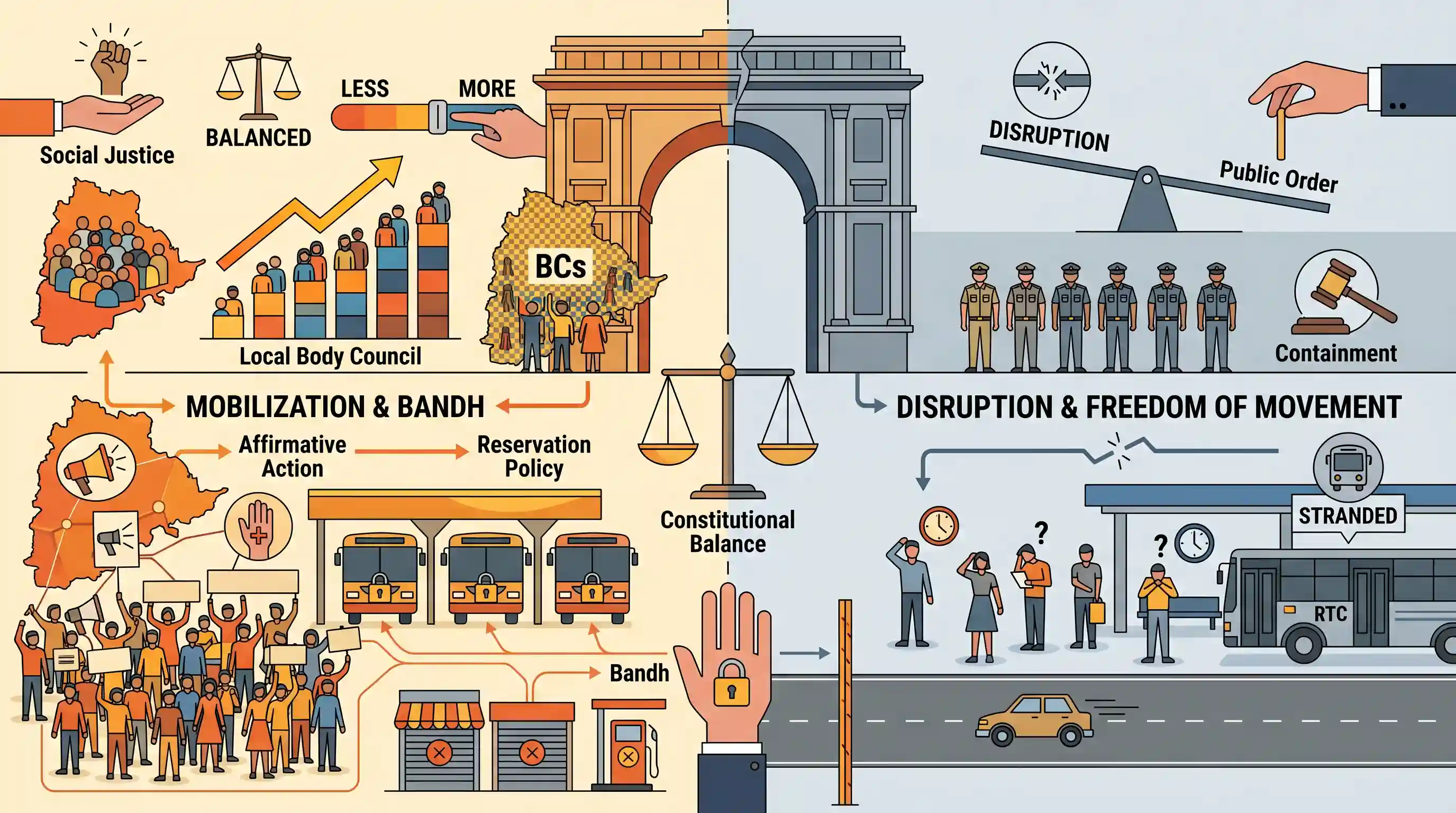
Demands for expanding Backward Classes reservations often lead to large-scale protests, raising constitutional questions regarding the legal limits of affirmative action and the delicate balance between democratic rights to protest and the maintenance of public order under Article 19.
Summary
A statewide bandh was observed in Telangana demanding an increase in reservations for Backward Classes (BCs), leading to the closure of shops and significant disruptions in public transportation. The mobilization highlights ongoing socio-political demands for equitable political representation and affirmative action, particularly concerning local body quotas. Furthermore, the disruption of essential services and daily life brings into focus the constitutional balance between the right to protest and the state's mandate to maintain public order and ensure citizens' freedom of movement.
Key Points
- A statewide bandh was organized in Telangana to demand increased reservation quotas for Backward Classes (BCs), impacting businesses and public transport.
- The agitation reflects ongoing socio-political mobilization for proportional representation, often tied to demands for a comprehensive caste census and local body election quotas.
- The event highlights the constitutional friction between the fundamental right to protest peacefully and other fundamental rights, such as the freedom of movement and trade, which are subject to reasonable restrictions under public order.
- The demand for enhanced quotas ties into the broader national debate over reservation limits (like the 50% ceiling established in the Indra Sawhney case) and the role of constitutional bodies like the NCBC.
Important Terms
Affirmative Action

Government policies aimed at favoring marginalized groups (SCs, STs, OBCs) through quotas in education and public employment to redress historical injustices and ensure social equity.
UPSC context
GS Paper 2: Social Justice; tests understanding of 'Positive Discrimination' and constitutional provisions under Articles 15 and 16.
Backward Classes (BCs)
Sections of society identified as socially and educationally backward. The Constitution (Articles 15(4) and 16(4)) empowers the State to make special provisions for their advancement.
UPSC context
GS Paper 2: Polity/Governance; tests knowledge of reservation criteria, the Mandal Commission, and the creamy layer concept.
Local Body Quotas
Reservation of seats for SCs, STs, and BCs in Panchayats and Municipalities under Articles 243D and 243T. For BCs, this often requires fulfilling the 'Triple Test'.
UPSC context
GS Paper 2: Governance/Decentralization; critical for questions on the 73rd and 74th Constitutional Amendment Acts.
Right to Protest
A fundamental right derived from Article 19(1)(a) and (b), allowing peaceful assembly and expression of dissent, subject to 'reasonable restrictions' like public order.
UPSC context
GS Paper 2: Fundamental Rights; tests the balance between individual liberties and state responsibility to maintain order.
Bandh
A form of protest involving a total strike. The Supreme Court (Bharat Kumar case) ruled forced bandhs unconstitutional for infringing upon the fundamental rights of other citizens.
UPSC context
GS Paper 2: Polity/Judiciary; relates to legal precedents on public order and the limits of collective agitation.
Indra Sawhney Judgment
A landmark 1992 Supreme Court ruling that upheld 27% OBC reservation while capping total reservations at 50% and introducing the 'creamy layer' exclusion.
UPSC context
GS Paper 2: Significant Judgments; essential for any discussion on the evolution of reservation policy in India.
Prelims Trap
The Constitution mandates proportional reservation of seats for Backward Classes in all Panchayats under the 73rd Amendment Act.
False. While the 73rd Amendment mandates reservations for SCs, STs, and women, Article 243D(6) explicitly leaves reservations for Backward Classes in Panchayats to the discretion of the State Legislature.
Static Concepts Connected
Are forced bandhs protected under the Fundamental Right to Protest?
- Right to Protest: Implicit in Article 19(1)(a) [Freedom of Speech] and Article 19(1)(b) [Peaceful assembly], subject to reasonable restrictions.
- Unconstitutionality of Bandhs: The Supreme Court ruled (CPI(M) vs Bharat Kumar, 1997) that calling for and enforcing a 'bandh' is unconstitutional.
- Conflict of Rights: Forced closures inherently involve coercion, violating other citizens' fundamental rights to free movement (Article 19(1)(d)) and livelihood (Article 21).
What is the Supreme Court's "Triple Test" for OBC reservations in local bodies?
- Empirical Data: Establish a dedicated Commission to gather rigorous empirical inquiry into the nature and implications of backwardness qua local bodies.
- Proportion Specification: Specify the proportion of reservation required to be provisioned local body-wise based on the Commission's recommendations.
- 50% Ceiling: Ensure the aggregate reservation (SC/ST/OBC) does not exceed 50% of the total seats reserved.
Cross-Topic Patterns
Caste Census driving Local Body Quotas
Demands for statewide caste censuses are increasingly tied to fulfilling the Supreme Court's "Triple Test" mandate, requiring contemporary empirical data to justify OBC local body reservations.
NCBC elevation and Federal Friction
The 102nd Amendment elevated the NCBC to a constitutional body (Art 338B), leading to a Supreme Court case that required the 105th Amendment to restore states' powers to identify backward classes.

Expect a multi-statement Prelims question contrasting mandatory SC/ST Panchayat quotas with discretionary OBC quotas and the Triple Test.
Linked PYQs · 4
Linked PYQs · 4
- 2022MainsGS2
Discuss the role of the National Commission for Backward Classes in the wake of its transformation from a statutory body to a constitutional body.
- 2023PrelimsGS1
Consider the following organizations/bodies in India: 1. The National Commission for Backward Classes 2. The National Human Rights Commission 3. The National Law Commission 4. The National Consumer Disputes Redressal Commission How many of the above are constitutional bodies?
- 2023PrelimsGS1
Consider the following statements: Statement-I: The Supreme Court of India has held in some judgements that the reservation policies made under Article 16(4) of the Constitution of India would be limited by Article 335 for maintenance of efficiency of administration. Statement-II: Article 335 of the Constitution of India defines the term 'efficiency of administration'. Which one of the following is correct in respect of the above statements?
- 2022MainsGS2
“Right of movement and residence throughout the territory of India are freely available to the Indian citizens, but these rights are not absolute.” Comment.
