Tejashwi Yadav Issues Ultimatum Over Protester Arrests
Source:The Hindu ↗
Why It Matters
Understanding the dynamics of student movements and political agitations in Bihar is important for the State Politics segment of BPSC. The right to peaceful assembly and reasonable restrictions on fundamental rights frequently appear in Polity questions.
Summary
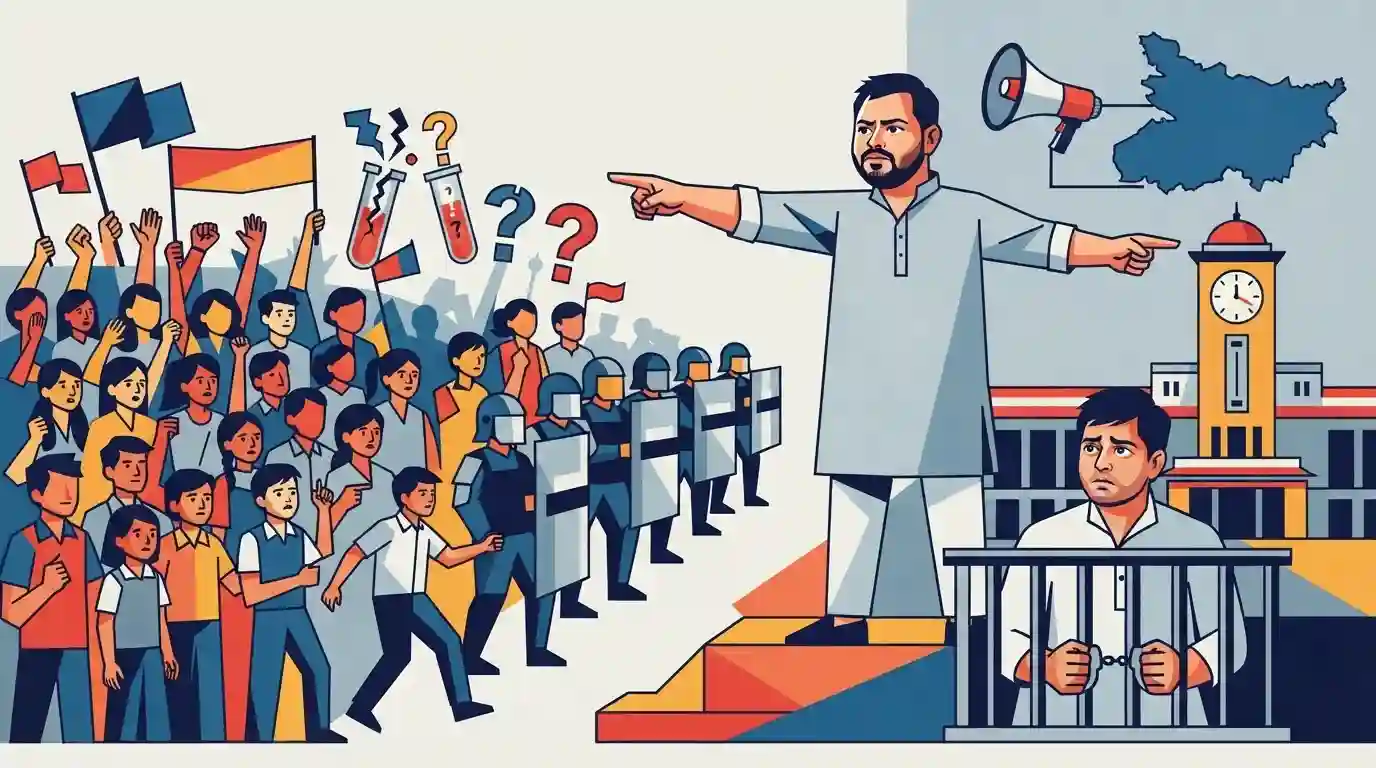
Bihar's Leader of the Opposition, Tejashwi Yadav, has threatened to resume statewide protests if the state government fails to release his brother, Tej Pratap Yadav, and several student protestors within 24 hours. The individuals were detained during an agitation against the alleged irregularities in the NEET medical entrance exam. Emphasizing the democratic right to peaceful protest, Yadav strongly criticized the police crackdown on students, signaling escalating political tensions in the state over the examination controversy.
Key Points
- Leader of Opposition in Bihar, Tejashwi Yadav, issued a 24-hour ultimatum to the state government to release his brother Tej Pratap Yadav and other student protestors.
- The arrests occurred during a student-led protest demanding accountability over the alleged NEET examination paper leak.
- Yadav condemned the police action against the protestors as a suppression of democratic rights and threatened to launch statewide agitations if their demands are unmet.
- The incident highlights political friction in Bihar and underscores widespread youth unrest concerning the integrity of major public examinations.
Important Terms
National Eligibility cum Entrance Test (NEET)

A national-level medical entrance examination in India conducted by the National Testing Agency (NTA). Recently marred by paper leaks and irregularities, it sparked nationwide student protests demanding transparency and structural reforms in high-stakes public examinations.
UPSC context
GS Paper 2 (Governance & Education). Tests knowledge of transparency, institutional accountability, and examination reforms.
All India Students' Association (AISA)
A left-wing student organization in India that led significant public protests, including the 'Bihar Bandh', against the recent NEET-UG paper leaks. They advocate for student rights, transparent examination processes, and government accountability.
UPSC context
GS Paper 2 (Role of Civil Society & Pressure Groups). Highlights the impact of student movements on democratic accountability.
Rashtriya Janata Dal (RJD)
A prominent regional political party based in Bihar, currently acting as the principal state opposition. Led by Tejashwi Yadav, the party has actively mobilized political support for student protests against the NEET-UG examination irregularities.
UPSC context
GS Paper 2 (State Politics & Role of Opposition). Demonstrates how regional parties leverage public issues to challenge the ruling government.
Right to Protest (Article 19)
A democratic right derived from Article 19(1)(b) of the Constitution, guaranteeing the freedom to assemble peacefully without arms. It is not absolute and is subject to reasonable restrictions to maintain public order and state security.
UPSC context
GS Paper 2 (Indian Constitution). Frequently tested regarding the balance between fundamental rights (freedom of assembly) and public order.
Prelims Trap
"The Public Examinations Act, 2024 penalizes individual student candidates caught cheating with up to 5 years of imprisonment."
The 2024 Act strictly targets organized syndicates and service providers. Individual candidates caught cheating are exempt from this law's penalties and face administrative action instead.
Static Concepts Connected
How is the 'Right to Protest' constitutionally protected and restricted?
- Constitutional Basis: It is not explicit, but derived from a combined reading of Article 19(1)(a) (speech/expression) and Article 19(1)(b) (peaceful assembly).
- Reasonable Restrictions: Under Article 19(3), the state can impose restrictions on peaceful assembly specifically for sovereignty, integrity of India, and public order.
- SC Guidelines: In Amit Sahni v. Commissioner of Police (Shaheen Bagh case), the SC ruled that public spaces and roads cannot be occupied indefinitely for protests.
What are the key penal features of the Public Examinations Act, 2024?
- Nature of Offences: All offences under the Act are categorized as cognizable, non-bailable, and non-compoundable.
- Punishment: Organized cheating syndicates face 5 to 10 years of imprisonment and a minimum fine of ₹1 crore.
- Target Audience: The legislation targets examination service providers, administrative facilitators, and organized crime rings rather than individual test-takers.
Cross-Topic Patterns
Protest Rights vs. Preventive Policing
Frequent use of preventive detention or prohibitory orders during student protests connects Article 19(2) and (3) restrictions directly with executive policing powers under the new Bharatiya Nagarik Suraksha Sanhita (BNSS).
Exam Integrity & Demographic Dividend
Recurring paper leaks (like NEET) are increasingly framed in Mains as a barrier to realizing India's demographic dividend, linking examination governance failures directly to human capital underutilization.

Expect a Prelims question combining Art 19 assembly restrictions with the specific candidate exemptions under the 2024 Public Exams Act.
Linked PYQs · 1
Linked PYQs · 1
- 2025BPSC_PRELIMSGS1
The constitution of India provides for reasonable restrictions on Fundamental Rights but reasonableness must keep in mind that: 1. The restrictions must be necessary for the protection of the rights of others. 2. The restrictions must be proportionate to the end sought. 3. The restrictions must be reasonable in the light of the circumstances. 4. The restrictions must be in the public interest.
