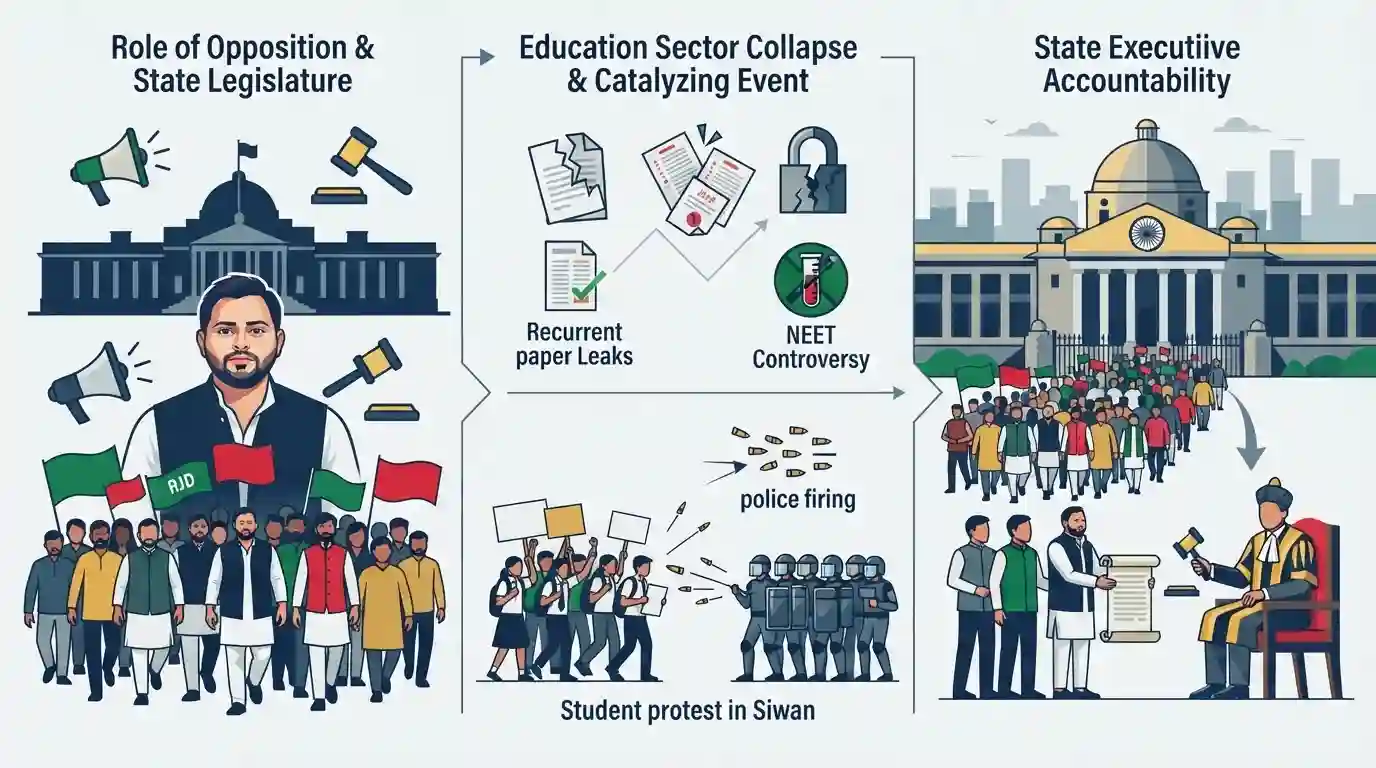
RJD announces Raj Bhavan march over paper leaks and police firing
Source:the-print ↗
Why It Matters
This event is significant for BPSC aspirants as it touches upon the practical dynamics of state politics, the role of the opposition in holding the executive accountable, and the administrative challenges in the education sector (paper leaks). It also highlights the constitutional role of the Governor as the avenue for political grievances.
Summary
RJD leader and Leader of Opposition in the Bihar Assembly, Tejashwi Yadav, announced a protest march to the Raj Bhavan on August 19 to highlight the alleged failures of the Nitish Kumar-led NDA government. The march focuses on the collapse of the examination system, citing recurrent paper leaks such as the NEET exam controversy, and the deteriorating law and order situation. A key trigger for the protest was a recent incident in Siwan where police allegedly fired on students protesting exam irregularities. By marching to the Raj Bhavan, the opposition aims to petition the Governor, the constitutional head of the state, demanding accountability and intervention.
Key Points
- Leader of Opposition Tejashwi Yadav has called for a march to the Raj Bhavan on August 19 to protest against the Bihar government.
- The primary grievance revolves around the complete collapse of the state's examination system, highlighted by recent paper leaks including the national-level NEET exam.
- The RJD is also protesting against the deteriorating law and order situation, specifically citing a recent incident in Siwan where police allegedly fired upon protesting students.
- The protest march to the Raj Bhavan underscores the role of the Governor in the state's constitutional machinery as the recipient of opposition grievances.
Important Terms
Leader of Opposition

The statutory leader of the largest opposition party in the legislature, responsible for holding the ruling government accountable and offering alternative policies.
UPSC context
BPSC GS Paper 2 (Polity). Tests the functioning of the State Legislature and the crucial role of the opposition.
Rashtriya Janata Dal (RJD)
A major recognized state political party in Bihar, historically advocating for social justice, secularism, and the political representation of backward classes.
UPSC context
BPSC GS Paper 2 (State Politics). Relevant for studying regional political dynamics, party systems, and electoral politics in Bihar.
National Democratic Alliance (NDA)
A broad center-right political coalition in India, led by the Bharatiya Janata Party (BJP), currently forming the ruling government in Bihar and at the Centre.
UPSC context
BPSC GS Paper 2 (Polity). Tests knowledge of coalition politics, multi-party systems, and federal political alignments in India.
Raj Bhavan
The official residence and principal office of the Governor of an Indian state, functioning as the center of the state's constitutional executive.
UPSC context
BPSC GS Paper 2 (State Executive). Highlights the Governor's powers, functions, and constitutional role in state administration.
Prelims Trap
"Education and Public Order are both subjects under the Concurrent List of the 7th Schedule."
Education was moved to the Concurrent List via the 42nd Amendment, but 'Public Order' and 'Police' remain strictly State List subjects.
Static Concepts Connected
How are "Education" and "Police" classified under the Seventh Schedule?
- Education (Concurrent): Placed in List III (Entry 25) after the 42nd Amendment (1976), allowing both Parliament and State Legislatures to legislate on it.
- Police (State List): 'Police' and 'Public Order' are in List II (Entries 1 & 2), making them the exclusive domain and responsibility of the state government.
What constitutional mechanism allows the Governor to seek information on state administration?
- Constitutional Mandate: Under Article 167, it is the duty of the Chief Minister to communicate all decisions of the Council of Ministers relating to state administration.
- Right to Demand: The Governor can actively call for information relating to the administration of the state's affairs and proposals for legislation.
Cross-Topic Patterns
Demographic Dividend vs. Youth Unrest
Frequent exam cancellations (NEET, state exams) bridge governance failures (GS2) with demographic challenges (GS1), turning potential human capital into a source of youth unrest.
Opposition as a Democratic Check
Protest marches to the Raj Bhavan exemplify the opposition's extra-parliamentary mechanisms to enforce executive accountability on the Council of Ministers.

Expect a Prelims list-matching Q on 7th Schedule subjects (Education vs Police) or a GS2 Mains Q on the Governor's oversight role.
Linked PYQs · 3
Linked PYQs · 3
- 2023BPSC_PRELIMSGS1
The Council of Ministers in a State is collectively responsible to
- 2018BPSC_PRELIMSGS1
The Governor of a State is appointed by
- 2005BPSC_PRELIMSGS1
Which of the following subjects lies in the Concurrent List?
