Tejas fighter jet production challenges and defense indigenization
Source:The Hindu ↗
Why It Matters
Provides a practical case study for GS-3 discussions on the 'Indigenization of Technology' and the 'Make in India' initiative in the defense sector. It highlights the real-world challenges of supply-chain dependencies on foreign OEMs (like GE Aerospace) for critical components, underscoring the strategic necessity of building self-reliance in complex technologies like aero-engines.
Summary
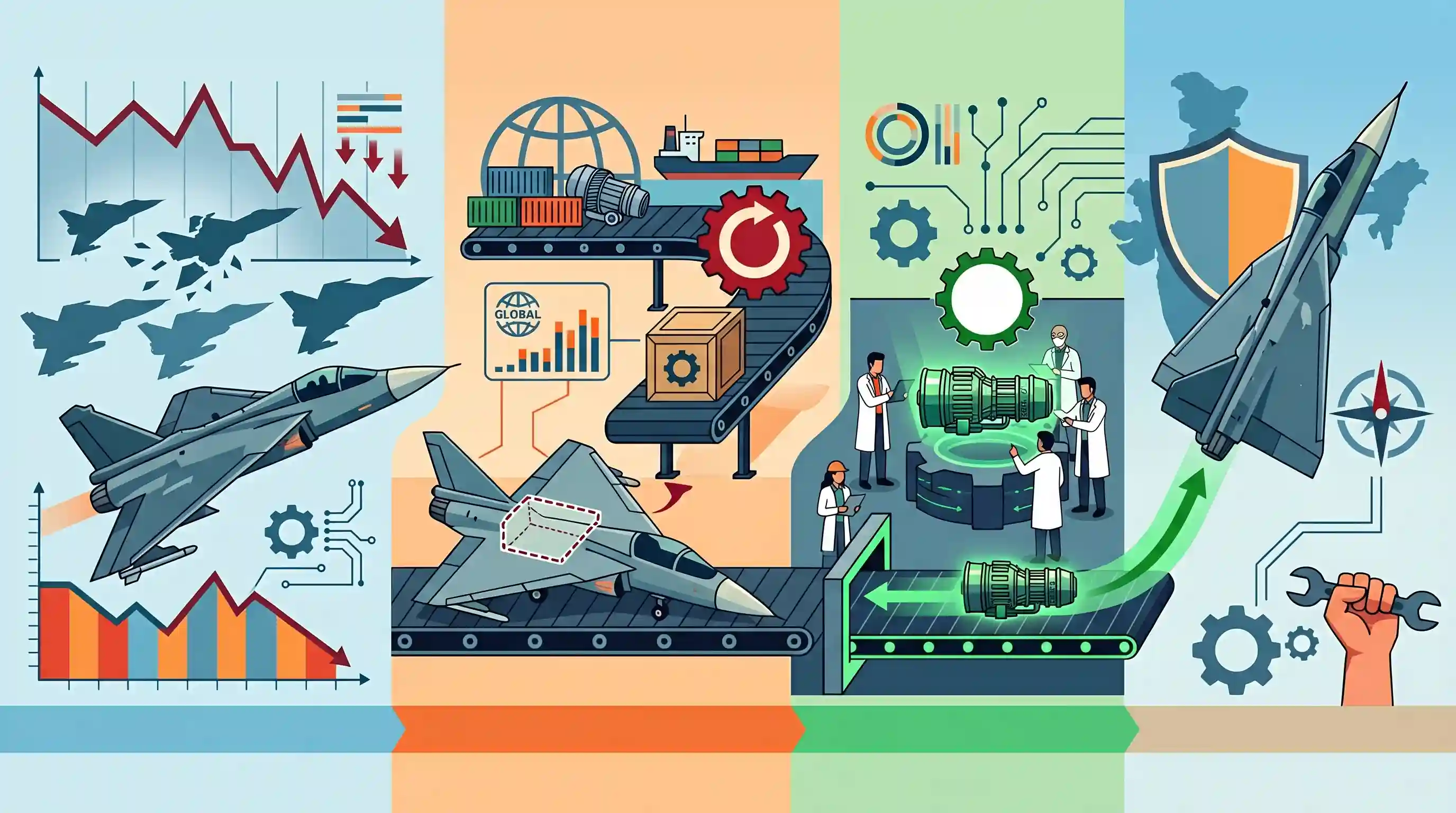
The article highlights the critical importance of the indigenous Light Combat Aircraft (LCA) Tejas as the vital vanguard of the Indian Air Force's (IAF) combat fleet amid a continuous decline in its fighter squadron strength. It addresses the challenges plaguing the Tejas Mk-1A production, particularly the delays caused by global supply chain issues and the non-delivery of F404 aero-engines by US-based GE Aerospace. This external dependency emphasizes the urgent need for India to achieve genuine self-reliance ('Atmanirbhar Bharat') in critical defense technologies, especially in indigenous engine development, to safeguard its strategic autonomy and ensure timely defense preparedness.
Key Points
- The Indian Air Force is facing a depleting fighter squadron strength, making the induction of the indigenous LCA Tejas critical for national security and air defense.
- The advanced Tejas Mk-1A variant is facing production and delivery delays, significantly impacting the IAF's modernization timelines.
- The delays are primarily caused by global supply chain disruptions, most notably the delayed supply of F404 turbofan engines by the American manufacturer GE Aerospace.
- This reliance on foreign Original Equipment Manufacturers (OEMs) exposes vulnerabilities in India's defense manufacturing ecosystem.
- The bottlenecks reinforce the strategic necessity of 'Atmanirbhar Bharat', particularly the urgent need to develop indigenous aero-engine technology to ensure long-term defense autonomy.
Important Terms
Atmanirbhar Bharat

A national mission and policy framework to make India self-reliant by reducing critical import dependencies and strengthening domestic manufacturing, particularly in sensitive sectors like defense.
UPSC context
GS Paper III (Economy/S&T); central to discussions on India's industrial policy and defense self-sufficiency.
Indigenization of Technology
The process of designing, developing, and manufacturing technological systems within the country using local resources and expertise to ensure technological sovereignty and reduce reliance on foreign OEMs.
UPSC context
GS Paper III (S&T); a core syllabus topic regarding achievements of Indians in science and developing new technology.
LCA Tejas
India's indigenous, single-engine, multirole light combat aircraft. The Mk-1A variant includes major upgrades like AESA radar, an electronic warfare suite, and beyond-visual-range missile capabilities.
UPSC context
GS Paper III (Security/S&T); the flagship project for indigenous defense manufacturing and Indian Air Force squadron modernization.
Strategic Autonomy
A state's ability to pursue its national interests and foreign policy independently, without being structurally dependent on external powers for critical needs like energy or defense technology.
UPSC context
GS Paper II (International Relations); key to analyzing how defense supply chain vulnerabilities affect India’s geopolitical maneuvering.
Hindustan Aeronautics Limited (HAL)
An Indian state-owned aerospace and defense company responsible for the manufacturing and assembly of the LCA Tejas and other indigenous platforms.
UPSC context
GS Paper III (Industrial Policy/Defense); represents the role of Defense Public Sector Undertakings (DPSUs) in national security.
Defence Research and Development Organisation (DRDO)
India's premier military research and development agency, responsible for the design of the LCA Tejas, missile systems, and other advanced indigenous defense technologies.
UPSC context
GS Paper III (S&T Achievements); focuses on the R&D challenges and institutional role in achieving 'Atmanirbharta' in defense.
Prelims Trap
The LCA Tejas Mk-1A is entirely powered by the indigenously developed Kaveri aero-engine.
While Tejas is an indigenous platform, its engine is the imported US-made GE F404. The DRDO Kaveri engine faced thrust issues and was delinked from the LCA program.
Static Concepts Connected
What are the key technical upgrades in the LCA Tejas Mk-1A variant?
- AESA Radar: Features an Active Electronically Scanned Array radar for superior target tracking and engagement.
- EW Suite: Incorporates an advanced Electronic Warfare suite for better survivability against enemy air defenses.
- BVR Missiles: Equipped with advanced Beyond Visual Range missile capabilities to strike targets from a safer distance.
What are the primary technical hurdles in developing indigenous aero-engines?
- Advanced Metallurgy: Requires complex single-crystal blade technology capable of withstanding extreme core turbine temperatures without melting.
- Thrust-to-Weight Ratio: Designing an engine that delivers the necessary high thrust output without becoming excessively heavy is highly complex.
- Test Infrastructure: India lacks adequate domestic high-altitude test cells, forcing reliance on foreign facilities and slowing the testing cycle.
Cross-Topic Patterns
Indo-US iCET & tech transfer
GE engine delays underscore the strategic importance of the US-India iCET, which aims to smoothen regulatory hurdles for joint defense production and critical technology transfer.
Squadron depletion & two-front war
IAF's authorized strength is 42 squadrons. Phased MiG retirements coupled with Tejas production delays push active numbers down, exacerbating vulnerabilities in a potential two-front collusive threat scenario.

UPSC 2026 Prelims will likely feature a multi-statement question on LCA Tejas variants, Kaveri engine status, and imported GE tech.
Linked PYQs · 2
Linked PYQs · 2
- 2024PrelimsGS1
Consider the following aircraft : 1. Rafael 2. MiG-29 3. Tejas MK-1 How many of the above are considered fifth generation fighter aircraft?
- 2014MainsGS3
Foreign Direct Investment (FDI) in the defence sector is now set to be liberalized. What influence this is expected to have on Indian defence and economy in the short and long run?
