Tejas Fighter Jet Crash at Dubai Air Show and Defence Indigenisation
Source:The Hindu ↗
Why It Matters
The Tejas LCA is a flagship project for India's self-reliance (Aatmanirbhar Bharat) in defense manufacturing. Incidents involving indigenous platforms have geopolitical and economic implications, testing the reliability of domestic defense products meant for export. The topic directly overlaps with UPSC's focus on defense indigenization and public sector defense enterprises.
Summary
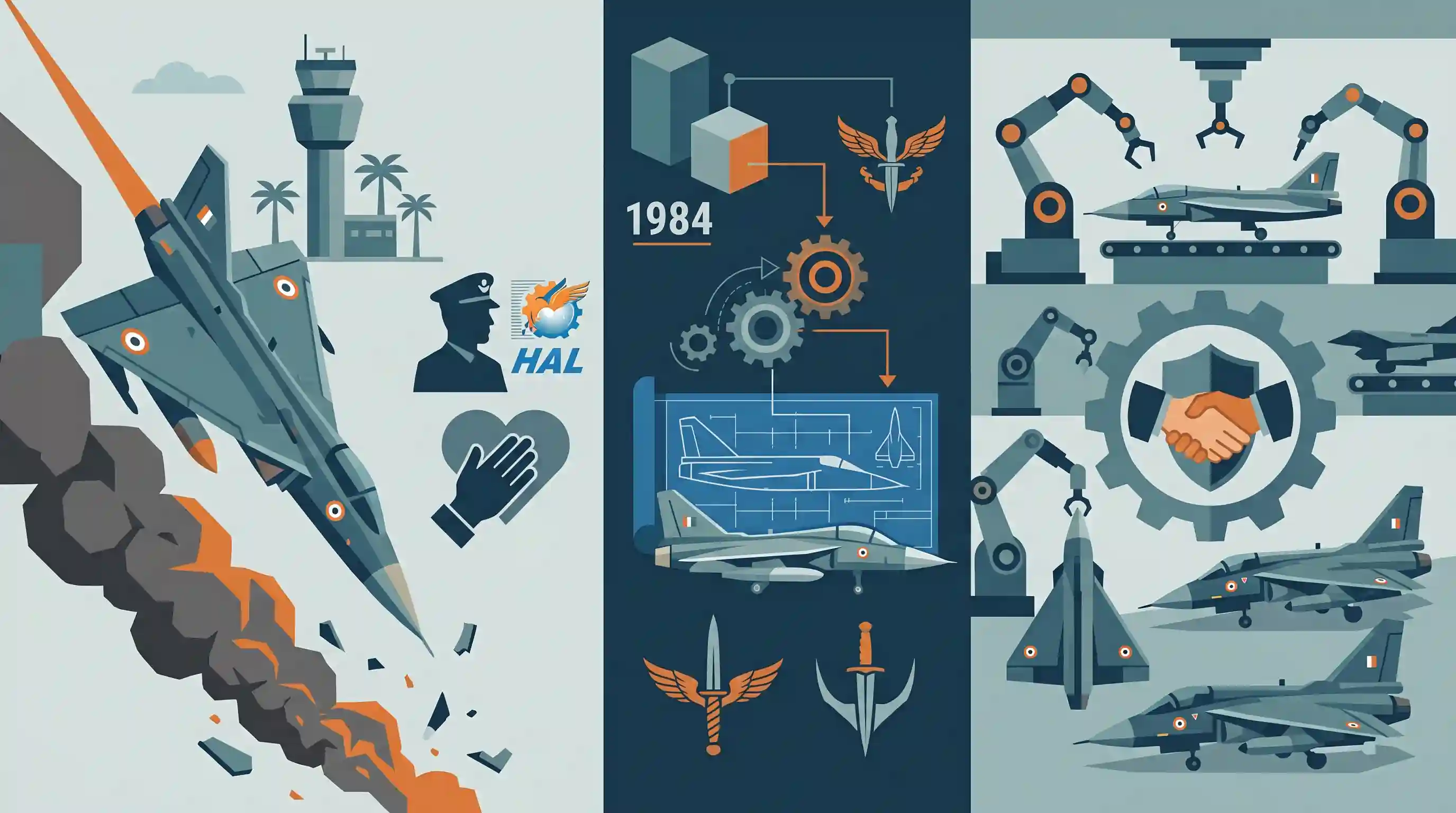
An Indian Air Force (IAF) Tejas fighter jet crashed during a demonstration at the Dubai Air Show, killing Wing Commander Namansh Syal. Hindustan Aeronautics Ltd (HAL), the manufacturer of the indigenous Light Combat Aircraft (LCA), expressed deep sorrow over the incident. The LCA project, initiated in 1984 under the Aeronautical Development Agency (ADA), has been a cornerstone of India's defense indigenization. The Tejas was officially inducted into the IAF's 'Flying Daggers' squadron in 2016. Recent defense procurements include major contracts for the advanced Tejas MK-1A variants, reflecting India's push for self-reliance in aerospace manufacturing.
Key Points
- A Tejas fighter jet manufactured by HAL crashed during an aerial display at the Dubai Air Show, resulting in the death of IAF pilot Wing Commander Namansh Syal.
- The Light Combat Aircraft (LCA) project was initiated by the Indian government in 1984, establishing the Aeronautical Development Agency (ADA) to manage the program.
- The IAF inducted the Tejas in 2016 into the 'Flying Daggers' squadron.
- India's defense indigenization efforts include a ₹48,000 crore contract signed in 2021 for 83 Tejas MK-1A jets and a 2024 tender for 97 more jets worth over ₹65,000 crore.
Important Terms
Hindustan Aeronautics Ltd (HAL)

A central Indian public sector aerospace and defense company under the Ministry of Defence, responsible for manufacturing and maintaining indigenous aircraft and helicopters.
UPSC context
GS Paper III: Indian Economy and S&T; tests knowledge of Public Sector Undertakings (PSUs) in defense indigenization.
Aeronautical Development Agency (ADA)
The nodal agency under the Department of Defence Research and Development (DRDO) established in 1984 to manage the design and development of India's Light Combat Aircraft (LCA).
UPSC context
GS Paper III: Science & Technology; relevant for institutional frameworks supporting indigenous defense R&D.
Flying Daggers
Officially No. 45 Squadron of the Indian Air Force, it was the first unit to be equipped with the indigenous Tejas Light Combat Aircraft in 2016.
UPSC context
GS Paper III: Internal Security/Defence; tests knowledge of IAF's operational modernization and indigenous asset induction.
Defence Indigenization
The policy and process of developing defense equipment within India to achieve self-reliance (Atmanirbharta) and reduce fiscal and strategic dependence on foreign imports.
UPSC context
GS Paper III: Science & Technology and Security; a core topic regarding technological self-reliance and strategic autonomy.
Tejas MK-1A
An improved 4.5-generation variant of the Tejas fighter featuring advanced AESA radar, an electronic warfare suite, and beyond-visual-range (BVR) missile capabilities.
UPSC context
GS Paper III: S&T; tests familiarity with specific indigenous technological advancements and defense procurement programs.
Prelims Trap
Tejas Mk-1A is India's first 5th-generation stealth fighter developed entirely by Hindustan Aeronautics Limited (HAL).
Tejas is a 4.5-generation aircraft lacking full structural stealth and supercruise. Additionally, ADA is the design agency; HAL is only the manufacturer.
Static Concepts Connected
What distinguishes 5th-generation fighter jets from 4.5-generation aircraft like Tejas?
- Structural Stealth: 5th-gen fighters have internal weapons bays and radar-absorbent materials to achieve structural stealth. Tejas lacks this comprehensive stealth profile.
- Supercruise Capability: 5th-gen jets can sustain supersonic flight without using fuel-heavy afterburners. 4.5-gen jets typically cannot.
- Avionics Bridge: Tejas Mk-1A uses an AESA radar and advanced Electronic Warfare Suite to bridge the gap, placing it firmly in the 4.5-generation tier.
How does a quadruplex 'Fly-By-Wire' (FBW) system function in modern fighter aircraft?
- Electronic Interface: Replaces manual flight controls with an electronic interface. Pilot inputs are converted to electrical signals processed by flight control computers.
- Quadruplex Redundancy: Four independent computer channels operate simultaneously. If one fails, the others override it, ensuring extremely high safety and redundancy for unstable aerodynamic designs.
- Aerodynamic Stability: Allows structurally unstable aircraft (like delta-wing Tejas) to remain highly maneuverable while computers constantly auto-correct the flight path.
Cross-Topic Patterns
LCA Tejas & Jet Engine Dependency
While Tejas symbolizes domestic aerospace capabilities, its continued reliance on American GE F404/F414 engines highlights a critical gap in India's strategic self-reliance regarding jet engine manufacturing.
Defence Exports & Aerospace Diplomacy
Displaying Tejas at venues like the Dubai Air Show aligns with India's push to become a net security provider and hit its aggressive ₹35,000 crore defence export target by 2025.

Expect a 2026 Prelims MCQ testing the exact technological boundaries (supercruise, internal weapon bays) separating 4.5-Gen from 5-Gen jets.
Linked PYQs · 2
Linked PYQs · 2
- 2024PrelimsGS1
Consider the following aircraft : 1. Rafael 2. MiG-29 3. Tejas MK-1 How many of the above are considered fifth generation fighter aircraft?
- 2014MainsGS3
Foreign Direct Investment (FDI) in the defence sector is now set to be liberalized. What influence this is expected to have on Indian defence and economy in the short and long run?
