Tej Pratap Yadav Remanded Under BNS Section 109
Source:india-today ↗
Why It Matters
The transition from IPC to BNS is a major landmark in the Indian legal system. This development highlights the real-time application of BNS codes (such as Section 109 replacing IPC Section 307 for attempt to murder) in public order and political protests, making it highly relevant for exam questions on administrative and legal reforms.
Summary
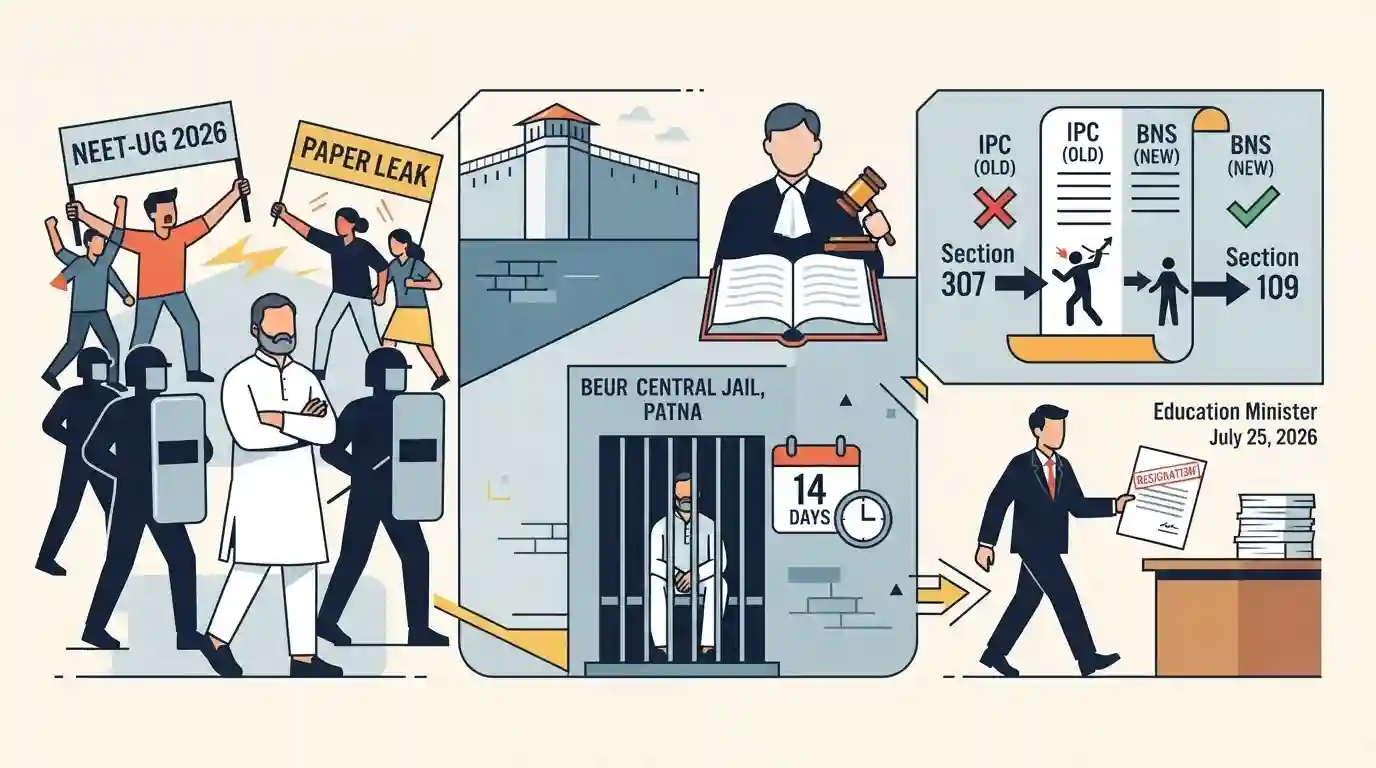
Jan Shakti Janata Dal leader Tej Pratap Yadav has been arrested and remanded to 14 days of judicial custody in Beur Central Jail, Patna, over violence during the Bihar bandh protests against the NEET-UG 2026 paper leak. He has been booked under Section 109 of the newly enacted Bharatiya Nyaya Sanhita (BNS), which replaces Section 307 of the Indian Penal Code (IPC) for attempt to murder. The wider agitation also led to the resignation of Union Education Minister Dharmendra Pradhan on July 25, 2026.
Key Points
- Jan Shakti Janata Dal chief Tej Pratap Yadav was arrested and sent to 14 days of judicial custody in Patna's Beur Central Jail following clashes during a 'Bihar bandh' protest.
- Yadav was charged under Section 109 of the Bharatiya Nyaya Sanhita (BNS) for 'attempt to murder' (which was under Section 307 in the erstwhile Indian Penal Code).
- Under Section 109 of the BNS, a conviction for attempt to murder carries a punishment of up to 10 years in prison and a fine, and can extend to life imprisonment if grievous hurt is caused.
- The protest was part of nationwide demonstrations against the NEET-UG 2026 paper leak, which led to the resignation of Union Education Minister Dharmendra Pradhan on July 25, 2026.
- The legal proceedings highlight the practical application of the BNS criminal codes, unlawful assembly charges, and the transition of judicial custody protocols under the revamped criminal justice framework.
Important Terms
Bharatiya Nyaya Sanhita (BNS)

The primary penal code of India, enacted in 2023 to replace the colonial-era Indian Penal Code (IPC), consolidating and defining offences and their punishments.
UPSC context
GS Paper II (Polity & Constitution/Judicial Reforms); tests knowledge of transition from colonial laws to indigenous criminal justice frameworks.
Indian Penal Code (IPC)
The official criminal code of India drafted in 1860 during British rule, which served as the comprehensive penal code defining crimes and punishments until its replacement in 2024.
UPSC context
GS Paper II (Polity & Constitution); tests historical evolution of Indian legal systems and colonial legacy of laws.
Section 109 of BNS
A key provision under the Bharatiya Nyaya Sanhita (BNS) that criminalizes the "attempt to murder," replacing Section 307 of the old Indian Penal Code (IPC) with updated grading and punishments.
UPSC context
GS Paper II (Criminal Justice Reforms); tests comprehension of specific legal transitions, shift in section numbering, and updated penal provisions.
Judicial Custody
The legal detention of an accused person in a central or state prison under the direct authority and supervision of a Magistrate, rather than under physical police control.
UPSC context
GS Paper II (Polity/Judiciary); high-frequency prelims topic testing distinctions between judicial and police detention, and safeguards under Article 22.
Jan Shakti Janata Dal
A regional political group in Bihar founded by former state minister Tej Pratap Yadav, formed after his estrangement and expulsion from the Rashtriya Janata Dal (RJD).
UPSC context
GS Paper II (Electoral Politics/Political Parties); tests awareness of regional parties, splinter groups, and state-level political dynamics.
Prelims Trap
Section 109 of the Bharatiya Nyaya Sanhita (BNS) deals with the punishment for abetment, mirroring its predecessor in the Indian Penal Code.
Under the IPC, Section 109 dealt with abetment. In the new BNS, Section 109 governs 'Attempt to Murder', while abetment has been repositioned elsewhere, making literal cross-code transfers highly deceptive.
Static Concepts Connected
What are the structural differences between Police Custody and Judicial Custody?
- Custodial control: Police custody places the suspect in a police station lock-up, while judicial custody lodges the suspect in jail under the magistrate's supervision.
- Interrogation access: Police require explicit judicial permission to interrogate an accused in judicial custody, whereas they have direct access during police custody.
- Time limits: Police custody is generally restricted to 15 days, whereas judicial custody can extend up to 60 or 90 days before a charge sheet is filed.
How does the Constitution regulate the Right to Protest?
- Constitutional source: The right flows from Article 19(1)(a) (freedom of speech) and Article 19(1)(b) (peaceful assembly without arms).
- Reasonable restrictions: Articles 19(2) and 19(3) permit restrictions on grounds of public order, sovereignty, integrity of India, and security of the State.
- Federal jurisdiction: Under the Seventh Schedule, 'Public Order' and 'Police' are listed under State List (List II), giving states jurisdiction over protests.
Cross-Topic Patterns
Exam malpractices + Public order
Recruitment leaks under the 2024 Act act as severe flashpoints for public violence, linking educational governance (GS2) directly to internal security and law enforcement (GS3).
Decentralized policing + Code transition
The transition from IPC to BNS tests cooperative federalism, as states bear the fiscal and training burdens of executing new criminal codes under List II mandate.

Comparative analysis of BNS vs IPC provisions and the legal limits of judicial custody remain highly probable GS-2 topics.
Linked PYQs · 2
Linked PYQs · 2
- 2025BPSC_PRELIMSGS1
The constitution of India provides for reasonable restrictions on Fundamental Rights but reasonableness must keep in mind that: 1. The restrictions must be necessary for the protection of the rights of others. 2. The restrictions must be proportionate to the end sought. 3. The restrictions must be reasonable in the light of the circumstances. 4. The restrictions must be in the public interest.
- 2022BPSC_PRELIMSGS1
Judicial process in India is based on
