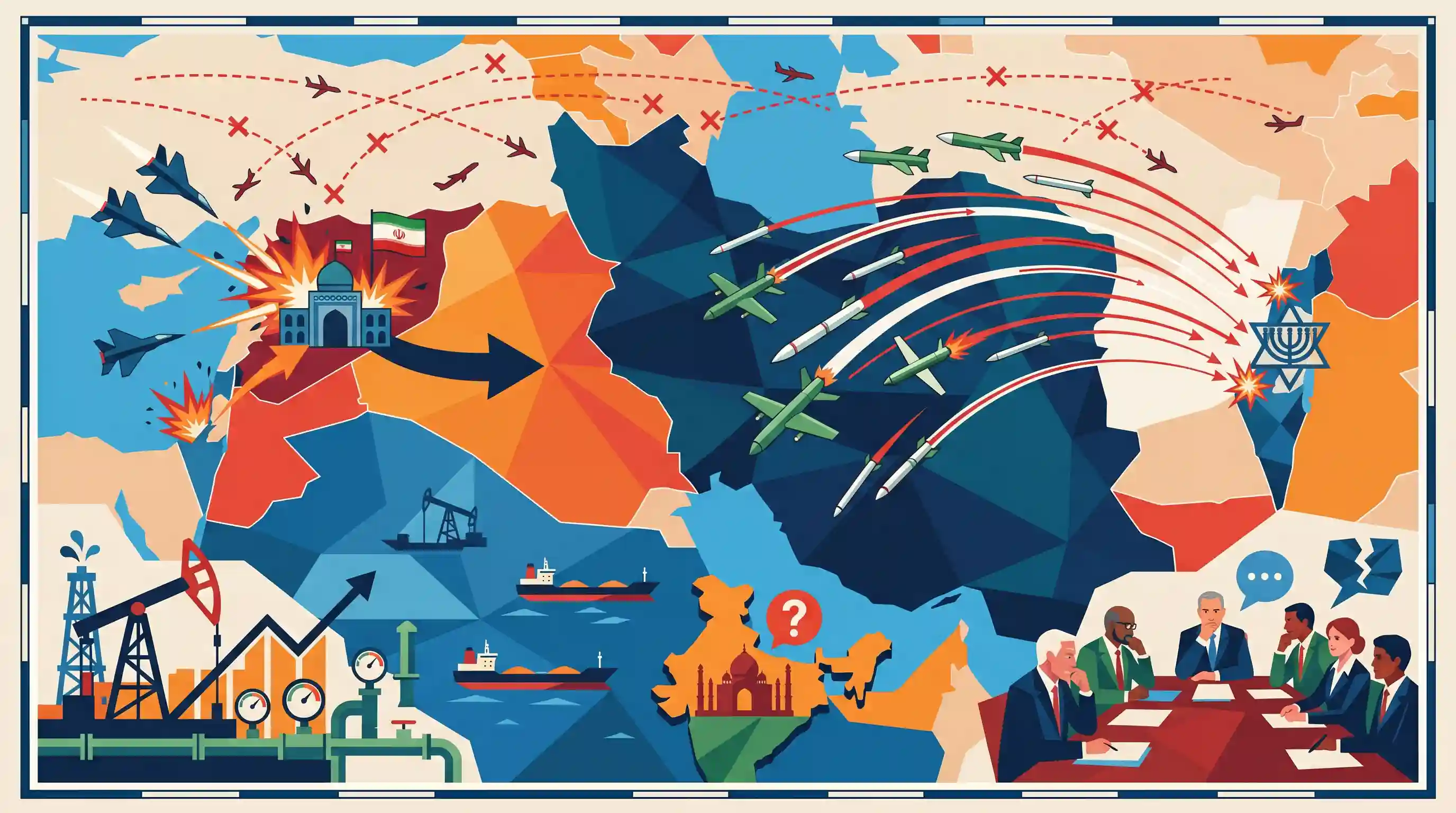
Airspace closures and retaliatory strikes across West Asia
Source:Indian Express ↗
Why It Matters
The Iran-Israel conflict directly impacts global energy prices and maritime security, which are critical for India's energy security and economic stability. Understanding this geopolitical flashpoint is essential for analyzing India's foreign policy maneuvering in the Middle East (e.g., balancing ties with Israel, Iran, and Arab states).
Summary
Iran launched retaliatory drone and missile strikes directly at Israel, escalating tensions following a suspected Israeli attack on an Iranian diplomatic mission in Syria. This unprecedented direct confrontation prompted widespread airspace closures across West Asia, disrupting aviation and heightening fears of a wider regional conflict. The development has profound implications for global geopolitics, energy markets, and India's strategic interests in the Middle East.
Key Points
- Iran launched an unprecedented direct drone and missile strike against Israel in retaliation for a suspected Israeli strike on its diplomatic compound in Damascus.
- The military escalation prompted immediate airspace closures across several West Asian countries, including Iraq, Jordan, and Lebanon, disrupting regional and global aviation.
- The direct confrontation marks a significant shift from Iran's traditional strategy of using proxy militias, raising fears of a broader regional war involving the US and its allies.
- The crisis threatens to disrupt global energy markets and critical maritime supply chains, which poses a direct risk to India's energy security and its expatriate population in the Gulf.
Important Terms
Islamic Revolutionary Guard Corps (IRGC)

An elite branch of the Iranian Armed Forces responsible for internal security, overseeing proxy networks, and managing Iran's ballistic missile program.
UPSC context
GS-II: International Relations; crucial for understanding West Asian power dynamics and Iran's regional influence.
Israel Defense Forces (IDF)
The unified military forces of Israel, comprising the ground forces, air force, and navy, responsible for national defense and retaliatory operations.
UPSC context
GS-II: International Relations; key actor in the Middle East security architecture and India-Israel defense ties.
Axis of Resistance
A Tehran-led informal anti-Western and anti-Israeli political and military alliance involving state and non-state actors like Hezbollah, Houthis, and Hamas.
UPSC context
GS-II: International Relations; tests India’s 'Strategic Autonomy' and 'Link West' policy amid regional polarization.
Iron Dome
A short-range, ground-to-air defense system developed by Israel to intercept and destroy incoming rockets, mortars, and artillery shells.
UPSC context
GS-III: Security and Defense; relevant for studying air defense technologies and modern warfare.
Strait of Hormuz
The world's most critical oil chokepoint located between Oman and Iran, through which approximately 20-30% of global oil trade passes.
UPSC context
GS-III: Energy Security; vital for India's crude oil supply chain and economic stability.
Strategic Autonomy
India's foreign policy principle of making independent decisions in its national interest without being coerced by external powers or alliances.
UPSC context
GS-II: International Relations; frequently tested by India’s need to balance ties between Israel and Iran.
Chabahar Port
An Iranian deep-sea port project in the Sistan-Baluchestan province, critical for India's connectivity to Central Asia and bypassing Pakistan.
UPSC context
GS-II: Regional Connectivity; essential for India's strategic reach and bilateral ties with Iran.
Prelims Trap
"The Strait of Hormuz connects the Persian Gulf to the Red Sea, serving as a critical oil transit route."
Aspirants often confuse West Asian chokepoints. The Strait of Hormuz connects the Persian Gulf to the Gulf of Oman, while Bab el-Mandeb links the Red Sea to the Gulf of Aden.
Static Concepts Connected
What are the critical maritime chokepoints surrounding the Arabian Peninsula?
- Strait of Hormuz: Links the Persian Gulf to the Gulf of Oman and Arabian Sea; transits ~20% of global oil.
- Bab el-Mandeb: Connects the Red Sea to the Gulf of Aden and Arabian Sea; heavily impacted by Houthi attacks.
- Suez Canal: Connects the Red Sea to the Mediterranean Sea, enabling direct maritime trade between Europe and Asia.
What are India's primary macroeconomic and strategic stakes in West Asia?
- Energy Security: The region supplies roughly 50-60% of India's total crude oil imports.
- Diaspora & Remittances: Over 9.5 million Indians reside in the Gulf, contributing a massive share of India's annual inward remittances ($135B+).
- Strategic Connectivity: Projects like IMEC, I2U2, and the Chabahar Port depend heavily on regional stability to bypass Pakistan and reach Europe/Central Asia.
Cross-Topic Patterns
Energy Security + Imported Inflation
Any prolonged conflict in West Asia threatens the Strait of Hormuz, risking an oil price shock. For India, this translates directly to imported inflation, rupee depreciation, and a widened Current Account Deficit.
Geopolitics + Mega-Connectivity Projects
Heightened Israel-Iran military hostilities directly threaten the viability of the India-Middle East-Europe Economic Corridor (IMEC) and the I2U2 grouping, potentially stalling India's strategic and economic integration with the Arab world.

Expect a multi-statement Prelims question in 2026 pairing West Asian mapping (bordering nations of Israel/Syria) with the mandate of IMEC/I2U2.
Linked PYQs · 4
Linked PYQs · 4
- 2025MainsGS2
"Energy security constitutes the dominant kingpin of India's foreign policy, and is linked with India's overarching influence in Middle Eastern countries.” How would you integrate energy security with India's foreign policy trajectories in the coming years?
- 2022MainsGS2
How will I2U2 (India, Israel, UAE and USA) grouping transform India's position in global politics?
- 2023PrelimsGS1
Consider the following pairs: Regions often mentioned in news Reason for being in news 1. North Kivu and Ituri : War between Armenia and Azerbaijan 2. Nagorno-Karabakh : Insurgency in Mozambique 3. Kherson and Zaporizhzhia : Dispute between Israel and Lebanon How many of the above pairs are correctly matched?
- 2023PrelimsGS1
Consider the following pairs: Area of conflict mentioned in news Country where it is located 1. Donbas : Syria 2. Kachin : Ethiopia 3. Tigray : North Yemen How many of the above pairs are correctly matched?
