Multi-pronged strategy to protect children from online exploitation
Source:The Hindu ↗
Why It Matters
The article provides critical insights into the intersection of child rights and digital governance, a highly relevant theme for GS2 (Vulnerable Sections) and GS3 (Cyber Security). It offers specific policy recommendations (like age verification and social media bans for minors) and highlights systemic bottlenecks in policing, which are valuable points for Mains answers on regulating cyberspace to protect vulnerable populations.
Summary
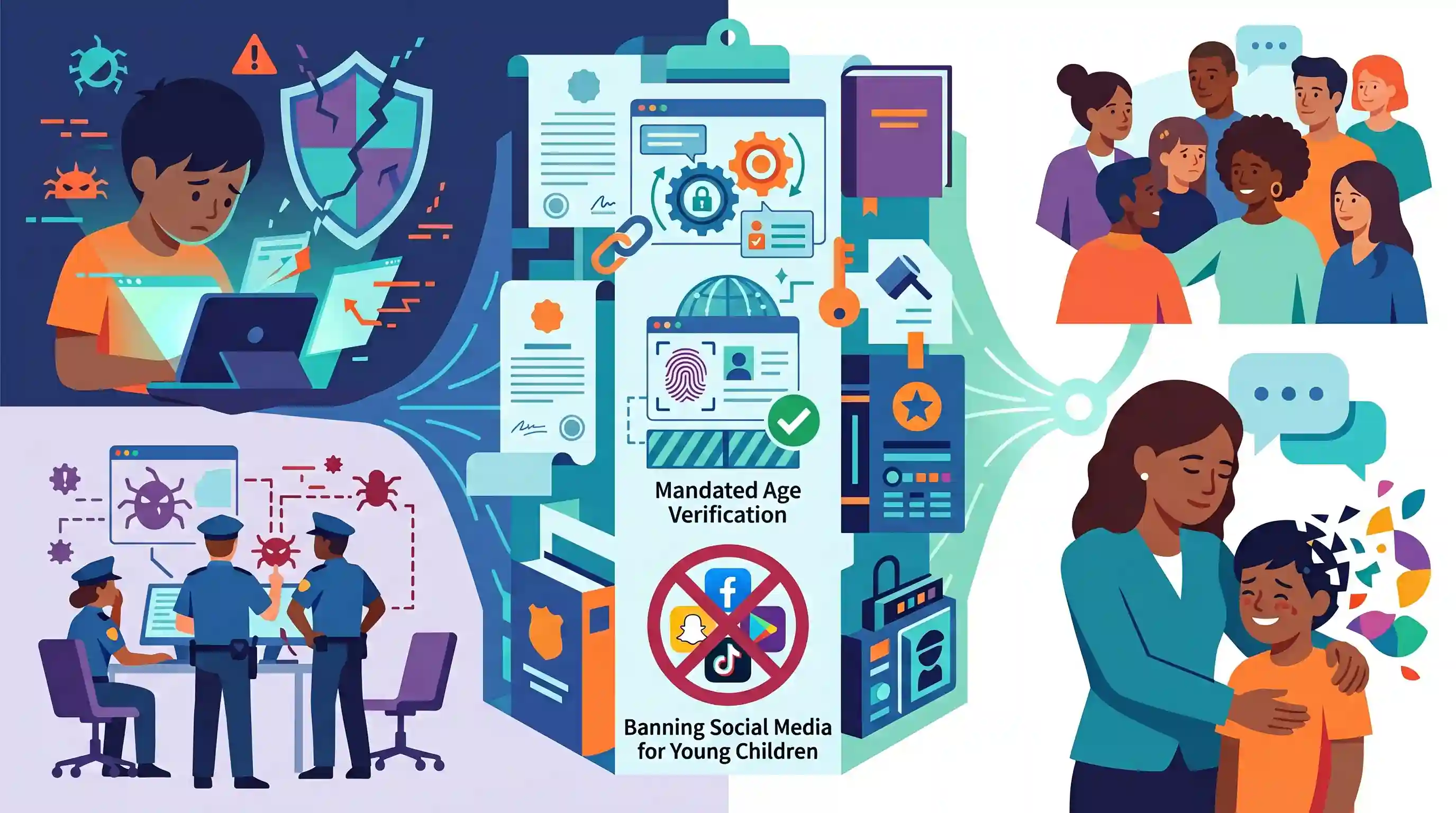
Experts at the Shield 2026 conclave in Hyderabad emphasized that technology alone cannot prevent online child exploitation; it must be supported by robust policies and capable policing. Key recommendations included embedding safety by design, mandating age verification for digital platforms, and banning social media for young children. The discussions also shed light on the stark shortage of technical specialists in law enforcement to counter cyber threats. Furthermore, speakers underscored the indispensable role of civil society and trained counselors in addressing the severe, long-term psychological trauma faced by child victims.
Key Points
- The Shield 2026 conclave highlighted that protecting children from online exploitation requires a multi-pronged approach combining technology, agile policymaking, and sustained human engagement.
- Experts called for a \'prevention-first\' strategy, advocating for an uncompromising ban on social media use by young children and mandatory age verification for platforms with age-inappropriate content.
- Law enforcement faces critical practical challenges in tackling cybercrimes against children, particularly a severe shortage of specialized technical personnel to understand evolving criminal methods.
- Civil society organizations and trained counselors at the district and school levels are essential to provide the human connection needed to help young victims recover from the long-term trauma of online sexual abuse.
Important Terms
Just Rights for Children (JRC)

A global network of over 250 NGOs focusing on legal interventions to combat child trafficking, labor, marriage, and online exploitation.
UPSC context
GS Paper 2 (Social Justice/Civil Society). Relevant for the role of non-state actors in human rights and legal reforms.
India Child Protection (ICP)
An NGO network (often called India Child Protection Fund) focused on research and funding to curb child exploitation and monitor POCSO case pendency.
UPSC context
GS Paper 2 (Issues related to children). Tests understanding of data-driven child safety and judicial efficacy.
Safety by Design
A proactive principle where safety and privacy protections are built into the technical architecture and default settings of digital platforms from the start.
UPSC context
GS Paper 3 (Cyber Security) and GS Paper 2. Crucial for topics on platform accountability and systemic risk mitigation.
Age Verification
Technical processes used by digital platforms to confirm a user's age, primarily to protect minors from age-inappropriate content and ensure parental consent.
UPSC context
GS Paper 2 (Government Interventions). Relates to the Digital Personal Data Protection (DPDP) Act and balancing privacy with safety.
POCSO Act, 2012
A comprehensive 2012 law providing a child-friendly legal framework to penalize sexual abuse, including the online transmission of child sexual abuse material.
UPSC context
GS Paper 2 (Laws for vulnerable sections). A core legislative framework for questions on child rights and judicial reforms.
Digital Personal Data Protection (DPDP) Act, 2023
Legislation establishing a consent-based framework for data processing, imposing 'fiduciary duties' on platforms to safeguard children's data and verify age.
UPSC context
GS Paper 3 (Security/IT) and GS Paper 2 (Rights). Tests knowledge of digital sovereignty and legal obligations of intermediaries.
Shield 2026
An annual cybersecurity conclave in Hyderabad focusing on AI-driven defense, child protection, and collaboration between law enforcement and civil society.
UPSC context
GS Paper 3 (Internal Security). Relevant for studying state-level institutional mechanisms and public-private partnerships in cybercrimes.
Telangana Cyber Security Bureau (TGCSB)
A specialized state agency under Telangana Police dedicated to combating cybercrime and strengthening cybersecurity through forensic expertise and specialized units.
UPSC context
GS Paper 3 (Internal Security). Important as a model for state-led specialized law enforcement agencies tackling digital threats.
Prelims Trap
The POCSO Act 2012 explicitly penalizes AI-generated synthetic Child Sexual Abuse Material (CSAM) involving completely non-existent, computer-generated children.
Current IT rules and POCSO struggle with fully synthetic AI-generated CSAM where no real child is victimized. The lack of an actual human victim creates a regulatory grey area not explicitly covered by older definitions.
Static Concepts Connected
What are the primary legal provisions in India tackling online child sexual abuse?
- IT Act Section 67B: Penalizes publishing, transmitting, creating, or browsing material depicting children in sexually explicit acts in electronic form.
- POCSO Act 2012: Contains specific provisions (Sections 13 and 14) criminalizing the use of children for pornographic purposes and the storage/distribution of such material.
What does the 'Safety by Design' (SBD) principle entail for digital platforms?
- Proactive Architecture: Embedding user safety, threat mitigation, and age verification directly into the software's core design phase, rather than relying on reactive moderation.
- Privacy by Default: Ensuring default settings maximize user privacy, particularly for minors, by disabling targeted advertising and public data sharing automatically.
Cross-Topic Patterns
Capacity deficits in Cyber Policing
The chronic shortage of digital forensic experts links GS-3 cybersecurity directly to GS-2 police reform debates, highlighting institutional bottlenecks in handling complex tech-crimes.
DPDP Act 2023 & Child Data Privacy
The Digital Personal Data Protection Act mandates verifiable parental consent for processing children's data, explicitly tying online child protection to the broader fundamental right to privacy.

Expect a Mains GS-3 question integrating AI-driven synthetic CSAM threats with the regulatory limitations of the IT Act & POCSO Act.
Linked PYQs · 3
Linked PYQs · 3
- 2025MainsGS2
The National Commission for Protection of Child Rights has to address the challenges faced by children in the digital era. Examine the existing policies and suggest measures the Commission can initiate to tackle the issue.
- 2024MainsGS3
Social media and encrypting messaging services pose a serious security challenge. What measures have been adopted at various levels to address the security implications of social media? Also suggest any other remedies to address the problem.
- 2020MainsGS3
Discuss different types of cyber crimes and measures required to be taken to fight the menace.
