Technology and Innovation in India France Bilateral Relations
Source:The Hindu ↗
Why It Matters
France is one of India's most steadfast and reliable strategic partners in the West. As technology increasingly defines geopolitics (techno-geopolitics), understanding how defense tech, space collaboration, and digital public infrastructure are strengthening this bilateral relationship is highly relevant for GS2 (International Relations) and GS3 (Science & Tech and Defense Indigenization).
Summary
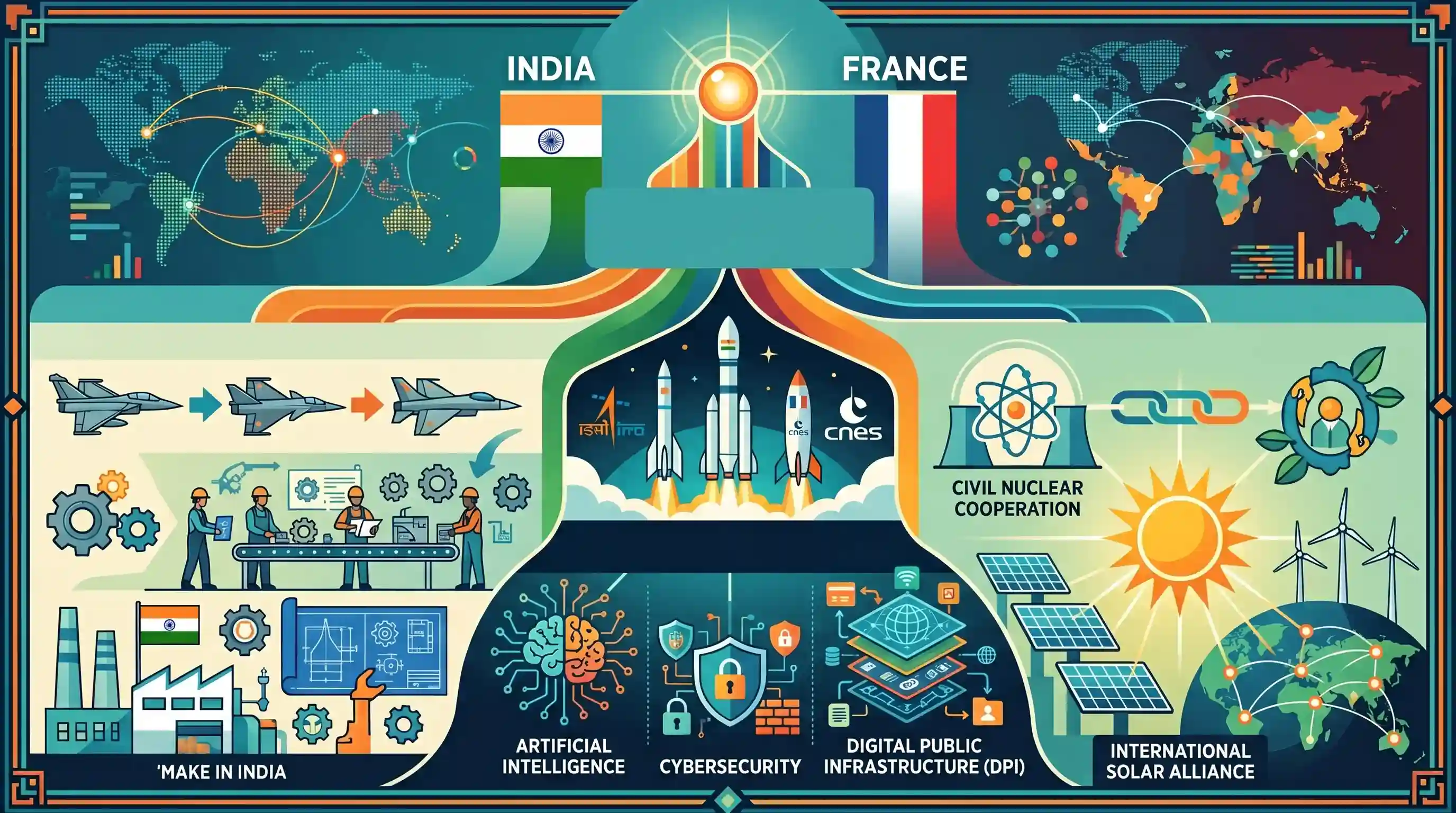
The article highlights how technology has emerged as the defining pillar of the India-France strategic convergence. Driven by a shared pursuit of 'strategic autonomy' in a multipolar world, the two nations are deepening cooperation across critical and strategic domains. Bilateral defense ties are actively transitioning from mere procurement to co-development and technology transfer, aligning with India's 'Make in India' initiative. The historic space collaboration between ISRO and CNES sets a foundation that is now expanding into new frontiers such as Artificial Intelligence, cybersecurity, and Digital Public Infrastructure (DPI). Furthermore, their joint focus on clean energy, including civil nuclear cooperation and the International Solar Alliance, underscores a comprehensive partnership anchored in advanced technology and mutual geopolitical interests.
Key Points
- Shared Pursuit of Strategic Autonomy: Both India and France prioritize an independent foreign policy in a multipolar world, using technological self-reliance to avoid overdependence on superpowers.
- Defense Co-development over Import: The bilateral defense relationship is transitioning from a traditional buyer-seller dynamic to joint research, technology transfer, and co-production, directly supporting India's defense indigenization goals.
- Legacy and Future in Space Tech: Building on decades of robust collaboration between ISRO and CNES, the partnership is now expanding into critical emerging tech domains like Artificial Intelligence, quantum computing, and cybersecurity.
- Digital Diplomacy and DPI: India's successful Digital Public Infrastructure (DPI) model is acting as a diplomatic tool, showcased by France's adoption of the Unified Payments Interface (UPI).
- Clean Energy Synergy: Collaborative efforts in civil nuclear technology (e.g., Jaitapur) and the International Solar Alliance underline a mutual commitment to sustainable technological solutions for climate change.
Important Terms
Horizon 2047 Roadmap

A 25-year bilateral blueprint adopted in 2023 to guide India-France relations across three pillars—Security & Sovereignty, Planet, and People—aligned with India's 2047 independence centenary.
UPSC context
GS Paper II (IR); tests knowledge of long-term bilateral frameworks and India's vision for its 100th year of independence.
Strategic Autonomy
The shared policy principle where nations maintain independent decision-making and reject binary power blocs, serving as the philosophical foundation for India-France strategic and technological cooperation.
UPSC context
GS Paper II (Foreign Policy); tests conceptual understanding of multipolarity and non-alignment in contemporary international relations.
India-France Strategic Partnership
Established in 1998 as India's first such pact with a Western power, this deep-seated alliance focuses on defense, space, and nuclear energy, recently elevated to a 'Special Global Strategic Partnership.'
UPSC context
GS Paper II (Bilateral Relations); tests history and evolution of India’s most consistent Western security partnership.
International Solar Alliance (ISA)
A treaty-based intergovernmental organization co-founded by India and France in 2015 to promote solar energy deployment and reduce fossil fuel dependence in sunshine-rich developing nations.
UPSC context
GS Paper III (Environment); tests India's leadership in global climate diplomacy and South-South cooperation.
CNES
The French government space agency (Centre National d'Études Spatiales) which has collaborated with ISRO for six decades on critical missions like Megha-Tropiques and the TRISHNA thermal imaging satellite.
UPSC context
GS Paper III (S&T); tests awareness of international collaborations in space exploration and earth observation.
Make in India (Defense)
An Indian initiative aimed at domestic manufacturing; in the France-India context, it signifies a shift from 'buyer-seller' relations to co-development and technology transfer in defense.
UPSC context
GS Paper III (Economy/Internal Security); tests understanding of indigenization and defense industrial corridors.
Prelims Trap
France is the first country globally to adopt India's Unified Payments Interface (UPI).
France is the first European country to adopt UPI, not the first globally. Nations like Bhutan, Singapore, and the UAE integrated UPI mechanisms much earlier.
Static Concepts Connected
Why is India's Civil Liability for Nuclear Damage Act (2010) controversial for foreign suppliers?
- Right of Recourse: Section 17(b) uniquely allows the operator (NPCIL) to claim damages from foreign suppliers if an accident is caused by defective equipment.
- Supplier Hesitancy: Foreign firms (like France's EDF) refuse to supply large reactors due to the financial risks associated with open-ended, indefinite liability.
- Strict Liability: The operator maintains strict, no-fault liability for damage, meaning victims claim from the operator, who can then sue the supplier.
How does Project-75 differ from Project-75I in submarine construction?
- Project-75: Involves building six Kalvari-class diesel-electric submarines (Scorpene) in India with French (Naval Group) technology transfer.
- Project-75I: A follow-on initiative under the Strategic Partnership model requiring foreign vendors to provide advanced Air Independent Propulsion (AIP) technology.
Cross-Topic Patterns
SMRs + Climate targets
The shift from mega-reactors (Jaitapur) to Small Modular Reactors (SMRs) aligns with India's COP26 Panchamrit goals, balancing base-load energy needs with capital and liability constraints.
DPI as strategic soft power
UPI's expansion into developed nations like France transitions India's geopolitical image from a technology consumer to a sovereign digital standard-setter.

A mixed Prelims question on ISRO-CNES joint missions (TRISHNA) and India's nuclear liability hurdles for SMRs/Jaitapur is highly likely.
Linked PYQs · 4
Linked PYQs · 4
- 2019MainsGS2
‘The time has come for India and Japan to build a strong contemporary relationship, one involving global and strategic partnership that will have a great significance for Asia and the world as a whole.’ Comment.
- 2025MainsGS2
India-Africa digital partnership is achieving mutual respect, co-development and long-term institutional partnerships. Elaborate.
- 2016MainsGS3
Discuss India's achievements in the field of Space Science and Technology. How the application of this technology has helped India in its socio-economic development?
- 2024MainsGS2
‘The West is fostering India as an alternative to reduce dependence on China's supply chain and as a strategic ally to counter China's political and economic dominance.’ Explain this statement with examples.
