Karnataka Museum Modernization Integrates Virtual Reality Technology
Source:The Hindu ↗
Why It Matters
The article highlights the intersection of technology (AR/VR) and cultural heritage preservation, a growing theme in UPSC GS1 (Safeguarding Indian Art Heritage) and GS3 (Science & Tech applications). Additionally, references to specific archaeological sites like Lakkundi (Kalyana Chalukya architecture) and the Swadesh Darshan scheme are highly relevant for Prelims fact-based questions on ancient history and government programs.
Summary
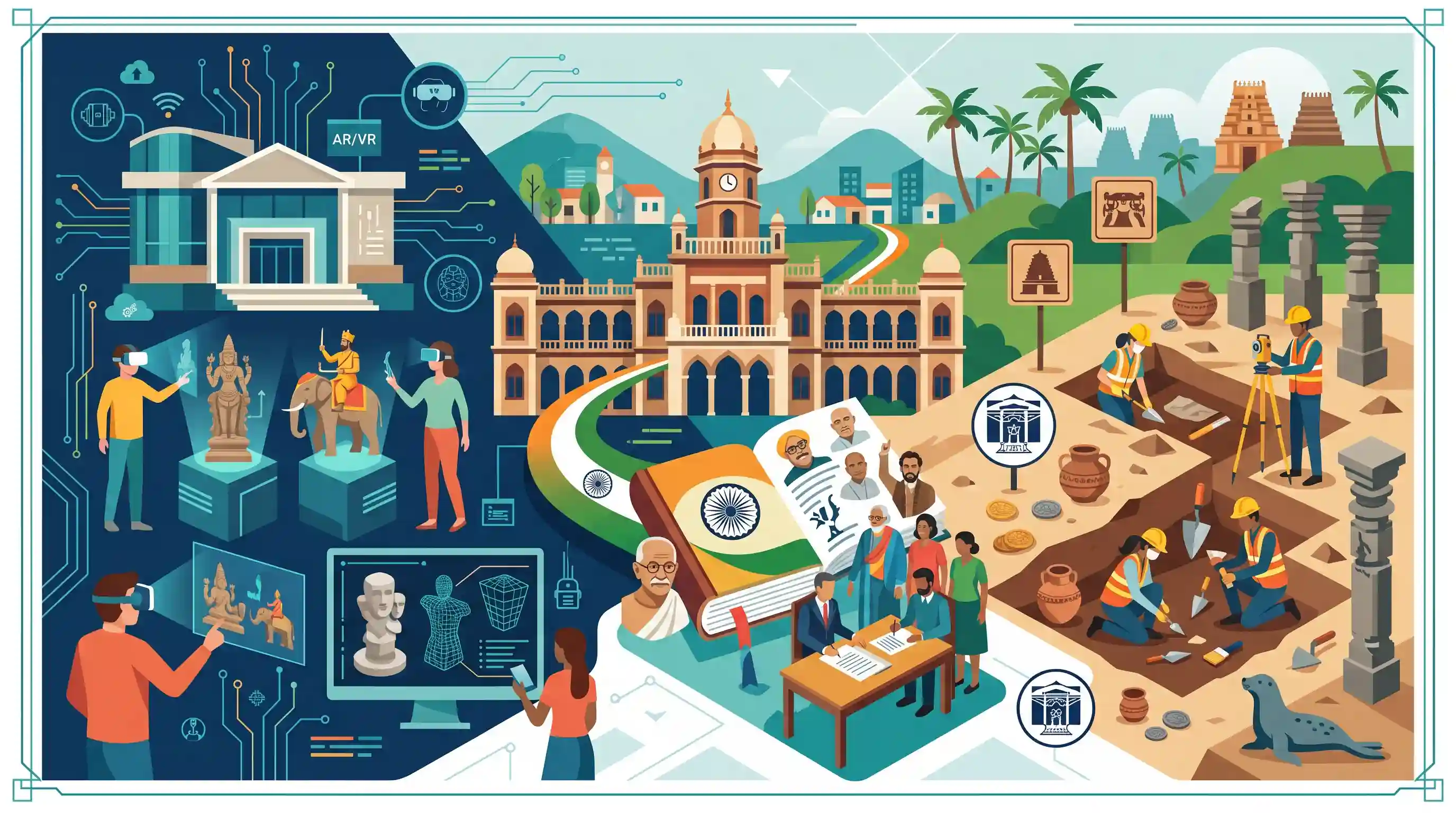
Karnataka is embarking on a comprehensive, technology-driven revamp of its state museums to enhance heritage conservation and visitor engagement. The Department of Archaeology, Museums and Heritage will deploy Augmented Reality (AR) and Virtual Reality (VR) technologies across several regional museums, enabling 3D mapping and immersive visual storytelling. Concurrently, a major project under the Swadesh Darshan scheme aims to transform Mysuru's Old Deputy Commissioner's office into a museum detailing the evolution of the Indian Constitution. Additionally, the Archaeological Survey of India (ASI) has sanctioned crucial excavations at historical sites like Rajghatta and Lakkundi, further reinforcing the state's focus on unearthing and preserving its cultural legacy.
Key Points
- Karnataka's Department of Archaeology, Museums and Heritage is integrating Augmented Reality (AR) and Virtual Reality (VR) to modernize state museums and offer immersive visitor experiences.
- Museums in Basavakalyan, Athani, Madikeri, Gadag, and Mangaluru are being revamped with digital mapping and 3D visual storytelling.
- Under the Swadesh Darshan scheme, the Old Deputy Commissioner's office in Mysuru will be converted into a mega museum, potentially showcasing the evolution of the Indian Constitution.
- The Archaeological Survey of India (ASI) has approved new excavations at historically significant sites, including Lakkundi (known for Kalyana Chalukya architecture) and Rajghatta.
Important Terms
Swadesh Darshan scheme

A flagship Ministry of Tourism initiative (launched 2014-15, revamped to 2.0) for developing theme-based tourist circuits. It provides financial assistance to states for sustainable, destination-centric infrastructure like the Mysuru museum project.
UPSC context
GS Paper II (Government Schemes) & GS Paper III (Economy/Tourism). Tests knowledge of tourism infrastructure and sustainable development models.
Archaeological Survey of India (ASI)
A premier central organization under the Ministry of Culture for archaeological research and protection of cultural heritage. It regulates excavations (like Rajghatta and Lakkundi) and manages centrally protected monuments.
UPSC context
GS Paper I (Art & Culture). Essential for questions on heritage conservation, ancient history, and institutional roles in archaeology.
Department of Archaeology, Museums and Heritage (DAMH)
The state-level nodal agency in Karnataka responsible for 16 museums and 800+ monuments. It leads digital initiatives like the 'Karnataka Digital Heritage' project and modern museum curation.
UPSC context
GS Paper II (Governance) & Karnataka State PSC. Highlights the role of state-level bodies in executing cultural policies and heritage management.
Lakkundi
A historical village in Gadag, Karnataka, renowned for 11th-12th century Chalukyan temples and stepwells. It is a candidate for UNESCO World Heritage status due to its medieval architectural brilliance.
UPSC context
GS Paper I (Art & Culture/Ancient History). Relevant for temple architecture (Kalyani Chalukyas) and archaeological discoveries.
AR and VR in Heritage
Digital tools used in museums to create 3D mapping and 'visual storytelling.' These technologies provide interactive, immersive experiences, moving away from static artifact displays to engage modern visitors.
UPSC context
GS Paper III (Science & Technology). Tests application of IT in non-traditional sectors like heritage conservation and education.
Rajghatta
An archaeological site in Karnataka where excavations have unearthed significant Buddhist remains, including a monastery (vihara). It highlights the spread of Buddhism in South India during early centuries CE.
UPSC context
GS Paper I (Ancient History/Culture). Pertains to the Buddhist legacy and archaeological findings in the Deccan region.
Constitution Museum
A specific project in Mysuru aimed at showcasing the drafting process, amendments, and core values of the Indian Constitution. It utilizes historical spaces for civic education and heritage promotion.
UPSC context
GS Paper II (Polity/Constitution). Connects constitutional history with cultural heritage; tests understanding of the Constitution as a living document.
Prelims Trap
"Swadesh Darshan is a Centrally Sponsored Scheme requiring state matching funds."
It is a Central Sector Scheme (100% funded by the Union Ministry of Tourism), not Centrally Sponsored. States do not provide matching funds for the core projects.
Static Concepts Connected
What are the key architectural features of the Kalyana Chalukyas?
- Vesara Style: Pioneered the 'Karnata Dravida' (Vesara) style, a transitional architecture that seamlessly blended northern Nagara and southern Dravida elements.
- Stepped Wells: Renowned for constructing ornate stepped wells (Kalyanis), such as the intricately carved Musukina Bavi at Lakkundi.
- Soapstone Usage: Extensively used soapstone (chloritic schist), a softer rock that allowed for highly detailed and intricate carvings, later adopted by the Hoysalas.
How does Augmented Reality (AR) differ from Virtual Reality (VR)?
- AR (Augmented): Overlays digital information (images, text) onto the real world. The physical environment remains partially visible and interactive.
- VR (Virtual): Creates a completely simulated 3D environment, blocking out the physical world entirely, usually requiring a headset.
Cross-Topic Patterns
AR/VR in Heritage Conservation
The intersection of emerging tech (AR/VR/3D mapping) and ASI's conservation efforts represents a growing syllabus overlap linking S&T applications directly to Art & Culture preservation.
Swadesh Darshan & Polity Integration
Funding a museum on the Constitution's evolution through Swadesh Darshan bridges Polity (historical underpinnings) with Central Sector Tourism Schemes, blending two distinct syllabus areas.

Expect a pair-matching Prelims question linking newly excavated/prominent archaeological sites (Lakkundi, Rajghatta) to their empires.
Linked PYQs · 3
Linked PYQs · 3
- 2018MainsGS1
Safeguarding the Indian art heritage is the need of the moment. Discuss.
- 2019PrelimsGS1
In the context of digital technologies for entertainment, consider the following statements: 1. In Augmented Reality (AR), a simulated environment is created and the physical world is completely shut out. 2. In Virtual Reality (VR), images generated from a computer are projected onto real-life objects or surroundings. 3. AR allows individuals to be present in the world and improves the experience using the camera of smart-phone or PC. 4. VR closes the world, and transposes an individual, providing complete immersion experience. Which of the statements given above is/are correct?
- 2024PrelimsGS1
Consider the following information (Archaeological Site — State — Description): 1. Chandraketugarh — Odisha — Trading port town 2. Inamgaon — Maharashtra — Chalcolithic site 3. Mangadu — Kerala — Megalithic site 4. Salihundam — Andhra Pradesh — Rock-cut cave shrines In which of the above rows is the given information correctly matched?
