Technical Bids Open for Infrastructure Revamp of Sonepur Mela
Source:timesofindia ↗
Why It Matters
The Sonepur Mela is a highly significant cultural and geographical topic for BPSC Prelims, frequently tested for its location (Saran district), river confluence (Ganga and Gandak), and seasonal timing. Schemes like Swadesh Darshan 2.0 and the tourism corporation (BSTDC) are also core to state-level current affairs and governance questions.
Summary
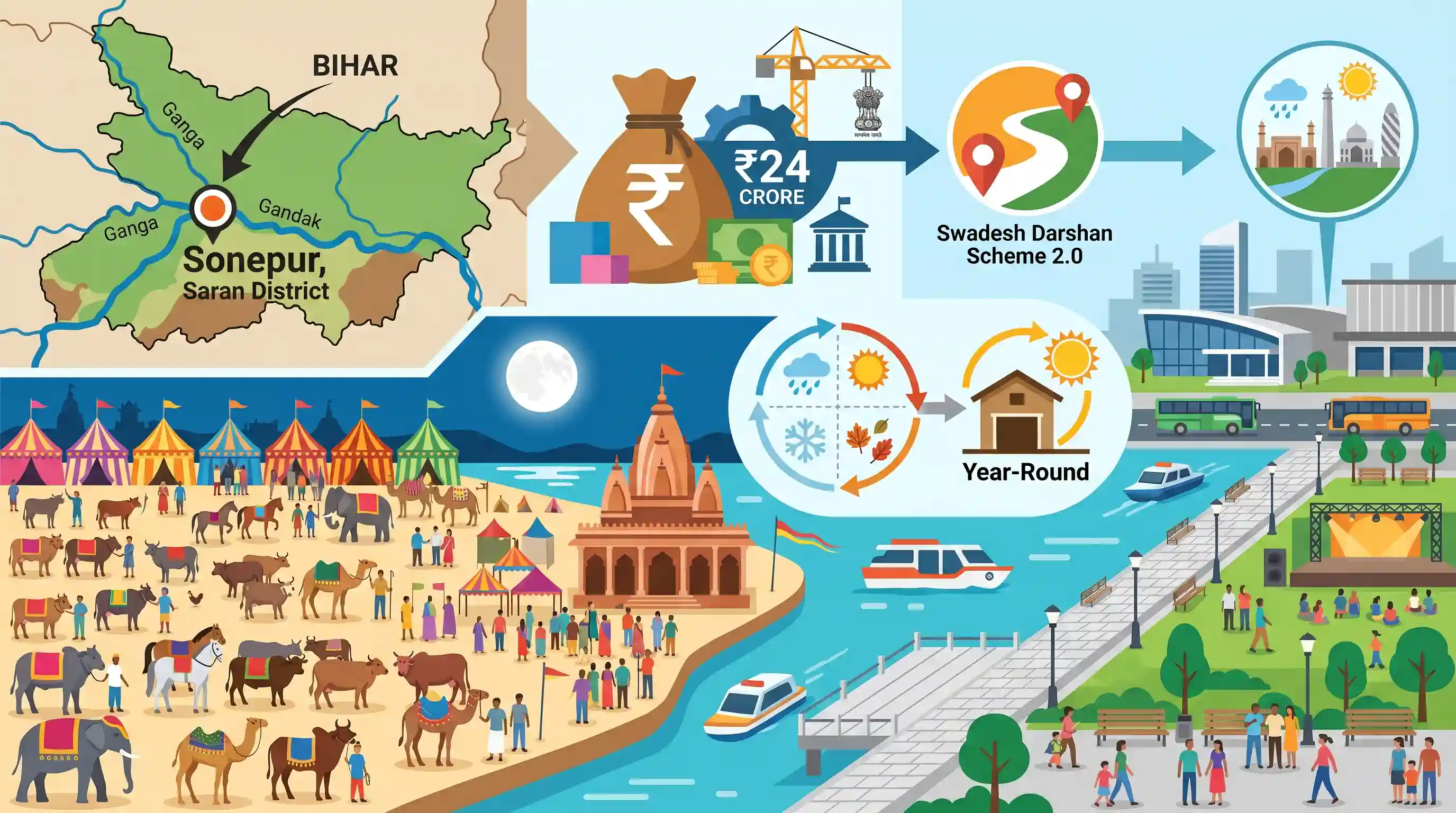
The Bihar State Tourism Development Corporation (BSTDC) has opened technical bids for a ₹24 crore infrastructure project to revamp the Sonepur Mela ground in Saran district. Funded under the Swadesh Darshan Scheme 2.0, this project aims to transform the seasonal site into a modern, year-round tourism hub. Sonepur Mela, also known as the Harihar Kshetra Mela, is Asia's largest cattle fair and is held annually at the confluence of the Ganga and Gandak rivers starting on Kartik Purnima.
Key Points
- The Bihar State Tourism Development Corporation (BSTDC) has opened technical bids for a ₹24 crore modernisation project at the historic Sonepur Mela ground.
- The project was recently approved by the Bihar government under the Swadesh Darshan Scheme 2.0.
- The Sonepur Mela (also called Harihar Kshetra Mela) is regarded as Asia's largest cattle fair.
- The fair is held annually at the confluence of the Ganga and Gandak rivers in Sonepur, Saran district.
- The month-long fair traditionally begins on Kartik Purnima (occurring in November/December) and has immense cultural, religious, and commercial significance.
- The planned revamp features a grand entrance gate, wider roads, digital infrastructure, green energy installations, improved parking, and upgraded sanitation to transition it into a year-round tourist hub.
Important Terms
Swadesh Darshan Scheme 2.0

A 100% centrally funded Central Sector Scheme launched by the Ministry of Tourism to develop sustainable, responsible, and destination-centric tourism infrastructure across India.
UPSC context
GS III (Infrastructure & Economy); tests knowledge of national tourism development policies and central schemes.
Sonepur Mela
Asia's largest cattle fair, held annually on Kartik Purnima at the Ganga-Gandak confluence in Bihar, carrying immense historical, cultural, and socio-economic significance since ancient times.
UPSC context
GS I (Indian Art & Culture); tests awareness of ancient Indian fairs, socio-religious traditions, and regional economic history.
Bihar State Tourism Development Corporation
A state government undertaking established in 1980, responsible for developing, commercializing, and maintaining tourist infrastructure and services within the state of Bihar.
UPSC context
GS II (State Policies & Public Undertakings) and BPSC; tests knowledge of regional developmental bodies and tourism administration.
Gandak River
A major left-bank tributary of the Ganges that originates in Nepal, flows through Bihar, and confluences with the Ganga at Sonepur, playing a vital hydrological role.
UPSC context
GS I (Geography of India); tests knowledge of major river systems, drainage basins, and confluences.
Kartik Purnima
A highly sacred Hindu festival celebrated on the full moon day of the Kartik month (November), associated with holy baths, religious offerings, and regional fairs.
UPSC context
GS I (Art & Culture); tests familiarity with Indian festival cycles, religious geography, and traditional lunar calendars.
Prelims Trap
The Sonepur Mela is held at the confluence of the Ganga and Sone rivers, and is funded under the PRASHAD scheme.
The fair is held at the Ganga-Gandak confluence (not the Sone River, despite the town being named Sonepur). The revamp is funded under Swadesh Darshan 2.0 (CBDD), not the PRASHAD scheme.
Static Concepts Connected
What is the Challenge Based Destination Development (CBDD) scheme?
- Origin & Sub-scheme: It is a competitive sub-scheme launched under the revamped Swadesh Darshan 2.0 (SD2.0) by the Ministry of Tourism.
- Selection Method: States compete for central funds by presenting feasible, sustainable tourism development models for specific niches.
- Focus Categories: Targets spiritual tourism, culture/heritage, vibrant border villages, and eco-tourism/nature-based destinations.
What is the historical and geographic context of the Gandak river?
- Vedic Identity: Mentioned as 'Sadanira' in Satapatha Brahmana, marking the boundary of Aryan expansion eastward into the kingdom of Videha.
- River Confluence: Merges with Ganga at Sonepur; historically served as a critical commercial highway during the Mauryan and Mughal eras.
- Origin: Rises in the Tibet-Nepal border region, flowing through the Valmiki National Park in Bihar.
Cross-Topic Patterns
Mauryan logistics to modern Swadesh Darshan
Links ancient military-economic supply chains (procuring war elephants and horses) to modern central schemes aiming to revitalize heritage sites into economic assets.
Syncretic Bhakti iconography & riverine ecology
Connects Harihar (Vishnu-Shiva) composite deities to ecological nodes (river confluences), illustrating how seasonal geography aligns with major astronomical festivals like Kartik Purnima.

SD2.0 destination criteria mixed with Gandak-Ganga confluence history (Mauryan war-elephant trade) highly likely for Prelims 2026.
Linked PYQs · 2
Linked PYQs · 2
- 2024-EBPSC_PRELIMSGS1
What is the name of the one month long cattle fair organized at the confluence of Ganga and Gandak rivers?
- 2019BPSC_PRELIMSGS1
What is the tagline of Bihar State Tourism Development Corporation?
